Ebook Info
- Published: 2009
- Number of pages: 432 pages
- Format: PDF
- File Size: 18.41 MB
- Authors: Cathleen Shamieh
Description
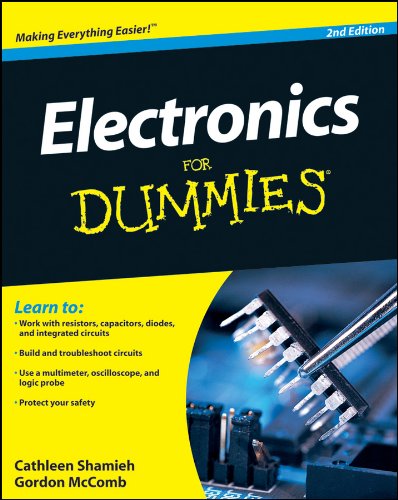
Electronics is fascinating – want to make something of it? This book shows you how! You can make all sorts of things, once you understand what electronics is and how it works. This book helps you out with that part, explaining the whole thing in plain English. Learn how electricity functions, how to harness it and put it to work, what tools you need to build circuits, what you can make with them, and how to do it safely.Mystery solved – understand what makes your iPod, remote control, and computer workEssential stuff – outfit your electronics lab with all the necessary tools, including some that will surprise youSchematic road maps – learn to read schematics and understand how they help your project get where it’s goingSymbols of power – recognize all the identifiers for power sources, grounds, and componentsTools of the trade – discover how to use a multimeter, logic probe, oscilloscope, and solderless breadboardBreak it down – get to know the ins and outs of components such as resistors, capacitors ,diodes and transistorsGetting it together – find out how integrated circuits make all the rest possible and learn to work with them& Analyze it – understand the rules that govern current and voltage and learn how to apply themOpen the book and find:The difference between electronics and electricityA list of essential toolsCool projects you can build quicklyGreat places to find partsImportant safety tipsWhat a sine wave isInteresting stuff about speakers, buzzers, and DC motorsOhm’s Law and how to use it
User’s Reviews
Editorial Reviews: About the Author Cathleen Shamieh is a high-tech writer with extensive engineering and consulting experience in the fields of medical electronics, speech processing, and telecommunications. Gordon McComb writes the Robotics Resources column for SERVO Magazine, the leading hobby electronics magazine in the US.
Reviews from Amazon users which were colected at the time this book was published on the website:
⭐Electronics for Dummies is a wonderful book for people interested in understanding and considering getting into the field of electronic component repair (not computers, but repairing components such as radios, stereos, amps, etc.).Unlike college text books (which I have recently used), it is not dependent on math, then more math. You can get through most of the book before having to fool with math, with most math being basic algebra. For basic component repair and hobby’s, you’ll rarely use math, so that is where this book excels.The book teaches the reader about the individual components and how to identify them, what they do individually and how they work in conjunction with other components in a circuit, learning schematic and schematic symbols, using multimeters and other testing equipment. Again, this is what most of us want and need, not tons of math that would be needed if you were considering an “electrical design” path, but not needed otherwise.Again, I recommend this book for anyone that is flirting with a career path or retirement income towards “electronic component repair” or just wanting to better understand how the components work.
⭐If you don’t know anything about electronics and want a well-witten introduction, this book would be a good choice. It describes both analog and digital electronics in clear prose with the typical light humor that is the tradition of the “Dummies” books. There are some helpful illustrations that show how charges flow in a circuit and how they accumulate in a capacitor and how they work in a semiconductor. It covers the simple algebraic math of Ohm’s and Kirchoff’s Laws as well as capacitive and inductive reactance and impedance. It describes some of the most common analog and digital integrated circuits and how they can be used in creating various kinds of circuits. It introduces schematic symbols from the beginning and later devotes an entire chapter to understanding circuit diagrams. There are sections on safety, basic manual skills such as soldering, and where to purchase parts and tools as well as some online resources for learning more. Finally, it has some simple projects you can make, although I didn’t think that this was the strongest part of the book.I bought this for my granddaughter to provide the theory to go along with the practical experience of building simple circuits with the Snap Circuits kit. It seemed the best of the introductory texts I reviewed for this purpose.
⭐As always with the “for Dummies” series this was an incredible readable book. I got it when I started working in an electronics company, my background is in finance and I had to be able to understand the electronics issues in the products and the factory for my work. I found this book invaluable in order to understand the products we were manufacturing.I do not believe it is anyone’s opinion that after reading a “for Dummies” book they would master the subject, but I felt fully capable of understanding the context of the technical challenges and then perform my work understanding and quantifying for the finance department the resulting consequences. It still brings a smile to my face when I show to one of the engineers that I understand the basic concepts that they are dealing with and it has greatly helped me in my work. What else could a dummy ask for?
⭐You need to be one of the more adept dummies, but if so, this is a good reference. The structure of the book is mostly effective, with sections on theory and components, safety and actual test circuits. That said, some of the theory is a struggle. This, coupled with the kit bought, is a good place to start though, and I will continue the struggle to sort out some of the concepts for capacitors and transistors. Be warned, you do need some comfort with maths to be able to cope here. It is not deep stuff, but brush up your basic algebra to be able to sort out some of the ideas.
⭐This is one of the better basic electronics books out there, in part because it is so basic. The author starts with electrons and goes from there in simple, non-technical language to introduce you to how the things around us work, Although the work starts at a very basic level, it builds through computers, control systems and schematics, grounding the reader carefully all the way. The treatment is about as non-mathematical as you can get when talking about electronics. It is also primarily not a project book. Just a clear explanation. A very good book to get you started in electronics.
⭐This book is great, but at times it is a little complicated because i skip around, but that is mostly my fault. I’ve been using it to get started with a research project that is outside of my field and I need to build boards. This has helped me to understand the basics and dynamics of what is really going on. I bought the electronic pdf version, but kind of wishing i had just got the real book. Either way it i s helpful.Cons: PDF/Ebooks are not for some people (me)Pros: Its got everything I need so far and I didnt know anything about electronic components starting up and now i can generate PWM signals using an Arduino Uno board
⭐I like Dummies books,They always anticipate that the reader of the book is at the start line, (Read the Foolish Assumptions just to be sure)I read this book on the summer last year, and I got 90%+ (Grade 10) in PhysicsIt gave me a lot of knowledge- Informed me with the very basic components of electronics- I could have calculated the resistance in a very nasty looking circuit diagram in class- I could read circuit diagrams from the internet for projectsWhat it lacked- Although it physically explained how transistors worked such as a PnP and NpN, I still did not know how to manipulate the component in order to “invent” or understand why the component is in that location in the circuit- How to program a IC xD not really a drawback since it is an advanced topic, just a recommendation to include some other books for startersIf you are a beginner start from hear,
⭐Great book for the begginer.
⭐I used this book to help prepare myself for an interview / exam.Must be a decent enough guide as I passed the exam and got the job.Its the usual from a dummies guide, gives too much information about somethings which don’t really matter and doesn’t go in deep enough to other things that do but on the whole it is a good guide.
⭐Great book very helpful reference I enjoy electronics but wouldn’t say I was very knowledgeable – this book is helping me look less daft in conversations.
⭐I’ve only read a few pages and i already i’m loving it, my fav book at the moment, the wealth of knowledge is immerse you gotta love the author i’ll be back to leave a proper review when i’m done. its great so far.
⭐This is a very good introductory book and a useful bolster for my ad hoc knowledge, easy to read and clear examples
⭐Explains the basics of the subject in simple plain language whilst keeping maths to a minimum, fine for beginners prior to moving on to more in-depth study.
Keywords
Free Download Electronics For Dummies 2nd Edition in PDF format
Electronics For Dummies 2nd Edition PDF Free Download
Download Electronics For Dummies 2nd Edition 2009 PDF Free
Electronics For Dummies 2nd Edition 2009 PDF Free Download
Download Electronics For Dummies 2nd Edition PDF
Free Download Ebook Electronics For Dummies 2nd Edition