

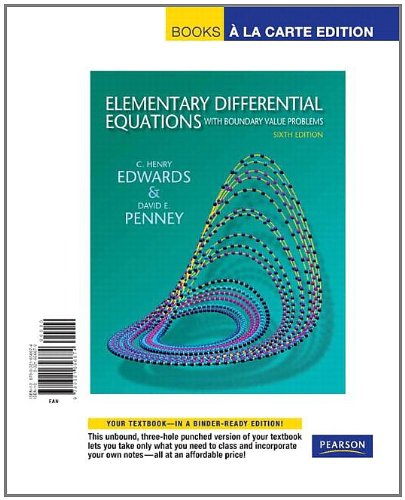
Ebook Info
- Published: 2009
- Number of pages: 784 pages
- Format: PDF
- File Size: 26.17 MB
- Authors: C. Edwards
Description
The Sixth Edition of this acclaimed differential equations book remains the same classic volume it’s always been, but has been polished and sharpened to serve readers even more effectively. Offers precise and clear-cut statements of fundamental existence and uniqueness theorems to allow understanding of their role in this subject. Features a strong numerical approach that emphasizes that the effective and reliable use of numerical methods often requires preliminary analysis using standard elementary techniques. Inserts new graphics and text where needed for improved accessibility. A useful reference for readers who need to brush up on differential equations.
User’s Reviews
Editorial Reviews: About the Author C. Henry Edwards is emeritus professor of mathematics at the University of Georgia. He earned his Ph.D. at the University of Tennessee in 1960, and recently retired after 40 years of classroom teaching (including calculus or differential equations almost every term) at the universities of Tennessee, Wisconsin, and Georgia, with a brief interlude at the Institute for Advanced Study (Princeton) as an Alfred P. Sloan Research Fellow. He has received numerous teaching awards, including the University of Georgia’s honoratus medal in 1983 (for sustained excellence in honors teaching), its Josiah Meigs award in 1991 (the institution’s highest award for teaching), and the 1997 statewide Georgia Regents award for research university faculty teaching excellence. His scholarly career has ranged from research and dissertation direction in topology to the history of mathematics to computing and technology in the teaching and applications of mathematics. In addition to being author or co-author of calculus, advanced calculus, linear algebra, and differential equations textbooks, he is well-known to calculus instructors as author of The Historical Development of the Calculus (Springer-Verlag, 1979). During the 1990s he served as a principal investigator on three NSF-supported projects: (1) A school mathematics project including Maple for beginning algebra students, (2) A Calculus-with- Mathematica program, and (3) A MATLAB-based computer lab project for numerical analysis and differential equations students. David E. Penney, University of Georgia, completed his Ph.D. at Tulane University in 1965 (under the direction of Prof. L. Bruce Treybig) while teaching at the University of New Orleans. Earlier he had worked in experimental biophysics at Tulane University and the Veteran’s Administration Hospital in New Orleans under the direction of Robert Dixon McAfee, where Dr. McAfee’s research team’s primary focus was on the active transport of sodium ions by biological membranes. Penney’s primary contribution here was the development of a mathematical model (using simultaneous ordinary differential equations) for the metabolic phenomena regulating such transport, with potential future applications in kidney physiology, management of hypertension, and treatment of congestive heart failure. He also designed and constructed servomechanisms for the accurate monitoring of ion transport, a phenomenon involving the measurement of potentials in microvolts at impedances of millions of megohms. Penney began teaching calculus at Tulane in 1957 and taught that course almost every term with enthusiasm and distinction until his retirement at the end of the last millennium. During his tenure at the University of Georgia he received numerous University-wide teaching awards as well as directing several doctoral dissertations and seven undergraduate research projects. He is the author of research papers in number theory and topology and is the author or co-author of textbooks on calculus, computer programming, differential equations, linear algebra, and liberal arts mathematics.
Reviews from Amazon users which were colected at the time this book was published on the website:
⭐Only use the book for exercise problems, I never read math books. My instructors have been great at deciphering that, but there are all kinds of challenging problems. They work your way up building on top of the previous sections.
⭐I bought this book after finishing “Calculus Early Transcendentals” by the same authors. This is another book that is so well-written that it doesn’t require a teacher.There are 9 chapters in all: 1) First-Order Differential Equations 2) Linear Equations of Higher Order 3) Power Series Methods 4) Laplace Transform Methods 5) Linear Systems of Differential Equations 6) Numerical Methods 7) Nonlinear Systems and Phenomena 8) Fourier Series Methods 9) Eigenvalues and Boundary Value Problems.The most important part of studying any maths book is doing the exercises. In each exercise, make sure that you solve one problem of each type. (Don’t do much more than this or you’ll get overworked; don’t do much less than this or you won’t get enough practice.) This way you’ll end up solving roughly 10 problems from each exercise. Make sure you use MATLAB (or any similar software) whenever a problem requires it. Remember that this book requires a solid background of high-school calculus, and be prepared to work hard. Good luck with it.
⭐This isn’t the best differential equations book. The explanations are satisfactory, but the overall quality is definitely not the best you could find. It does not mention complex methods as a way of solving trigonometric inputs, which makes the equations much easier to solve. This book was required for a class I’m taking at MIT. If I could do it over, I would probably just get the pdf for problems and buy a better differential equations book for a reference. It’s not bad, but it’s not the best.
⭐Good textbook. Exactly what I needed for my differential equations summer class. A few of the examples are hard to follow, but most are easy to understand.
⭐Pages are upside down but overall good bang for the buck
⭐Super affordable in price!! No negativity!!
⭐Though I am leaving a 5-star review for Ron Larson’s Multivariate Calculus and earned an A in both Multivariate Calculus and DiffEq, I am leaving a 2-star review for this DiffEq text.This book is very theoretical–a strength for the pure math analysis types–and a weakness for those of us who like a math text to have strong applications. Unfortunately, the book is riddled with typos and often phrases explanations and questions in ways too vague to be useful.If you must use this book, be sure to buy the study guide as well, or you will be undoubtedly lost. It will also save you many hours/days over the course of your course. Schaum’s DiffEq outline ($15?) might also be a good optional investment.
⭐Great for college students
⭐The book is very good as I expected it to be. Shipment and delivery very, very fast …
Keywords
Free Download Elementary Differential Equations with Boundary Value Problems 6th Edition in PDF format
Elementary Differential Equations with Boundary Value Problems 6th Edition PDF Free Download
Download Elementary Differential Equations with Boundary Value Problems 6th Edition 2009 PDF Free
Elementary Differential Equations with Boundary Value Problems 6th Edition 2009 PDF Free Download
Download Elementary Differential Equations with Boundary Value Problems 6th Edition PDF
Free Download Ebook Elementary Differential Equations with Boundary Value Problems 6th Edition