

Ebook Info
- Published: 1990
- Number of pages: 578 pages
- Format: PDF
- File Size: 10.09 MB
- Authors: Otto Nachtmann
Description
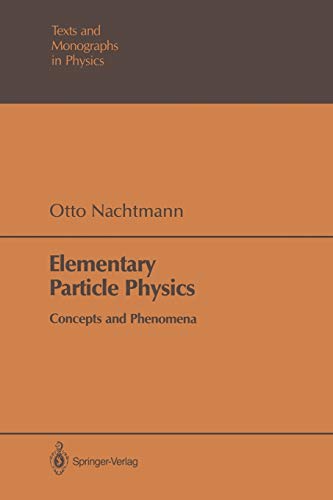
This book grew-how could it be otherwise?-out of a series oflectures which the author held at the University of Heidelberg. The purpose ofthese lectures was to give an introduction to the phenomenology of elementary particles for students both of theoretical and experimental orientation. With the present book the author has set himself the same aim. The reader is assumed to be familiar with ordinary nonrelativistic quantum mechanics as presented, e.g., in the following books: Quantum Mechanics, by L.1. Schiff (McGraw-Hill, New York, 1955); Quantum Mechanics, Vol. I, by K. Gottfried (W.A. Benjamin, Reading, Ma., 1966). The setup of the present book is as follows. In the first part we present some basic general principles and concepts which are used in elementary particle physics. The reader is supposed to learn here the “language” of particle physics. An introductory chapter deals with special relativity, of such funda mental importance for particle physics, which most ofthe time is high energy, i.e., highly relativistic physics. Further chapters of this first part deal with the Dirac equation, with the theory of quantized fields, and with the general definitions of the scattering and transition matrices and the cross-sections.
User’s Reviews
Reviews from Amazon users which were colected at the time this book was published on the website:
⭐This out-of-print book deserves to be reprinted and bought by everyone. It is a mathematical physics version of the popular books on elementary forces and elementary particles except gravitation: the electromagnetic, strong, and weak forces, which occur in quantum electrodynamics (QED), quantum chromdynamics (QCD), and quantum flavor dynamics (QFD) as well as the standard and and grand unified models. The reader without the mathematical background should buy the book and hire a good consultant or tutor to translate the book into almost ordinary English or even to teach the mathematics involved. The Editor and some other reviewers have commented on the easy to read bold face print. Most people do not realize how rare the use of easy to read print is in physics. It is more common in mathematics, thanks largely to Springer/Springer-Verlag publishers in Germany where Nachtmann is one of the outstanding physics algebraic theorists. Nachtmann emphasizes Lagrangian densities and the Hamiltonians and Least Action Principle related to them, which is one of the highest level and most effective concepts in all of science and mathematics and should be understood by people in other fields as well. I have argued elsewhere that Lagrangians are a fundamental mathematical logic basis of the universe (sort of a Kurt Godel type argument in physics – recall the prize-winning book Godel, Bach, and Escher), but Nachtmann’s approach is algebraic and experimental.
⭐Not found.
⭐Not found.
⭐Not found.
⭐Not found.
⭐Not found.
Keywords
Free Download Elementary Particle Physics: Concepts and Phenomena (Theoretical and Mathematical Physics) in PDF format
Elementary Particle Physics: Concepts and Phenomena (Theoretical and Mathematical Physics) PDF Free Download
Download Elementary Particle Physics: Concepts and Phenomena (Theoretical and Mathematical Physics) 1990 PDF Free
Elementary Particle Physics: Concepts and Phenomena (Theoretical and Mathematical Physics) 1990 PDF Free Download
Download Elementary Particle Physics: Concepts and Phenomena (Theoretical and Mathematical Physics) PDF
Free Download Ebook Elementary Particle Physics: Concepts and Phenomena (Theoretical and Mathematical Physics)