Ebook Info
- Published:
- Number of pages:
- Format: PDF
- File Size: 7.32 MB
- Authors: William J. LeVeque
Description
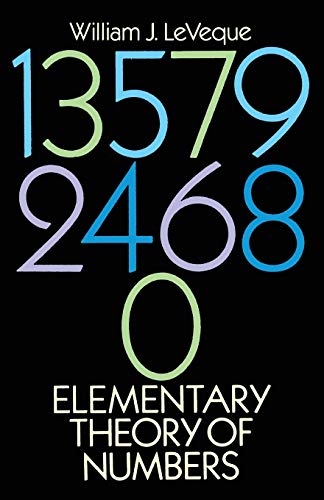
This superb text introduces number theory to readers with limited formal mathematical training. Intended for use in freshman- and sophomore-level courses in arts and science curricula, in teacher-training programs, and in enrichment programs for high-school students, it is filled with simple problems to stimulate readers’ interest, challenge their abilities and increase mathematical strength.Contents:I. IntroductionII. The Euclidean Algorithm and Its ConsequencesIII. CongruencesIV. The Powers of an Integer Modulo mV. Continued FractionsVI. The Gaussian IntegersVII. Diophantine EquationsRequiring only a sound background in high-school mathematics, this work offers the student an excellent introduction to a branch of mathematics that has been a strong influence in the development of higher pure mathematics, both in stimulating the creation of powerful general methods in the course of solving special problems (such as Fermat conjecture and the prime number theorem) and as a source of ideas and inspiration comparable to geometry and the mathematics of physical phenomena.
User’s Reviews
Reviews from Amazon users which were colected at the time this book was published on the website:
⭐Fairly basic introduction. Very easy to read. The level of abstraction is low, so this is accessible to anyone with a high school math background. But it omits a number of important topics, and is not really appropriate for a college level number theory course. It does however, provide a nice introduction to topics a bit more abstract that most high school math.
⭐I have only read one chapter. It is not for people with little or no background in Mathematics.
⭐This book is approachable for someone with no background in number theory. It also serves as a great resource for questions.
⭐Brief but excellent and quite comprehensive.
⭐fun
⭐William J. LeVeque’s short book (120 pages), Elementary Theory of Numbers, is quite satisfactory as a self-tutorial text. It should appeal to math majors new to number theory as well as others that enjoy studying mathematics.Chapter 1 introduces proofs by induction (in various forms), proofs by contradiction, and the radix representation of integers that often proves more useful than the familiar decimal system for theoretical purposes.Chapter 2 derives the Euclidian algorithm, the cornerstone of multiplicative number theory, as well as the unique factorization theorem and the theorem of the least common multiple. Speaking from experience, I recommend that you take the time necessary to master Chapter 2, not just because these basic proofs are important, but more critically to reinforce the skills and discipline necessary for the subsequent chapters.Two integers a and b are congruent for the modulus m when their difference a-b is divisible by the integer m. In chapter 3 this seemingly simple concept, introduced by Gauss, leads to topics like residue classes and arithmetic (mod m), linear congruences, polynomial congruences, and quadratic congruences with prime modulus. The short chapter 4 was devoted to the powers of an integer, modulo m.Continued fractions, the subject of chapter 5, was not unfamiliar and yet, as with congruences, I quickly found myself enmeshed in complexity, wrestling with basic identities, the continued fraction expansion of a rational number, the expansion of an irrational number, the expansion of quadratic identities, and approximation theorems.I have yet to tackle the last two chapters, the Gaussian integers and Diophantine equations, but my expectation is that both topics will also require substantial effort and time. LeVeque’s Elementary Theory of Numbers is not an elementary text, nor a basic introduction to number theory. Nonetheless, it is not out of reach of non-mathematics majors, but it will require a degree of dedication and persistence.For a reader new to number theory, LeVeque may be too much too soon. I suggest first reading Excursions in Number Theory by C. Stanley Ogilvy and John T. Anderson, another Dover reprint. It is quite good.Some caution: LeVeque emphasizes that many theorems are easy to understand, and yet this very simplicity is a two-edged sword. Simple theorems often provide no clues, no hints, on how to proceed. Discovering a short and elegant proof is often far from easy. LeVeque also stresses that a technique ceases to be a trick and becomes a method only when it has been encountered enough times to seem natural. A reader new to number theory may initially be overwhelmed by the variety of techniques used.A nit: The Dover edition of LeVeque’s Elementary Theory of Numbers would benefit from a larger font size. I occasionally found myself squinting to read tiny subscripts and superscripts.
⭐As others have said, this is a fairly easy read. For me it’s actually fun and I’m working through it for that reason. But:- I don’t normally use a highlighter, but found it necessary to highlight symbols where they were defined, because some of them come up only once in a while and it’s easy to forget where the definition is. Symbols are not indexed. I have started my own symbol index in the back of the book.- There are some annoying errors. The theorem to be proven in section 1-3, problem 2 is false for n=1. The decimal expansions in the chapter on continued fractions (page 75) are wrong (for example 1.273820… should actually be 1.273239…). It seems to me if you’re going to give 7 digits they should be the right 7 digits.On the other hand, these errors don’t affect the overall flow of the text, and I’m having a great time working through this book on my own. I’ve read through the whole thing over the summer, and I’m going back through doing problems and writing programs. I was a math major 40 years ago, and haven’t done much with it since, to give a context for that remark.
⭐The book covers main topics of elementary number theory. The book is very short (120 text pages) but not at cost of clarity: almost all theorems are proven in the text and many examples are given.Not many problems have answer in the back, which is not good thing for self-studying.The text does not require much mathematical background (I believe highschool is enough), and I can recommend the book to anyone interested in number theory. The book is very well worth its price. Buy this and if you still like number theory, buy one of those heavy books over $100 :-).
⭐In my school days almost seventy years ago number theory did not feature. Arithmetic did. Recently I came across some ideas described as number theory and realised I had touchrd on these as Algebr. I am not a mathematician but did maths to first year univerity level and retained an interest in maths all my life. Having discovered number theory I was curious to know more, but with a long gap from any formal maths study I wanted a gentle introduction to the subject. This book filled that need well, being clearly written with the authur making few assumptions about the readers matematical expertise. This is an excellent intrduction to a fascinating subject.
⭐Comprato come regalo ( su richiesta). E’ stato (inevitabilmente) molto gradito. La persona in questione studia matematica all’università ma lo ritiene un testo adatto a tutti.Ordinato a fine settembre, l’oggetto deve ancora arrivare. Servizio incredibilmente pessimo, sicuramente non in linea con le altre esperienze di acquisto da Amazon da me sostenute
⭐
Keywords
Free Download Elementary Theory of Numbers (Dover Books on Mathematics) in PDF format
Elementary Theory of Numbers (Dover Books on Mathematics) PDF Free Download
Download Elementary Theory of Numbers (Dover Books on Mathematics) PDF Free
Elementary Theory of Numbers (Dover Books on Mathematics) PDF Free Download
Download Elementary Theory of Numbers (Dover Books on Mathematics) PDF
Free Download Ebook Elementary Theory of Numbers (Dover Books on Mathematics)