

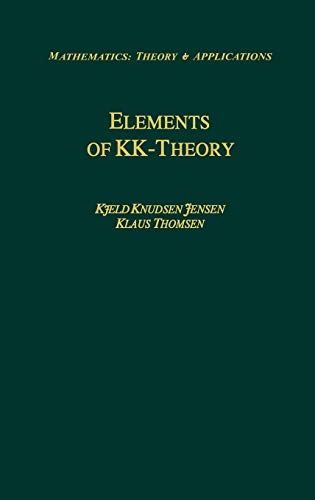
Ebook Info
- Published: 1991
- Number of pages: 202 pages
- Format: PDF
- File Size: 36.59 MB
- Authors: Kjeld Knudsen Jensen
Description
The KK-theory of Kasparov is now approximately twelve years old; its power, utility and importance have been amply demonstrated. Nonethe less, it remains a forbiddingly difficult topic with which to work and learn. There are many reasons for this. For one thing, KK-theory spans several traditionally disparate mathematical regimes. For another, the literature is scattered and difficult to penetrate. Many of the major papers require the reader to supply the details of the arguments based on only a rough outline of proofs. Finally, the subject itself has come to consist of a number of difficult segments, each of which demands prolonged and intensive study. is to deal with some of these difficul Our goal in writing this book ties and make it possible for the reader to “get started” with the theory. We have not attempted to produce a comprehensive treatise on all aspects of KK-theory; the subject seems too vital to submit to such a treatment at this point. What seemed more important to us was a timely presen tation of the very basic elements of the theory, the functoriality of the KK-groups, and the Kasparov product.
User’s Reviews
Reviews from Amazon users which were colected at the time this book was published on the website:
⭐This monograph gives an excellent introduction to a very abtruse and difficult subject. Readers familiar with the K-theory of operators due to Brown-Douglas-Fillmore and the Kadison-Ringrose theory of operator algebras should have ample background to read this book. These background works are very advanced mathematical subjects and so this book should be viewed as one written for specialists only. KK-theory can be thought of in some sense as a unification of K-homology and K-cohomology. This takes place via the KK bivariant groups of the mathematician G.G. Kasparov. Ordinary K-theory has its origins of course in the theory of elliptic operators via the work of M.Atiyah and I.Singer on index theory. The authors of this book however do not motivate their book at all with any history or with any discussion of elliptic operators but instead proceed from a purely algebraic/axiomatic point of view. This approach is well suited to mathematicians coming to the subject for the first time since no doubt they are familiar with the BDF theory if they are choosing to learn KK-theory. However, KK-theory is now finding applications in physics, such as superstring and dual theories, and physicists would not in general be familiar with the BDF/Kadison-Ringrose works. For physicists then this book might be very difficult to follow. That being said this is an interesting subject, and the authors do a good job for those who are prepared. The product on KK groups that Kasparov constructed can be used to obtain all the usual products in topological K-theory, such as the cap, cup, and slant products. Reading the book will also prepare one for the fascinating area of non-commutative geometry ala Alain Connes.
Keywords
Free Download Elements of KK-Theory (Mathematics: Theory & Applications) 1991st Edition in PDF format
Elements of KK-Theory (Mathematics: Theory & Applications) 1991st Edition PDF Free Download
Download Elements of KK-Theory (Mathematics: Theory & Applications) 1991st Edition 1991 PDF Free
Elements of KK-Theory (Mathematics: Theory & Applications) 1991st Edition 1991 PDF Free Download
Download Elements of KK-Theory (Mathematics: Theory & Applications) 1991st Edition PDF
Free Download Ebook Elements of KK-Theory (Mathematics: Theory & Applications) 1991st Edition