Ebook Info
- Published: 2006
- Number of pages: 685 pages
- Format: PDF
- File Size: 1.43 MB
- Authors: J. V. Armitage
Description
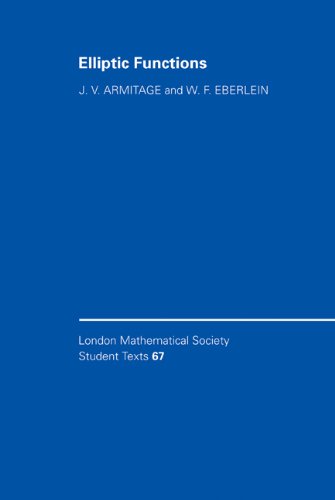
In its first six chapters this 2006 text seeks to present the basic ideas and properties of the Jacobi elliptic functions as an historical essay, an attempt to answer the fascinating question: ‘what would the treatment of elliptic functions have been like if Abel had developed the ideas, rather than Jacobi?’ Accordingly, it is based on the idea of inverting integrals which arise in the theory of differential equations and, in particular, the differential equation that describes the motion of a simple pendulum. The later chapters present a more conventional approach to the Weierstrass functions and to elliptic integrals, and then the reader is introduced to the richly varied applications of the elliptic and related functions. Applications spanning arithmetic (solution of the general quintic, the functional equation of the Riemann zeta function), dynamics (orbits, Euler’s equations, Green’s functions), and also probability and statistics, are discussed.
User’s Reviews
Reviews from Amazon users which were colected at the time this book was published on the website:
⭐I purchased this book as a follow-on to John Howie’s “Fields and Galois Theory”, in which at the end of the tenth chapter, after proving that there is no general solution by radicals of the general quintic equation, he states that the general solution of the quintic equation can be expressed in terms of elliptic modular functions. These are functions of the upper half-complex plane which are doubly periodic and obey certain transformation laws. The tenth chapter of “Elliptic Functions” covers this very nicely. However, I “cheated” in that I first read various entries in Wikipedia on the elliptic modular functions and related topics, in order to get a concise overview of the topic. I don’t think I would have been able to achieve such a clear overview using this book, because I would probably have lost sight of the forest for the trees, or perhaps more aptly, for slogging through the dense underbrush, sweat burning my eyes.In any event, my original plan was to go through the entire book in sequence, but after spending several weeks just going through the first two chapters, I decided to skip straight to chapter ten, which covers the general solution of the quintic. The first two chapters give an introduction to how elliptic functions were first discovered (by Niels Abel) as inversions of elliptic integrals, and how they might have been further developed along these lines, rather than as they were actually further developed, namely as theta functions by Jacobi after Abel’s early death. They’re interesting but not particularly essential to the core of the topic. If you want a standard exposition of the topic without this historical detour, you can start with the third chapter.The tenth chapter clearly expounds the use of elliptic modular functions to solve the general quintic equation. It covers two different methods for doing so, of which I only studied the first. I stand in awe of how anyone could be smart enough to have figured this out. It is reasonably straightforward and concise, with references supplied to more detailed treatments. There are some minor typos, annoying but not seriously interfering with the comprehensibility of the text. (The subject matter itself provides sufficient such interference!)There is a lot of additional theory and application of elliptic modular functions in this book, which look fascinating but which my brain is currently unable to muster the energy to attack. Perhaps some day.I can recommend this book to anyone who wants to learn more about the theory and applications of elliptic modular functions, including the solution of the general quintic equation. The exposition is reasonably clear, there are good examples, and each chapter section is followed by exercises, the answers to which are unfortunately not provided. A background in complex analysis and linear algebra is required.Good Luck!Notes: (reader assumes all responsibility for relying on these notes!)chapter 1: nonechapter 2:p. 48 first integral (phi) should be from 0 to x, not 0 to 1p. 48 right hand side of second equation should readcos lemn (omega/2 – phi), not cos lemn (1/2 – phi). Omega is defined in (2.46)Chapter 10p. 281 (10.14): equation holds for each y sub k and x sub k where the y sub k are the roots of q(y) and the x sub k are the roots ofp(x)p. 283 line 11 should be (10.13) not (10.12). Each of the q’s (I’ll call them q sub i’s for convenience) are functions of the respective eta sub i’s and therefore of sigma sub i; the sigma sub i’s are functions of the set {alpha, beta, gamma, delta, epsilon} and the s sub i’s; the s sub i’s are functions of the p sub i’s; the p sub i’s are functions of the xi sub i’s; therefore the q sub i’s are functions of the set {alpha beta gamma delta epsilon} and the xi sub i’s.p. 286 first line of section 10.4 refers to (10.22), not (10.12)p. 287 third line refers to (10.26) not (10.32)p. 287 (10.40) see p. 153p. 288 line 2 should be (10.26) not (10.32)p. 289 after exercise 10.4 we have section 10.5 not section 10.4p. 291 title of section 10.6 should be transformation singular not transformations pluralp. 298 table second row should be tau to -1/tau not tau to tau minus 1/taup. 301 first table same mistakep. 304 line 7 should be u^24 + 2^12 u^-24, not u^24 + 12 u^-24
⭐The book on elliptic functions has a good introduction of the elliptic functions. It covers the functions of complex variable, the residues, the derivation of the addition formulas of the functions, the Fourier series of the dn(u) function. The book has a very introduction of the theta functions. After these basic properties the books goes to more advanced topics without covering other basics topics: no derivation of half angle formulas, no square of the functions as function of the double angle, no Maclaurin/Taylor expansions, no mapping of the functions to the integrals in the complex plane, no Fourier series of the elliptic sine and cosine which are left to the reader, no differential equation for the functions.
⭐Too bad this book was not proof read correctly. It is defined as a student text: there are way too many typos, sometime more than one per page in some chapters.It would otherwise be an excellent book; this product should be recalled by the editor.Wait for the next edition.
⭐The author may just as well have published Shakespeare’s Richard III & be done with it.
⭐
Keywords
Free Download Elliptic Functions (London Mathematical Society Student Texts Book 67) 1st Edition in PDF format
Elliptic Functions (London Mathematical Society Student Texts Book 67) 1st Edition PDF Free Download
Download Elliptic Functions (London Mathematical Society Student Texts Book 67) 1st Edition 2006 PDF Free
Elliptic Functions (London Mathematical Society Student Texts Book 67) 1st Edition 2006 PDF Free Download
Download Elliptic Functions (London Mathematical Society Student Texts Book 67) 1st Edition PDF
Free Download Ebook Elliptic Functions (London Mathematical Society Student Texts Book 67) 1st Edition