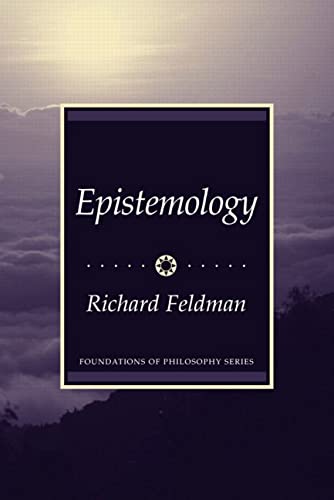
Ebook Info
- Published: 2002
- Number of pages: 208 pages
- Format: PDF
- File Size: 12.55 MB
- Authors: Richard Feldman
Description
For courses in Epistemology.Introduction to contemporary epistemology. Content is organized around “The Standard View”―the view that we do know most of the things reflective common sense tells us we know. Skepticism is discussed as only one of several objections to the view.
User’s Reviews
Editorial Reviews: From the Back Cover Many of the problems of philosophy are of such broad relevance to human concerns, and so complex in their ramifications, that they are in one form or another perennially present. In the course of time, they yield to philosophical study and may be reexamined by each age in the light of its broader scientific knowledge and deepened ethical and religious experience. Thus, one who approaches the study of philosophy in the hope of understanding the best of what it affords will look for both fundamental interpretations and contemporary achievements. Written by a group of distinguished philosophers, the Foundations of Philosophy Series aims to exhibit some of the main problems in the various fields of philosophy as they stand at the present stage of philosophical inquiry. PICK A PENGUIN – We are delighted to offer select Penguin Putnam titles at a substantial discount to your students when you request a special package of one or more Penguin titles with any Prentice Hall text. Contact your Prentice Hall sales representative for special ordering instructions. Excerpt. © Reprinted by permission. All rights reserved. Many of the problems of philosophy are of such broad relevance to human concerns, and so complex in their ramifications, that they are, in one form or another, perennially present. Though in the course of time they yield in part to philosophical inquiry, they may need to be rethought by each age in the light of its broader scientific knowledge and deepened ethical and religious experience. Better solutions are found by more refined and rigorous methods. Thus, one who approaches the study of philosophy in the hope of understanding the best of what it affords will look for both fundamental issues and contemporary achievements. Written by a group of distinguished philosophers, the Foundations of Philosophy Series aims to exhibit some of the main problems in the various fields of philosophy as they stand at the present stage of philosophical history. While certain fields are likely to be represented in most introductory courses in philosophy, college classes differ widely in emphasis, in method of instruction, and in rate of progress. Every instructor needs freedom to change his course as his own philosophical interests, the size and make-up of his classes, and the needs of his students vary from year to year. The volumes in the Foundations of Philosophy Series—each complete in itself, but complementing the others—offer a new flexibility to the instructor, who can create his own textbook by combining several volumes as he wishes, and can choose different combinations at different times. Those volumes that are not used in an introductory ‘course will be found valuable, along with other texts or collections of readings, for the more specialized upper-level courses. Tom L. Beauchamp, Editor Elizabeth Beardsley and Monroe Beardsley, Founding Editors
Reviews from Amazon users which were colected at the time this book was published on the website:
⭐We always make references like “Jets fans are irrational if they think their team will win” or “atheists are irrational if they believe in mind independent moral facts” but we do not generally explain what this means. That is what epistemology does. It is arguably the most important branch of philosophy. You can read a lot of shallow introductions but ultimately gain little understanding. You need to dive into the deep end of the pool and work hard. That’s what this book lets you do. It is written clearly and simply with a minimum of jargon. It also does not assume any knowledge of philosophy. You could read and understand this book as a complete beginner. But you will have to read slowly and carefully.——————What is Knowledge?——————Knowledge is a true belief that is held for a rational reason. It is rational to believe that it will rain based on the weather forecast, but not on your horoscope. However, philosophers use the word ‘justified’ instead of ‘rational’ so we’ll switch to that. Knowledge is a justified true belief. The book then gets into the Gettier-style cases which challenge this view of knowledge. Feldman takes the view that knowledge consists of justified true beliefs that do not essentially depend on falsehood. I would put it this way: knowledge is justified true belief in which there are no successful defeaters for your justification. E.g. suppose you formed that belief that it would rain based on the weather forecast, but unknown to you, the newspaper made a mistake and printed the wrong forecast. The real forecast was for sun. Yet, oddly enough, it did rain. You have a true belief that it would rain. And you were justified in that you did your “due diligence” and checked the weather forecast. But you did not have knowledge because the weather forecast was wrong. We can control whether or not we are justified in our beliefs by doing our “due diligence” but we can’t control whether or not we have knowledge. Sometimes you do your due diligence but end out with false beliefs. Sometimes the weather forecast is wrong.———————————————-Justification and the Infinite Regress Problem———————————————-The heart of epistemology is justification. What do we have to do to be justified in our beliefs? The most common approach is evidentialism. That means beliefs are justified if we have evidence. My belief that it will rain tomorrow is justified by checking the weather report. That leads to a new problem – perhaps the central problem in epistemology. My belief ‘it will rain tommorow’ is based on another belief ‘the weather report said it would rain’. Well, what is my evidence for that other belief? Like a child who keeps asking “why” this leads to an infinite regress. There are two major ways to solve this infinite regress. The first is foundationalism, the other is the coherence theory.———————-Modest Foundationalism———————-Modest foundationalism solves the infinite regress by arguing that some beliefs are justified even if they aren’t based on other beliefs. Beliefs that are not based on other beliefs are called basic beliefs. That leads to a new problem. How are basic beliefs justified? Feldman argues that basic beliefs are justified if they are spontaneously formed and a suitable response to the environment. A good example of this is vision. If you see a tree and form the belief ‘there is a tree’ then you are justified. Visual beliefs are justified on the basis of having a visual experience of a tree.That takes us right back to the regress problem. When you see a tree and form the belief ‘there is a tree’ it is only because you implicitly hold some other belief, namely ‘vision gives me reliable information about the world’. But why do we think that is true? We need a justification for that belief. The infinite regress is “back on” again. I do not think Feldman does an acceptable job of grappling with this objection. He holds that modest foundationalism does not lead to an infinite regress because we have direct and immediate justification of our basic beliefs, such as those based on vision. Skeptics and coherence theorists would argue that he is begging the question. I agree even though I subscribe to modest foundationalism myself.——————–The Coherence Theory——————–The coherence theory solves the regress problem by arguing that beliefs can “loop around” and support each other. Of course, that leads to circular reasoning. A better way of putting it is that beliefs form an interlocking web. No individual belief is justified but the strength of the web as a whole justifies one’s entire worldview. This defeats the charge of circularity.The isolation argument is the one that is truly fatal to the coherence theory. Feldman provides a simple example. Subjects in a psychology experiment were asked to say whether the line on the left or the line on the right is longer, but the scientists manipulated them into believing that the line on the right will be longer. However, they show one of the subjects a picture in which the line on the left is actually longer. Because he was misled he still believes that the line on the right is longer. That is a false belief. This belief coheres with the rest of their worldview. According to the coherence theory, he is justified in their belief. Nevertheless, it is a belief based on an error.The isolation objection shows that the coherence theory doesn’t actually force people to have beliefs that correspond to reality. All they need to do is spin a narrative in which their belief fits the rest of their worldview. Delusion and denial are allowed. Feldmen drives this point home with the case of “Magic Feldman”. Feldman is a short philosophy professor who loves basketball and manages to adopt every single belief that Magic Johnson holds. His beliefs are every bit as coherent as Magic Johnson’s belief so he would be as justified. But of course this absurd.———–Externalism———–Feldman’s criticism of the coherence theory is sound but as I said above, I don’t think he properly defends modest foundationalism against the objection that it fails to escape the regress argument. Feldman says that the belief ‘there is a tree’ based on the visual experience of seeing a tree is justifed in a direct and immediate way. But why should we trust that? What if we made a mistake? Feldman subscribes to internalism, which basically says “this visual experience of seeing a tree is so clear and vivid that it is likely that there really is a tree.” But what if the tree is a cardboard cutout? What if it is the illusion of an evil demon? What if we are suffering from a cognitive error?I think the only way to truly escape the infinite regress is to switch to an externalist perspective, at least for basic beliefs. For example, Alvin’s Plantinga’s externalism holds that we are justified in our basic beliefs if “the belief was formed by cognitive faculties that are functioning properly and in accordance to a good design plan in a cognitive environment appropriate for the way those faculties were designed and when the design plan for our faculties is aimed at the truth.” The problem with externalism is that it is unsatisfying. There is no way of knowing if Plantinga (or someone else’s) requirements have been met. If the world is the illusion of an evil demon then we could be tricked into thinking our senses are aimed at the truth even if they are not.Feldman also gives a reasonable overview of these externalist theories of justification such as the causal theory of knowledge and Alvin Planting’s view of warrant. He also has a good discussion of skepticism and naturalized epistemology. But the core of the book is his clear and careful explanation of knowledge, modest foundationalism and the coherence theory.—————Further Reading—————I would recommend picking up
⭐for the next step. It is a denser discussion of many of these same issues. I think atheists would find the epistemology a profitable study even if they disagree elsewhere. It also grapples more fully with the skeptic’s argument that claiming direct and immediate knowledge of beliefs based on experience is question-begging.
⭐”Epistemology” is a near-model introductory philosophical text. It is clearly written and fair to all points of view. It takes the reader slowly and carefully through the definitions, distinctions, arguments and counter-arguments that define epistemology. It gives the reader a solid grounding in epistemological doctrine. Best of all, “Epistemology” teaches by example: it shows how philosophers actually do philosophy by critiquing and restructuring the ordinary features of experience that we usually take for granted.That said, I took off one star because most of the books and articles discussed in “Epistemology” are less than forty years old. Great philosophers like Descartes and Hume are mentioned only in passing, and giants like Berkeley, Reid, and Wittgenstein aren’t mentioned at all! Whatever philosophy is, it isn’t a technical science with “state of the art” technical findings. Students who ignore philosophy’s canonical texts are missing the most important part of a philosophical education.
⭐Jim Pryor from NYU recommended Feldman to me as a great intro to the subject. I really appreciated the accessibility and clarity of Feldman’s expression. The various positions were up to date with current discussions in the field of epistemology giving the reader immediate access without having to work through the history of epistemology. Moreover the counter arguments were well written and represented some of the prominent voices in epistemological circles.I recommend this for any under graduate who’s wanting to understand the current debate in epistemology.
⭐This is the best epistemology text on the market and a model of clarity. It covers the vast majority of what an instructor would want to treat in an undergraduate course, and it does so in a straightforward, easy style. Although Feldman argues for some particular views on substantive, controversial issues, he fairly provides the standard objections to major views, including his own. I very highly recommend this book to anyone who wants to understand major issues and problems of contemporary analytic epistemology.
⭐I absolutely loved reading this book. Feldman is very student friendly and explains everything in detail. Most philosophy books seem to be harder to read, but not this one. It is all laid out in a great manner. If you are interested in knowledge or philosophy definitely order this book.
⭐Not what I expected, but very good. A wonderful introduction to the world of Epistemology.
⭐The book was better than described. The shipping was a little slow, but important part is that the book was in great condition. I recommend this seller.
⭐Feldman says he learned about the subject f epistemology by listening to a lecture by his brother. Nowhere does he show that he found it interesting or worthwhile. Feldman consistently reduces concepts to a number of letters, abc or cba. By the third chapter it becomes clear that the letters have no meaning as they reappear repeatedly in different constellations. I had hoped for an overview, a kind of family tree of epistemology, but found only the husks and dried leaves left by an indifferent gardener.
Keywords
Free Download Epistemology 1st Edition in PDF format
Epistemology 1st Edition PDF Free Download
Download Epistemology 1st Edition 2002 PDF Free
Epistemology 1st Edition 2002 PDF Free Download
Download Epistemology 1st Edition PDF
Free Download Ebook Epistemology 1st Edition