

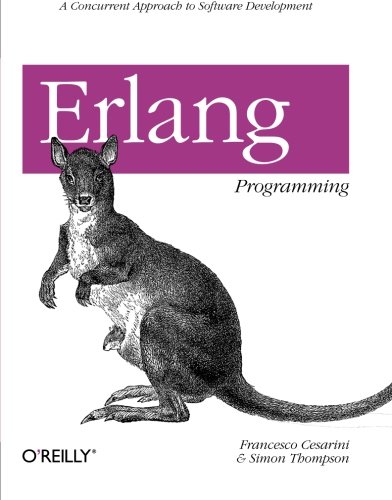
Ebook Info
- Published: 2009
- Number of pages: 498 pages
- Format: PDF
- File Size: 3.33 MB
- Authors: Francesco Cesarini
Description
This book is an in-depth introduction to Erlang, a programming language ideal for any situation where concurrency, fault tolerance, and fast response is essential. Erlang is gaining widespread adoption with the advent of multi-core processors and their new scalable approach to concurrency. With this guide you’ll learn how to write complex concurrent programs in Erlang, regardless of your programming background or experience. Written by leaders of the international Erlang community — and based on their training material — Erlang Programming focuses on the language’s syntax and semantics, and explains pattern matching, proper lists, recursion, debugging, networking, and concurrency.This book helps you:Understand the strengths of Erlang and why its designers included specific featuresLearn the concepts behind concurrency and Erlang’s way of handling itWrite efficient Erlang programs while keeping code neat and readableDiscover how Erlang fills the requirements for distributed systemsAdd simple graphical user interfaces with little effortLearn Erlang’s tracing mechanisms for debugging concurrent and distributed systemsUse the built-in Mnesia database and other table storage featuresErlang Programming provides exercises at the end of each chapter and simple examples throughout the book.
User’s Reviews
Editorial Reviews: About the Author Francesco Cesarini has used Erlang on a daily basis for over 15 years, having started his career as an intern at Ericsson’s computer science laboratory, the birthplace of Erlang. He moved on to Ericsson’s Erlang training and consulting arm working on the first release of the OTP middleware, applying it to turnkey solutions and flagship telecom applications.In 1999, soon after Erlang was released as open source, he founded Erlang Solutions. With offices in the UK, Sweden, Poland (and soon the US), they have become the world leaders in Erlang based consulting, contracting, training, systems development, support services and conferences. At Erlang Solutions, Francesco has worked on major Erlang based projects both within and outside Ericsson, and in his current role as Technical Director, is setting the strategy and vision of the company while supervising the technical teams.Francesco is active in the Erlang community not only through regularly talks, seminars and tutorials at conferences worldwide, but also through his involvement in international research projects. With whatever time he has left over, he teaches Erlang to graduates and undergraduates at Oxford University and the IT University of Gothenburg. You can follow his ramblings (mainly on Erlang and Erlang Solutions) on twitter.
Reviews from Amazon users which were colected at the time this book was published on the website:
⭐Summary: This is a great Erlang starter and maybe the only book you’ll need. It is not an academic text but is very practical and applied.I’ve only just started with Erlang and am enjoying it quite a bit – other than wondering if this is another one of those flash-in-the-pan languages. Even if Erlang is not long lived, I think that something like Erlang is where computing is destined to go. The reason being that even our supercomputers seem to have moved away from big iron and into the cluster world. Erlang fits onto clusters more naturally than anything I’ve yet experienced and that includes MPI and PVM. The reason is that Erlang provides the infrastructure for running an awe inspiring number of “processes” in a multi-machine environment. Or on one machine if that’s your preference. Process is in quote marks above because each process runs in an erlang VM instead of as a process/thread in the operating system.The thing that really amazes me about Erlang is how easy it is to design and build stuff that is fault tolerant and that scales unbelievably. It really is beautiful. I’m kinda wondering if Erlang is the destined to be the “glue language” for clusters.As for direct usefulness of the book… I’ve read chapters: 1 Intro; 2 Erlang Basics; 3 Sequential Erlang; 4 Concurrent Programming; and 11 Distributed Programming. In that order. It was a few hours of reading and fiddling around and now I’m somewhat dangerously able to use the language for what I want. Gotta read those other chapters though.So, why read the chapters? It’s because the writing is honest and applicable. Kind of like the bit in Chapter 2 (I think) where the author says you should mess around with something error prone in the shell now because the next time it’ll be buried deep in some module and be difficult to isolate. Now that’s practical. I bet that OTP chapter will keep me from reinventing some wheels too.
⭐I’ve read entire book with great pleasure — I wish I could have more books as good as this one. The language of the book is very light, entertaining, informative, the authors don’t spare you the crucial details and don’t avoid explanation of complex stuff (I wish there were more “war stories”, I love them). There was very little I didn’t like — footnote marks were taken from some very weird attic, somebody has to have affection for Dingbats font ;-D Second, the chapters about GUI programming in Erlang and interoperability with other languages should be pushed somewhere near the end of the book, while debugging should be introduced earlier.So, as you can see, those are rather minor things. The only more serious flaw I spotted was presenting some piece of code, which rang all the bells in my head labeled “magic values” (p.232, at that point I thought that simply Erlang is so bad, because it does not have anything like enums). It appeared, almost at the end of the book (p.396), about exactly the same piece of code, that you can specify what values you can pass. So it is really strange, that authors didn’t show the correct (i.e. polished) code the first time.Considering the quality of the book, and the amount of information, it is easy to forgive, so I can only wholeheartedly recommend this book. Either if you are thinking about Erlang as a business venture, or reading it for pleasure to widen your horizons. In both cases this will be right pick.NOTE: for me it was very quickly evident, that I won’t write a line in Erlang (it is not strict enough for me, I need consts, enums, avalanche of scopes, and it does not fit text processing, if you ask me), so I was reading it paying more attention to big picture of Erlang, and not technicalities like what is the order of arguments for spawn.
⭐There are only a couple of Erlang Books out right now, primarily this one and Joe’s book. I would recommend getting both of them since they both have different styles, but if you had to choose I would get this one.The days of using one programming language are behind us, yes it use to be C, then C++, then Java, but the age of Domain Specific Languages is upon us. So what Domain does Erlang help us with? Well Erlang powers Facebook Chat servicing 1 Billion messages per day, it powers Jabber one of the top Instant Messaging protocols and it boasts some of the most highly available systems in the world. We are using it for several of the key messaging components in our Video on Demand platform, if you have a cable set top box and Video on Demand you might be using Erlang 😉 It is absolutely excellent for highly concurrent networked systems.Functional programming is something of a mind warp, it’s hard to learn when coming from a procedural language background like most of us (C/C++/Java developers) but it’s well worth spending the time to add Erlang to your tool kit. By reading this book, Joe’s book and watching the Erlang Videos from Pragmatic Programmers I was able to start developing Erlang Applications. After that I would recommend looking at the source code for things like Mochiweb, RabbitMQ, Riak, etc to see how the masters do it.I would also learn a Object Oriented Scripting language like Ruby (1st choice) or Python (2nd choice), with one of these languages and Erlang under your belt you will be able to develop Enterprise applications with ease. Then you can stop battling J2EE Containers, JPA, EJB, etc and get some real work done!
⭐More than in one occasion on articles I spotted references to this new language and I become curious so I arrived to this book.The book is very well written, the exposition is very clear even to the real beginner.It is very easy to follow, it is never boring and go straight to the point.The examples are very well developed and the excersises as well.It is a must have for anyone that wants to master Erlang or simply want to learn if to scratch.
⭐I am new to Erlang and wanted to read a good introductory book. I am more than satisfied with this book.As showin in the TOC, this books covers/touches-on many topics.
⭐Totally met all my expectations. Great book to recommend from every Erlang beginner. Having no previous experience in Erlang I was able to quickly learn everything covered in book.
⭐This is a book for programmers who have experience in a non-Erlang language (C, C++, Python, etc.) but have not met Erlang and its “strange” properties (e.g., no variables (or at least variables that can only be written once which, to the uninitiated, therefore look a lot like constants)).I had a particular professional need to get to grips with Erlang and bought this book as a paper copy (after failing to get it in eBook format on my reader—something that really annoyed me at the time). Like many of the O’Reilly books this one is thorough, authoritative and extremely clear. The examples are not “clever” as they are in many books: they are minimal and just cover the point being made. The authors have not allowed themselves to demonstrate their cleverness and ability with Erlang at the expense of the reader. I wish I could say the say for some other computing books.If you are responsible for designing or implementing dependable (reliable and available) multi-threaded (or “multi-light-weight-processed” in Erlang) systems then get this book and switch to Erlang.
⭐This book is a real gem. Francesco did an extremely good job when writing this book.Don’t waste your time learning Scala or the Java-way of using the actor model of concurrency. Learn the original instead. Once you learned this elegant programming language you will become addicted. You will fall in love with OTP and the Erlang-way of concurrency.
⭐
Keywords
Free Download Erlang Programming: A Concurrent Approach to Software Development 1st Edition in PDF format
Erlang Programming: A Concurrent Approach to Software Development 1st Edition PDF Free Download
Download Erlang Programming: A Concurrent Approach to Software Development 1st Edition 2009 PDF Free
Erlang Programming: A Concurrent Approach to Software Development 1st Edition 2009 PDF Free Download
Download Erlang Programming: A Concurrent Approach to Software Development 1st Edition PDF
Free Download Ebook Erlang Programming: A Concurrent Approach to Software Development 1st Edition