

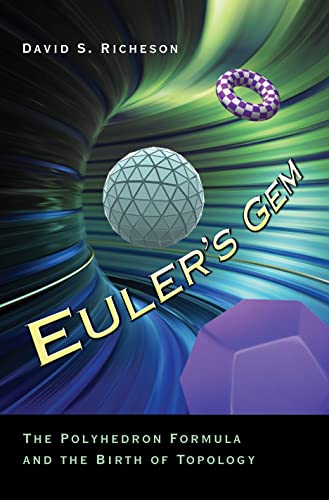
Ebook Info
- Published: 2012
- Number of pages: 336 pages
- Format: PDF
- File Size: 18.03 MB
- Authors: David S. Richeson
Description
Leonhard Euler’s polyhedron formula describes the structure of many objects–from soccer balls and gemstones to Buckminster Fuller’s buildings and giant all-carbon molecules. Yet Euler’s formula is so simple it can be explained to a child. Euler’s Gem tells the illuminating story of this indispensable mathematical idea. From ancient Greek geometry to today’s cutting-edge research, Euler’s Gem celebrates the discovery of Euler’s beloved polyhedron formula and its far-reaching impact on topology, the study of shapes. In 1750, Euler observed that any polyhedron composed of V vertices, E edges, and F faces satisfies the equation V-E+F=2. David Richeson tells how the Greeks missed the formula entirely; how Descartes almost discovered it but fell short; how nineteenth-century mathematicians widened the formula’s scope in ways that Euler never envisioned by adapting it for use with doughnut shapes, smooth surfaces, and higher dimensional shapes; and how twentieth-century mathematicians discovered that every shape has its own Euler’s formula. Using wonderful examples and numerous illustrations, Richeson presents the formula’s many elegant and unexpected applications, such as showing why there is always some windless spot on earth, how to measure the acreage of a tree farm by counting trees, and how many crayons are needed to color any map. Filled with a who’s who of brilliant mathematicians who questioned, refined, and contributed to a remarkable theorem’s development, Euler’s Gem will fascinate every mathematics enthusiast.
User’s Reviews
Editorial Reviews: Review “Winner of the 2010 Euler Book Prize, Mathematical Association of America””One of Choice’s Outstanding Academic Titles for 2009″”The author has achieved a remarkable feat, introducing a naïve reader to a rich history without compromising the insights and without leaving out a delicious detail. Furthermore, he describes the development of topology from a suggestion by Gottfried Leibniz to its algebraic formulation by Emmy Noether, relating all to Euler’s formula. This book will be valuable to every library with patrons looking for an awe-inspiring experience.” ― Choice”This is an excellent book about a great man and a timeless formula.”—Charles Ashbacher, Journal of Recreational Mathematics”I liked Richeson’s style of writing. He is enthusiastic and humorous. It was a pleasure reading this book, and I recommend it to everyone who is not afraid of mathematical arguments and has ever wondered what this field of ‘rubbersheet geometry’ is about. You will not be disappointed.”—Jeanine Daems, Mathematical Intelligencer”The book is a pleasure to read for professional mathematicians, students of mathematicians or anyone with a general interest in mathematics.” ― European Mathematical Society Newsletter”I found much more to like than to criticize in Euler’s Gem. At its best, the book succeeds at showing the reader a lot of attractive mathematics with a well-chosen level of technical detail. I recommend it both to professional mathematicians and to their seatmates.”—Jeremy L. Martin, Notices of the AMS”I highly recommend this book for teachers interested in geometry or topology, particularly for university faculty. The examples, proofs, and historical anecdotes are interesting, informative, and useful for encouraging classroom discussions. Advanced students will also glimpse the broad horizons of mathematics by reading (and working through) the book.”—Dustin L. Jones, Mathematics Teacher”The book should interest non-mathematicians as well as mathematicians. It is written in a lively way, mathematical properties are explained well and several biographical details are included.”—Krzysztof Ciesielski, Mathematical Reviews Review “Euler’s Gem is a thoroughly satisfying meditation on one of mathematics’ loveliest formulas. The author begins with Euler’s act of seeing what no one previously had, and returns repeatedly to the resulting formula with ever more careful emendations and ever-widening points of view. This highly nuanced narrative sweeps the reader into the cascade of interlocking ideas which undergird modern topology and lend it its power and beauty.”―Donal O’Shea, author of The Poincaré Conjecture: In Search of the Shape of the Universe”Beginning with Euler’s famous polyhedron formula, continuing to modern concepts of ‘rubber geometry,’ and advancing all the way to the proof of Poincaré’s Conjecture, Richeson’s well-written and well-illustrated book is a gentle tour de force of topology.”―George G. Szpiro, author of Poincaré’s Prize: The Hundred-Year Quest to Solve One of Math’s Greatest Puzzles”A fascinating and accessible excursion through two thousand years of mathematics. From Plato’s Academy, via the bridges of Königsberg, to the world of knots, soccer balls, and geodesic domes, the author’s enthusiasm shines through. This attractive introduction to the origins of topology deserves to be widely read.”―Robin Wilson, author of Four Colors Suffice: How the Map Problem Was Solved”Appealing and accessible to a general audience, this well-organized, well-supported, and well-written book contains vast amounts of information not found elsewhere. Euler’s Gem is a significant and timely contribution to the field.”―Edward Sandifer, Western Connecticut State University”Euler’s Gem is a very good book. It succeeds in explaining complicated concepts in engaging layman’s terms. Richeson is keenly aware of where the difficult twists and turns are located, and he covers them to satisfaction. This book is engaging and a joy to read.”―Alejandro López-Ortiz, University of Waterloo From the Back Cover “Euler’s Gem is a thoroughly satisfying meditation on one of mathematics’ loveliest formulas. The author begins with Euler’s act of seeing what no one previously had, and returns repeatedly to the resulting formula with ever more careful emendations and ever-widening points of view. This highly nuanced narrative sweeps the reader into the cascade of interlocking ideas which undergird modern topology and lend it its power and beauty.”–Donal O’Shea, author of The Poincare Conjecture: In Search of the Shape of the Universe”Beginning with Euler’s famous polyhedron formula, continuing to modern concepts of ‘rubber geometry, ‘ and advancing all the way to the proof of Poincare’s Conjecture, Richeson’s well-written and well-illustrated book is a gentle tour de force of topology.”–George G. Szpiro, author of Poincare’s Prize: The Hundred-Year Quest to Solve One of Math’s Greatest Puzzles”A fascinating and accessible excursion through two thousand years of mathematics. From Plato’s Academy, via the bridges of Konigsberg, to the world of knots, soccer balls, and geodesic domes, the author’s enthusiasm shines through. This attractive introduction to the origins of topology deserves to be widely read.”–Robin Wilson, author of Four Colors Suffice: How the Map Problem Was Solved”Appealing and accessible to a general audience, this well-organized, well-supported, and well-written book contains vast amounts of information not found elsewhere. Euler’s Gem is a significant and timely contribution to the field.”–Edward Sandifer, Western Connecticut State University”Euler’s Gem is a very good book. It succeeds in explaining complicated concepts in engaging layman’s terms. Richeson is keenly aware of where the difficult twists and turns are located, and he covers them to satisfaction. This book is engaging and a joy to read.”–Alejandro Lopez-Ortiz, University of Waterloo About the Author David S. Richeson is associate professor of mathematics at Dickinson College. Read more
Reviews from Amazon users which were colected at the time this book was published on the website:
⭐it is hard not to fall in love with topology after reading “euler’s gem.” this book is the epitome of outstanding mathematical exposition, presenting the history and consequences of euler’s humble looking polyhedron formula with extraordinary clarity. richeson takes the reader on a leisurely journey of mathematical exploration to get to the land of algebraic topology, while visiting along the way the surrounding territories of graph theory, knot theory, and classical and differential geometry. by the end, the reader should have realized that the various branches of mathematics are intimately intertwined and the journey itself was of significant value. the reader will see mathematical truth and beauty in the process of creation, as well as in its results.euler’s polyhedron formula is: v – e + f = 2, where v is the number of vertices, e is the number of edges, and f is the number of faces. such a simple formula, and yet so deep! if by some chance you’ve never plugged this formula before, try it now with a cube. draw a cube and start counting the number of vertices, edges and faces. you will get: v = 8, e = 12, f = 6, and so 8 – 12 + 6 = 2. incidentally, euler was a highly “experimental” mathematician in the sense that he was not afraid of calculations and would crunch things out to see if a pattern emerges. that was how euler found this formula in the first place, even wondering how such a simple observation could have escaped other mathematicians before him.euler’s original proof of his formula was combinatorial in nature and somewhat interesting, but it was legendre’s proof that completely blew me away. legendre’s proof made me utter the words, “so beautiful!!!” (actually, i also used an f-word in there, but amazon is a family website.) legendre’s ingenious idea was to consider the images of the vertices, edges and faces as projected onto a sphere encompassing the convex polyhedron. the projection is with respect to a point light source inside the polyhedron. the problem then transforms into a counting problem of areas on the sphere, completely out of left field! everyone who has an interest in mathematics should see the details of this proof before leaving this world. legendre’s contribution to uncovering the truly topological aspect foreshadows some of the later consequences of euler’s polyhedron formula. we see here an entrance to the road leading to triangulations of surfaces and the results that followed that development.while richeson’s book is suitable for a large readership, its potential is perhaps greatest among high school students who show promise in mathematics. this book expounds the history of the polyhedron formula, offers biographical sketches of great mathematicians, goes through different proofs, explores connections and cross-fertilization in the mathematical empire, and gives the reader a sense of the art of mathematical thinking. it is almost certain that not everything in “euler’s gem” will be fully understood by a student at the high school level, but that’s perfectly ok. it is good for the mind to see glimpses of where mathematics is heading in future courses so that math doesn’t feel like meaningless memorization without any direction. i hope “euler’s gem” will gain popularity among high school faculty members so that they will recommend it to their brightest students; i hope this book will be used to stoke the fires in the minds of those who will later walk the path of math and science.in writing “euler’s gem,” richeson has done the mathematical community a tremendous service. topology has never before been so lucidly explained to so wide an audience. well done.
⭐Euler’s Gem uses a simple formula (V – E + F = 2) to relate topics in polyhedra, graphs, knots and topology. This is written for a non-professional audience, in an informal style and without assuming any particular mathematical background. I am not sure how well this works with a reader who really is completely new to all the topics covered in the book, but it should be a rewarding read for anyone sufficiently interested in the topic to crack open the book in the first place.In addition to a substantial section on Euler’s life, most of the prominent mathematicians discussed are given at least a short biography before diving in to what they contributed to “Euler’s Gem”. The problems themselves are given a bit of a historical perspective (A started it, B fixed it, C extended it, D showed how it was related to another big topic, etc). This really helps emphasize the evolving nature of work in this area, starting around 2300 years ago, with substantial development 400 years ago, and continuing related work in the present day.Despite being familiar with much of the technical material at the advanced undergraduate or 1st year graduate level, I learned several results (e.g., Pick’s theorem and the “five neighbors” theorem) and some techniques (e.g., Legrendre’s proof of Euler’s polyhedron formula). So a considerable breadth compensates for the lack of technical depth.The text cites ample references to the professional literature, if the reader wants to go there, but in a low-key way. There is certainly no pressure to go off and study a chapter of something else in preparation for the next topic in this book.
⭐I often will flip through a new book reading short sections before starting from page 1. When I tried that with this book, I found I was so enthralled that I read each chapter through as I turned to it. Richeson makes this easy by keeping each chapter almost entirely self contained and independent of other chapters. I will be reading this one cover to cover. Never before have I had an entire branch of mathematics explained to me by a single book and at just the right depth of coverage to both give me a good grasp of each topic, and to make me want to dig deeper and learn more. I took topology in college, only to learn that it was elementary point-set topology. Nothing could be more dry and disappointing. Absent from the material presented was every topic I had heard of that fits under the umbrella of ‘topology’. Well here in this one volume are the platonic and Kepler polyhedra, the bridges of Konigsberg, graphy theory, knot theory, classification of surfaces, the 4 color theorem, the Poincare conjecture, Poincare-Hopf theorem, Brouwer fixed point theorem, and some algebraic topology. Amazingly, he ties it all together with the use of Euler’s Formula. This is the book I should have had in college. Previously, I always looked for Paul Nahin’s books. Now I will be looking for Richeson too.
⭐Excellent, detailed book
⭐I was looking for a book along the lines of Prime Obsession, with a good mix of mathematics and history, and this was exactly what I was looking for. My mathematics ability is probably around college sophomore level, and I was able to understand everything until the last two chapters.
⭐Extremely well written book. And very well documented. It covers a very nice selection of material. My only reservation is that, while it may make the reader “wonder” and marvel, it doesn’t have problems or puzzles to test and extend his/her understanding; i.e., the reader is encouraged to wonder, but not to think.
⭐This is a lovely book. The 18th Century mathematician Leonhard Euler discovered many mathematical formulae – almost every discipline I know has its “Euler’s formula”. His polyhedron formula, that is the subject of this book, marked the beginning of a mathematical revolution that today underpins everything from the difference between a baseball and a donut to the ten-dimensional world of string theory in theoretical physics.Richeson takes the beginner on a gentle but irresistible walk through the history of the formula (the “gem” as he calls it) and its mathematical adulthood, the study of shapes in space nowadays known as topology. From Euler’s birth in Switzerland to the Frenchman Poincaré’s explosive elaborations a hundred years later, we are led step by step on the path of discovery.There are few mathematical formulae in the book besides the gem itself, and the lay reader may cheerfully skip these without losing the gist of the story. That would be a shame though, as the beauty and elegance of mathematics shines through them.Learned, clearly and accurately written, thoughtfully referenced and carefully and profusely illustrated, this book is almost as much a gem as the formula itself.
⭐I hoped this book would say more about the proofs of Eulers polyhedron formula (filling gaps/ more explanation than in Lakatos “proof and refutations “). But sadly this book finds other gems more importand than the gem in its title
⭐Pocos libros me han cautivado como este. Con un estilo muy claro de exposición que facilita la comprensión sin sacrificar el rigor.Combina historia de la matemática con la de los personajes que la hicieron en proporción muy adecuada.El hilo de la exposición que va de la historia del asunto (formula de Euler para poliedros) desde la antigüedad clásica a lo moderno (topología) es admirable.
⭐
⭐Fantastic book…In depth study of Eiler’s formula and its rxtension and ramifiications by other great mathematicians of that epoch….Fascinating and beautiful descripton of the birth of Topology and how Topology forces constraint on Diferential Geometry. Beautiful accomt on the connection of Euler’s famous formula to the Gauss Bonet theorem. The many varied examples and figures help to digest the mathematics In a pleasant way.Great story of how the word Topology came to describe this field of mathematics, replaciing Poincare’s term “Amalysis Situs”, illustrating how proper teminology has a power of its own in promoting the develment of a field in mathematics.Very enjoyable reading by an author who is a gifted teacher.A must buy for anybody intested in studying mathematics through it’s historical development. Writen in the same spirit as John Stillwell’s famous book Mathematics and its History witch is , by the way,one of my favorite books.Congratulatipns to David Richeson for providing us with many enjoyable hours of readng.
⭐Usually, the ideas of mathematics are not readily accessible to people of other disciplines (like Engineering etc). This is primarily because it is difficult to read mathematical ideas in the form they are usually presented (in Wikipedia or Textbooks). One has to understand a lot of symbols and then deduce their inner meaning. That is exactly why this book is so good. It introduces topology to absolute beginners in the field. Richeson has managed to take an active research topic like topology and explain it to the “laymen”.While it is true that sophisticated mathematical techniques are not required to understand this book, it is also true that one has to think critically about the mathematical arguments and explanations which are given. They are NOT arguments that can be read over coffee. One needs to calmly think about them. But the end-result is that you get a good introduction to topology ( a really good one i have to say) from where you can move on to other things.The book start with the Greeks, goes through Euler’s discovery of the polyhedron formula and the many other proofs of it, introduces the ideas of how graph theory and topology are related, shows the relationship between geometry and topology and ends with the Poincare Conjecture.Its a really really good book i have to emphasize. I wish there were more books like this in all other fields as well so that outsiders can atleast start appreciating (and probably even applying) these ideas in their own fields.
Keywords
Free Download Euler’s Gem: The Polyhedron Formula and the Birth of Topology in PDF format
Euler’s Gem: The Polyhedron Formula and the Birth of Topology PDF Free Download
Download Euler’s Gem: The Polyhedron Formula and the Birth of Topology 2012 PDF Free
Euler’s Gem: The Polyhedron Formula and the Birth of Topology 2012 PDF Free Download
Download Euler’s Gem: The Polyhedron Formula and the Birth of Topology PDF
Free Download Ebook Euler’s Gem: The Polyhedron Formula and the Birth of Topology