

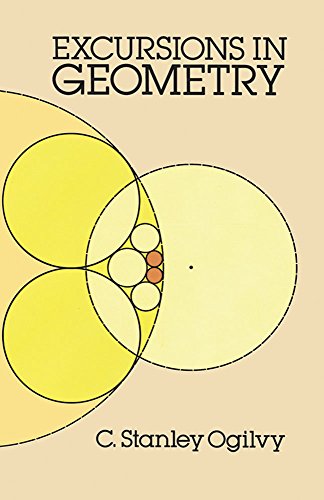
Ebook Info
- Published: 1990
- Number of pages: 192 pages
- Format: PDF
- File Size: 6.62 MB
- Authors: C. Stanley Ogilvy
Description
A charming, entertaining, and instructive book …. The writing is exceptionally lucid, as in the author’s earlier books, … and the problems carefully selected for maximum interest and elegance. — Martin Gardner.This book is intended for people who liked geometry when they first encountered it (and perhaps even some who did not) but sensed a lack of intellectual stimulus and wondered what was missing, or felt that the play was ending just when the plot was finally becoming interesting.In this superb treatment, Professor Ogilvy demonstrates the mathematical challenge and satisfaction to be had from geometry, the only requirements being two simple implements (straightedge and compass) and a little thought. Avoiding topics that require an array of new definitions and abstractions, Professor Ogilvy draws upon material that is either self-evident in the classical sense or very easy to prove. Among the subjects treated are: harmonic division and Apollonian circles, inversion geometry, the hexlet, conic sections, projective geometry, the golden section, and angle trisection. Also included are some unsolved problems of modern geometry, including Malfatti’s problem and the Kakeya problem.Numerous diagrams, selected references, and carefully chosen problems enhance the text. In addition, the helpful section of notes at the back provides not only source references but also much other material highly useful as a running commentary on the text.
User’s Reviews
Reviews from Amazon users which were colected at the time this book was published on the website:
⭐All the other reviews which rate this book highly are exactly correct. I am only going to add one thing: The discussion of the cross-ratio, in this book, is absolutely great.I have read a number of books on projective geometry. In those books the cross-ratio is defined and its invariance is proved in a very dry manner, without any explanation of why it is interesting at all. Yes, it is the key invariant of projective geometry, but it seems to come from nowhere – it is just a definition out of the blue.This book starts with a simple theorem on two chords of a circle, and then develops what it means to “divide a line harmonically”, and then goes to the cross-ratio. This development, though simple, actually for the first time for me really motivated what the heck the cross-ratio was, and why anyone was initially interested in it. And then, chapter by chapter, the cross-ratio is used in interesting ways.First, it is used in coaxial families of Apollonian circles, a simple example. Then, inversive geometry is developed and it – inversive geometry, and thus the cross-ratio – become the means to explain and/or solve really interesting and fun problems like Peaucellier’s linkage, the Apollonius problem of finding a circle tangent to three other circles, and truely amazing things like Steiner chains and Soddy’s hexlet.Later in the book the discussion turns to projective geometry and there the cross-ratio reappears – and well it should as the cross-ratio is the key invariant in projective geometry. (I believe I already said that.) But the discussion here is so much better motivated than the discussion in the rigorous texts on projective geometry I’ve been studying.At last I feel I understand the cross-ratio!(By the way, if you like inversive geometry, look at
⭐- that’s a really good text/problem book for it.)
⭐This is entertainment for the mathematics major as well as for the curious.The author was my college mathematics professor, and we studied several of the topics included.Starts you thinking about the advanced geometry.
⭐This is a beautiful book. It assumes essentially no knowledge of geometry, and is ideal for recreational mathematical reading. It’s written–and illustrated with diagrams–so well that it can be read without clarifying things for yourself with a pencil and paper. But you’ll want a pencil and paper just to play around with the ideas.
⭐Excellent, good reading
⭐This is a pretty interesting collection of classical geometry. Much of it is well known, but some topics are shamefully neglected today, such as harmonic division and Apollonian circles, which is treated in the interesting chapter 2. Suppose there is a ship at A and a ship at B, and that the ship at A is k times faster. If the ships sail towards each other they will meet at C; if the B-ship tries to flee away from A, the A-ship will catch up with it at D. So we have AC/CB=AD/BD=k, and one says that the line segment AB has been “harmonically divided” by C and D. Now here is a theorem proved by Apollonius: the locus of points that the ships can reach at the same time, i.e. points P such that AP/BP=k, is a circle, the Apollonian circle. Proof: Consider such a point P. Bisect the angle APB, cutting AB at C. Extend AP and bisect the exterior angle, cutting the extended AB at D. One sees at once that CPD is a right angle. And by drawing the parallels to CP and PD through B and applying similar triangles twice we find that both AC/CB and AD/BD is equal to AP/BP=k, so C and D are the same C and D as above, and the points the ships can reach at the same time lie on the circle with diameter CD. A remarkable extension is the theorem that the diameter of a circle is divided harmonically by another circle if and only if the circles are orthogonal. So harmonic divisions of AB corresponding to different values of k come from a family of circles orthogonal to the circle with diameter AB, and for any one, cutting AB at C and D, say, we can draw the family of circles having their diameters harmonically divided by C and D. In this way we get a net of mutually orthogonal circles, illustrating a connection between the classical notion of harmonic division and the modern notion of harmonic function. There are also implications for naval pursuit. Suppose we are on a ship, hunting an enemy ship. Assuming that both we and the enemy are going in a straight line, the points that we could reach at the same time as the enemy lie on the Apollonian circle of points P such that AP/BP=ratio of velocities. If we are faster than the enemy, this circle will encircle him. Thus, if the enemy keeps a straight course (e.g., if we are a submarine), we should aim for the point where his course intersects the circle.
⭐This book is intended as an introduction to some aspects of geometry which you are unlikely to have covered at school, including inversive geometry. It requires a lot of concentration, and I found explanations often hard to follow. I would not recommend the book to people without some grounding in the topics covered.
⭐Received on time, at advertised,
Keywords
Free Download Excursions in Geometry (Dover Books on Mathematics) in PDF format
Excursions in Geometry (Dover Books on Mathematics) PDF Free Download
Download Excursions in Geometry (Dover Books on Mathematics) 1990 PDF Free
Excursions in Geometry (Dover Books on Mathematics) 1990 PDF Free Download
Download Excursions in Geometry (Dover Books on Mathematics) PDF
Free Download Ebook Excursions in Geometry (Dover Books on Mathematics)