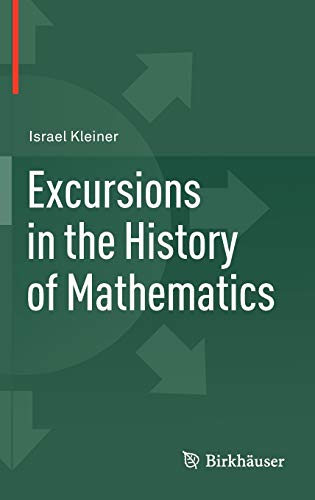
Ebook Info
- Published: 2012
- Number of pages: 347 pages
- Format: PDF
- File Size: 3.75 MB
- Authors: Israel Kleiner
Description
This book comprises five parts. The first three contain ten historical essays on important topics: number theory, calculus/analysis, and proof, respectively. Part four deals with several historically oriented courses, and Part five provides biographies of five mathematicians who played major roles in the historical events described in the first four parts of the work.Excursions in the History of Mathematics was written with several goals in mind: to arouse mathematics teachers’ interest in the history of their subject; to encourage mathematics teachers with at least some knowledge of the history of mathematics to offer courses with a strong historical component; and to provide an historical perspective on a number of basic topics taught in mathematics courses.
User’s Reviews
Editorial Reviews: Review From the reviews:“The book under review was written with two main goals in mind: (1) to arose mathematics teachers’ interest in the history of mathematics, and (2) to encourage mathematics teachers with at least some knowledge of the history of mathematics to offer courses with a strong historical component. … The book can serve teachers of mathematics as well as mathematicians who want to get to know historical background of their subjects. It can be also useful to those teaching or studying the history of mathematics.” (Roman Murawski, Zentralblatt MATH, Vol. 1230, 2012) From the Back Cover This book comprises five parts. The first three contain ten historical essays on important topics: number theory, calculus/analysis, and proof, respectively. Part four deals with several historically oriented courses, and Part five provides biographies of five mathematicians who played major roles in the historical events described in the first four parts of the work. Each of the first three parts―on number theory, calculus/analysis, and proof―begins with a survey of the respective subject and is followed in more depth by specialized themes. Among the specialized themes are: Fermat as the founder of modern number theory, Fermat’s Last Theorem from Fermat to Wiles, the history of the function concept, paradoxes, the principle of continuity, and an historical perspective on recent debates about proof. The fourth part contains essays describing mathematics courses inspired by history. The essays deal with numbers as a source of ideas in teaching, with famous problems, and with the stories behind various “great” quotations. The last part gives an account of five mathematicians―Dedekind, Euler, Gauss, Hilbert, and Weierstrass―whose lives and work we hope readers will find inspiring.Key features of the work include:* A preface describing in some detail the author’s ideas on teaching mathematics courses, in particular, the role of history in such courses;* Explicit comments and suggestions for teachers on how history can affect the teaching of mathematics;* A description of a course in the history of mathematics taught in an In-Service Master’s Program for high school teachers;* Inclusion of issues in the philosophy of mathematics; * An extensive list of relevant references at the end of each chapter.Excursions in the History of Mathematics was written with several goals in mind: to arouse mathematics teachers’ interest in the history of their subject; to encourage mathematics teachers with at least some knowledge of the history of mathematics to offer courses with a strong historical component; and to provide an historical perspective on a number of basic topics taught in mathematics courses.
Reviews from Amazon users which were colected at the time this book was published on the website:
⭐This book is a prime example of history as distorted through the eyes of a narrow-minded modern mathematician. Kleiner is dogmatically attached to the modern textbook expression of mathematics and refuses to let historical facts or basic rational thought stand in the way of his desire to see historical development as heading towards it and justifying it.So for example it is stated without any evidence or references that “mathematicians of the seventeenth and eighteenth centuries … recognized that their methods [of infinitesimal calculus] were unsatisfactory, but were willing to tolerate them because they yielded correct results” (p. 80). This is pure fabrication, plain and simple: Newton, Leibniz, Euler, etc. all unequivocally affirmed the soundness of their methods. But Kleiner is blind to this plain historical fact, for it conflicts with his dogmatic assumption that the modern textbook presentation is the one and only correct way to approach the calculus.By the same token, consider his absurd take on the history of the notion of continuity:”In the eighteenth century, Euler did define a notion of ‘continuity’ to distinguish between functions as analytic expressions and the new types of functions which emerged from the vibrating-string debate. Thus a continuous function was one given by a single analytic expression, while functions given by several analytic expressions or freely drawn curves were considered discontinuous. … The work on Fourier series showed the untenability of the eighteenth-century notion of continuity. Indeed, a function [defined piecewise] could be represented … by a single analytic expression, namely its Fourier series, hence it was both continuous and discontinuous in the eighteenth-century sense of that concept.” (p. 142)Again Keliner is so attached to the idea that the modern textbook definition is the “right” one that he takes it for granted that Euler’s notion was “untenable” and tries to conjure up historical reasons for this. But obviously Euler was trying to capture a completely different notion with his definition. The fact that he happened to use the same word that we use for something else is entirely coincidental and cannot be used to discredit him or to feign connections that do not exist. There is nothing “untenable” about Euler’s perfectly sound notion of continuity. In fact, if Euler’s notion is “untenable” then so is the modern notion of a piecewise defined function, since one can easily give many examples of functions that are “both piecewise and non-piecewise defined in the twentieth-century sense of that concept,” by for example replacing a piece of y=x^2 by y=sqrt(x^4).
⭐
⭐
Keywords
Free Download Excursions in the History of Mathematics (Operator Theory, Advances and Applications) 2012th Edition in PDF format
Excursions in the History of Mathematics (Operator Theory, Advances and Applications) 2012th Edition PDF Free Download
Download Excursions in the History of Mathematics (Operator Theory, Advances and Applications) 2012th Edition 2012 PDF Free
Excursions in the History of Mathematics (Operator Theory, Advances and Applications) 2012th Edition 2012 PDF Free Download
Download Excursions in the History of Mathematics (Operator Theory, Advances and Applications) 2012th Edition PDF
Free Download Ebook Excursions in the History of Mathematics (Operator Theory, Advances and Applications) 2012th Edition