

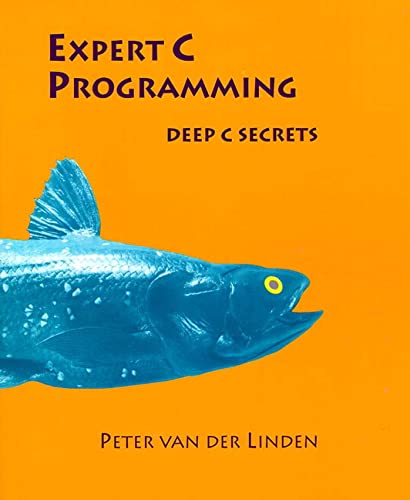
Ebook Info
- Published: 1994
- Number of pages: 353 pages
- Format: PDF
- File Size: 2.16 MB
- Authors: Peter van der Linden
Description
This book is for the knowledgeable C programmer, this is a second book that gives the C programmers advanced tips and tricks. This book will help the C programmer reach new heights as a professional. Organized to make it easy for the reader to scan to sections that are relevant to their immediate needs.
User’s Reviews
Editorial Reviews: Amazon.com Review Defying the stereotypical notion that technical books tend to be boring, Expert C Programming offers a lively and often humorous look at many aspects of C–from how memory is laid out to the details of pointers and arrays. The author reveals his points through invaluable anecdotes, such as stories of costly bugs, and through folklore, such as the contents of Donald Knuth’s first publication. Each chapter ends with a section entitled “Some Light Relief,” which discusses topics (topics that some may consider to be “recreational”), such as programming contests. A fabulous appendix on job interview questions finishes the book. From the Back Cover This is a very different book on the C language! In an easy, conversational style, Peter van der Linden, of Sun’s compiler and OS kernel group, presents dozens of astonishing examples drawn from practical experience, including:Software that blew up the space probe to VenusThe C bug that shut down the entire AT&T phone systemC programmer job interview secretsWhy programmers can’t tell Halloween from Christmas dayThe C code for a complete BASIC interpreterExpert C Programming reveals the coding techniques used by the best C programmers. It relates C to other languages, and includes an introduction to C++ that can be understood by an programmer without weeks of mind-bending study. Covering both the IBM PC and UNIX systems, it is an entertaining and educational romp through C showing how experts really use it. Expert C Programming is a must read for anyone who wants to learn more about the implementation, practical use, and folklore of C. “Not just clearly written, but fun to read. The tone and style of this text should make this a popular book with professional programmers. However, the tone of this book will make it very popular with undergraduates. Appendix A alone would make the purchase of this book a must. It’s filled with great advice.” ―Professor Jack Beidler, Chairman, Department of Computer Science, University of Scranton “So that’s why extern char *cp isn’t the same as extern char cp. I knew that it didn’t work despite their superficial equivalence, but I didn’t know why. I also love the job interview test questions on C.” ―David S. Platt, Rolling Thunder Computing “In Expert C Programming, Peter van der Linden combines C language expertise and a subtle sense of humor to deliver a C programming book that stands out from the pack. In a genre too often known for windy, lifeless prose, van der Linden’s crisp language, tongue-in-cheek attitude, and real-world examples engage and instruct.” ―John Barry, author of Sunburst, Technobabble, and other books
Reviews from Amazon users which were colected at the time this book was published on the website:
⭐Peter van der Linden’s “Expert C Programming: Deep C Secrets”, published in 1994, is already a classic. It explicitly assumes the reader knows how to program in C (according to the author, this “should be every programmer’s second book on C”). In that sense, it is similar to Scott Meyers’ “Effective C++” (originally published in 1991). Of course, C is a much smaller language than C++ but, even so, it does have some non-trivial aspects, which are precisely what van der Linden zeroes in on. Given the nature of this text, any review of its good and bad points needs to get down to the nitty-gritty.The Good: Dennis Ritchie, in his essay on “The Development of the C language”, wrote that “Two ideas are most characteristic of C among languages of its class: the relationship between arrays and pointers, and the way in which declaration syntax mimics expression syntax.” In the book under review, van der Linden is at his finest when discussing precisely these two topics. Starting with arrays & pointers: the book includes 3 chapters on the subject, first tackling the classic “defined as array / external declaration as pointer” problem. Later, the author returns to the root of the confusion, namely that even though arrays and pointers are distinct entities in declarations/definitions, there is one major exception: a function can have an array parameter, but the argument will be converted to a pointer before the call (though this rule isn’t recursive). As a result, even though arrays are not modifiable lvalues, you can use assignment inside a function since the argument will have been converted to a pointer. Leaving declarations behind us, the story gets more elaborate: i) when used in an expression an array name is converted to a pointer, and ii) a subscript is always equivalent to an offset from a pointer. Of course this is too straightforward, so the first point does not apply when the array “is the operand of the sizeof operator or the unary & operator, or is a string literal used to initialize an array” (6.3.2.1) — C1X adds the _Alignof operator to this list. Moving on to Ritchie’s second characteristic idea, the relationship between declaration syntax and expression syntax: van der Linden has one chapter on this subject, providing a very useful algorithm (in two versions) that allows one to untangle virtually any possible declaration (though it would have been nice if he had also mentioned “go right when you can, go left when you must”). He then applies this algorithm to the signal library function (sigaction’s prototype was presumably too simple). In this connection, the author makes the interesting observation that the addition of const and volatile to ANSI C led to a reduction of the number of cases in which the use of a variable mimics its declaration. In a later chapter he makes a similar point regarding calls to a function and calls to a function through a pointer (or any level of pointer indirection). These are only two examples of van der Linden’s non-hagiographic attitude: he devotes an entire chapter to the aspects of C he doesn’t like (C’s “sins of commission, sins of omission, and sins of mission” as he calls them), bringing to mind Matthew Wilson’s later volume “Imperfect C++”. The author’s choice of words in this case (“sins of mission”) reflects his wider approach to writing: his style is relaxed and often funny (more so in the early chapters). For example, he quotes Peter Weinberger (of awk fame) as saying: “All C programs do the same thing: look at a character and do nothing with it”. Finally, the book does contain a number of other insights/techniques from various aspects of C programming, some important and relatively obvious (e.g. to implement a finite-state machine in C you probably need an array of pointers to functions), others considerably less so (e.g. the typedef keyword doesn’t have to appear at the start of a declaration!).The Bad: starting with big-picture issues, it’s worth pointing out that the title is somewhat misleading. The book under review is better described by its subtitle “Deep C Secrets” (pun notwithstanding), as what it mainly covers are C’s dark corners. Still on the theme of what a book with this title should or shouldn’t include: the middle chapters (on the runtime system and on memory) are very clear and interesting, but most of this material can already be found in any undergrad Operating Systems textbook (minus the SunOS bent). While it is true that a skilled C programmer should know this stuff, these chapters are nowhere near expert-level. On a different note, the book is showing its age. Its datedness has secondary consequences (e.g. repeated references to MS-DOS and one mention of “machines on the Internet network”) but also substantive repercussions. As this book came out in 1994, it doesn’t contain anything on C99, therefore no bool, inline, restrict, static and type qualifiers in parameter array declarators, or any of the other features. Interestingly, van der Linden does mention that at the time people were talking about adding a complex number type to C: this was added in C99, but it looks like it’s going to become optional in C1X. Similarly, he laments the fact that gets was included in C89: it was deprecated in C99 and will be removed in C1X. As could be expected, the C++ chapter is even more temporally bound. The text also suffers from a few minor issues which ordinarily wouldn’t be worth noting, but seem out of place in a detail-oriented book whose author and publisher have had 17 years to fix up lesser faults. For example, terms like “data segment” and “text segment” are thrown around in the first half of the book but are only introduced in chapter 6 (of 11). At an even more fine-grained level, the order of expression evaluation is said to be unspecified on p. 48 though it was undefined only a page earlier. Another category of minor problems has to do with issues that were mangled in later reprints despite the errata list. First, on p. 80 the early part of the section title on “typedef x int[10] and #define x int[10]” was silently changed between printings (i.e. without an entry on the errata page) to “typedef int x[10]”. This raises new issues which are also not discussed in the main text: the macro expansion leads to an invalid declaration, but now the typedef is legal. Second, p. 205 used to say “the automatic promotion of a character literal causes it to become an int”, but in a later printing this was changed to “character literals have type int and they get there by following the rules for promotion from type char” which is obfuscatory at best. In reality, character literals (officially called “character constants”) have type int because the standard says so: “An integer character constant has type int” (6.4.4.4). [As an aside, this is one of the incompatibilities between C and C++ mentioned by van der Linden on p. 326.]. Finally, the book’s index is hopeless: e.g. there’s an entry on Fortran and a separate one on Fortran 90, but no entries on functions or structs.Readers who are searching for a “second book on C” with lots of insights on design should probably look at David Hanson’s “C Interfaces and Implementations”, as “Expert C Programming” doesn’t really discuss large-scale software construction. Also, this book does suffer from a pro-Sun/anti-Microsoft bias and it does contain some outdated material. However, a finite fraction of the C community still uses C89/C90 exclusively, so for readers who want to study not-so-often examined aspects of C this text is irreplaceable (despite minor problems here and there). All in all, 4 stars.Alex Gezerlis
⭐“Expert C Programming: Deep Secrets” is a fun, light-hearted book with a look into some traps and subtleties of the C programming language.It certainly doesn’t cover anything that isn’t known to most programmers who have worked with C., But it explains them in some detail and goes in-depth into some of them.Unfortunately, it doesn’t cover as many topics as one would like, and this is to be expected of a book of this size and scope.One crucial point is that the book is quite dated (before 1999 & C99), and this takes little of its value. This is due to the sad fact that many issues discussed still plague C programmers to this day. And many of the author’s predictions have already come to pass.A book that may be suitable to readers of this book is “The Practice of Programming,” co-authored by the UNIX veteran Rob Pike.
⭐I bought this book on the strength of a couple of reverential mentions on a C forum. It’s amusingly written, and the historical anecdotes are very interesting. The explanations of some topics, notably pointers vs. arrays and complicated declarations, are wonderfully illuminating.While the explanations of some of the more obscure aspects of the language remain useful, it’s hard to believe that the book is still getting five-star reviews in 2013. C has gone through two major revisions since the book’s publication in 1994. What is the utility of a book that advises programmers to use ANSI C (C 89) over K&R C? Is anybody seriously contemplating writing functions without prototype declarations or explicitly defined types in parameter lists? Throughout the book, paragraphs are devoted to comparisons between C and Pascal, Fortran, and/or Ada. How useful or illuminating is that in 2013? The book’s age also comes through in its focus on Sun’s operating system and its woefully out of date discussion of C++.The book is also poorly organized. There is no logical reason that pointers and arrays should be discussed in Chapter 4, then the topic should be dropped four four chapters, then picked up again in chapters 9 and 10, particularly considering that the latter chapters reproduce wholesale explanations and figures from the earlier one. Even within chapters, sometimes it’s hard to see what one section has to do with another. Finally, the production values are horrendous. The binding falls apart at the slightest touch; the paper is flimsy; the type is smudgy; and the proofing appears to be entirely absent.So three stars for entertainment value and for the still-useful parts, but honestly, the book is not worth the $30 or so. A book that incorporated the handy explanations of the language, but updated them in the context of C99, C11, current C++, and newer C offshoots such as Java, C#, and Objective C, would be worth that and more.
⭐Although this is an old book, it is still interesting and informative if you use C on a regular basis. It goes into all the traps and dangers with C and includes some useful utilities. I recommend to to any C programmer – you will learn some things about C that you never learnt from any other book!
⭐I like the mix of theory and examples/challenges. Just what I needed to bring my C up a level. Some references are a bit dated but that’s to be expected from a book written in 1994.
⭐You can avoid using the tricky bits of C and get by ok – but if you want to make good programs you have to use all the power of the language. This book helps you get a deeper understanding of C (it helped me as a casual programmer). I recommend it should not be rushed – take a paragraph and chapter at a time. Make sure you appreciate what the author is saying before moving on, its worth it.
⭐Even though it sometimes references things that are not modern, the contents and the tips on C are extremely useful.It is also a fun read, which is somehow impressive considering it is a programming book.
⭐I’ve been coding C for many, many years, and didn’t expect that a 20 year old book could give me much news. However, this book took my understanding to a new level. It’s also full of humor and good stories, which makes it really entertaining to read. Thank you, Peter, for writing such a fantastic book.Peter? What about a second edition which covers C99 and C11?
Keywords
Free Download Expert C Programming: Deep C Secrets 1st Edition in PDF format
Expert C Programming: Deep C Secrets 1st Edition PDF Free Download
Download Expert C Programming: Deep C Secrets 1st Edition 1994 PDF Free
Expert C Programming: Deep C Secrets 1st Edition 1994 PDF Free Download
Download Expert C Programming: Deep C Secrets 1st Edition PDF
Free Download Ebook Expert C Programming: Deep C Secrets 1st Edition