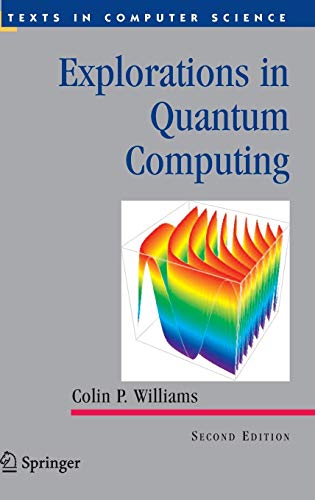
Ebook Info
- Published: 2011
- Number of pages: 739 pages
- Format: PDF
- File Size: 10.39 MB
- Authors: Colin P. Williams
Description
By the year 2020, the basic memory components of a computer will be the size of individual atoms. At such scales, the current theory of computation will become invalid. “Quantum computing” is reinventing the foundations of computer science and information theory in a way that is consistent with quantum physics – the most accurate model of reality currently known. Remarkably, this theory predicts that quantum computers can perform certain tasks breathtakingly faster than classical computers – and, better yet, can accomplish mind-boggling feats such as teleporting information, breaking supposedly “unbreakable” codes, generating true random numbers, and communicating with messages that betray the presence of eavesdropping. This widely anticipated second edition of Explorations in Quantum Computing explains these burgeoning developments in simple terms, and describes the key technological hurdles that must be overcome to make quantum computers a reality. This easy-to-read, time-tested, and comprehensive textbook provides a fresh perspective on the capabilities of quantum computers, and supplies readers with the tools necessary to make their own foray into this exciting field. Topics and features: concludes each chapter with exercises and a summary of the material covered; provides an introduction to the basic mathematical formalism of quantum computing, and the quantum effects that can be harnessed for non-classical computation; discusses the concepts of quantum gates, entangling power, quantum circuits, quantum Fourier, wavelet, and cosine transforms, and quantum universality, computability, and complexity; examines the potential applications of quantum computers in areas such as search, code-breaking, solving NP-Complete problems, quantum simulation, quantum chemistry, and mathematics; investigates the uses of quantum information, including quantum teleportation, superdense coding, quantum data compression, quantum cloning, quantum negation, and quantum cryptography; reviews the advancements made towards practical quantum computers, covering developments in quantum error correction and avoidance, and alternative models of quantum computation. This text/reference is ideal for anyone wishing to learn more about this incredible, perhaps “ultimate,” computer revolution. Dr. Colin P. Williams is Program Manager for Advanced Computing Paradigms at the NASA Jet Propulsion Laboratory, California Institute of Technology, and CEO of Xtreme Energetics, Inc. an advanced solar energy company. Dr. Williams has taught quantum computing and quantum information theory as an acting Associate Professor of Computer Science at Stanford University. He has spent over a decade inspiring and leading high technology teams and building business relationships with and Silicon Valley companies. Today his interests include terrestrial and Space-based power generation, quantum computing, cognitive computing, computational material design, visualization, artificial intelligence, evolutionary computing, and remote olfaction. He was formerly a Research Scientist at Xerox PARC and a Research Assistant to Prof. Stephen W. Hawking, Cambridge University.
User’s Reviews
Editorial Reviews: Review From the reviews of the second edition:“This book suggests that as computers decrease in scale, we should take a closer look at the relationship between the physical world in which computers live, and the theoretical aspects of what and how they compute. … This book is intended for graduate-level computer science students. … The book includes exercises at the end of each chapter. … The bibliography is extensive, demonstrating that the field has matured somewhat over time.” (William Fahle, ACM Computing Reviews, August, 2011)“It is a truly impressive object, clearly a labor of love, and I learned a great deal in reading it. … I enjoyed reading this book. … Explorations in quantum computing is a good and useful entry in the growing pedagogical literature on quantum information. It is not the most tightly focused book, but it is full-to-bursting with interesting facts and discussions. The book is well written and interesting, and experts as well as newcomers to the field will enjoy dipping into it.” (Todd A. Brun, Mathematical Reviews, February, 2013) From the Back Cover By the year 2020, the basic memory components of a computer will be the size of individual atoms. At such scales, the current theory of computation will become invalid.“Quantum computing” is reinventing the foundations of computer science and information theory in a way that is consistent with quantum physics – the most accurate model of reality currently known. Remarkably, this theory predicts that quantum computers can perform certain tasks exponentially faster than classical computers and, better yet, can accomplish “impossible” feats such as teleporting information, breaking supposedly “unbreakable” codes, generating true random numbers, and communicating with messages that betray the presence of eavesdropping.This widely anticipated second edition of Explorations in Quantum Computing explains the field from a fresh perspective, emphasizing lesser known quantum transforms, and practical applications of quantum algorithms and quantum information theory. The required mathematical machinery is developed systematically, and the students’ knowledge tested through several end-of-chapter exercises. This easy-to-read, time-tested, and comprehensive textbook provides a unique perspective on the capabilities of quantum computers, and supplies readers with the tools necessary to make their own foray into this exciting field.Topics and features:Concludes each chapter with exercises and a summary of the material coveredProvides an introduction to the mathematical formalism of quantum computing, and the quantum effects that can be harnessed to achieve unparalleled new capabilitiesDiscusses the concepts of quantum gates, entangling power, quantum circuits, quantum Fourier, wavelet, and cosine transforms, quantum universality, quantum computability, and quantum complexityExamines the potential applications of quantum computers in areas such as search, code-breaking, solving NP-Complete problems, quantum simulation, quantum chemistry, and mathematicsDescribes uses of quantum information, including quantum teleportation, superdense coding, quantum data compression, quantum cloning, quantum negation, and quantum cryptographyReviews the advancements made towards practical quantum computers covering developments in quantum error correction, quantum error avoidance, and alternative models of quantum computationThis text/reference is ideal for anyone wishing to learn more about this incredible, perhaps “ultimate,” computer revolution.Dr. Colin P. Williams is Program Manager for Advanced Computing Paradigms at the NASA Jet Propulsion Laboratory, California Institute of Technology, and formerly acting Associate Professor of Computer Science at Stanford University where he taught courses on quantum computing and quantum information theory, and computer-algebra systems. He has spent over a decade working in quantum computing, and inspiring and leading high technology teams. Today his interests include quantum computing, artificial intelligence, cognitive computing, evolutionary computing, computational material design, computer visualization, and computationally-enabled remote olfaction. He was formerly a Research Scientist at Xerox PARC and a Research Assistant to Prof. Stephen W. Hawking at Cambridge University.
Reviews from Amazon users which were colected at the time this book was published on the website:
⭐Overall this is an incredibly straight forward book. It is very clear in its descriptions of the material. I actually consider it to be better than “Mike and Ike” in terms of defining the fundamental concepts.The only issue that I have is that there are numerous typos through out the book. Sometimes, these typos will occur so frequently that it can distract from the topic at hand.
⭐thank you
⭐I’ll admit, I didn’t get past chapter 1. I’m not sure who the target audience is, but as a statistician/computer scientist I found it difficult to follow. There doesn’t seem to be any logical flow to things, and, there are large sections that I assume are supposed to motivate or give some kind of insight, but instead just distracted from whatever line of reasoning the author was trying to explore. It seemed like he was trying to make the text “informal” but it ended up as nonrigorous. For example, he carefully defines inner and outer products, which seems to assume the reader is relatively mathematically unsophisticated, then randomly starts using the term eigenstate, without defining it at all. It would be much better to take a more principled approach with a clearly defined level of sophistication for the reader in mind.But the worst part was the typos and grammar and spelling errors. By the middle of chapter 1 there were errors in every couple of sentences. I just stopped reading because I had no faith that the equations were going to be correct in the later sections, and no interest in puzzling over a confusing equation, only to realize it was confusing because of a typo.
Keywords
Free Download Explorations in Quantum Computing (Texts in Computer Science) 2nd Edition in PDF format
Explorations in Quantum Computing (Texts in Computer Science) 2nd Edition PDF Free Download
Download Explorations in Quantum Computing (Texts in Computer Science) 2nd Edition 2011 PDF Free
Explorations in Quantum Computing (Texts in Computer Science) 2nd Edition 2011 PDF Free Download
Download Explorations in Quantum Computing (Texts in Computer Science) 2nd Edition PDF
Free Download Ebook Explorations in Quantum Computing (Texts in Computer Science) 2nd Edition