Ebook Info
- Published: 2000
- Number of pages: 352 pages
- Format: PDF
- File Size: 16.30 MB
- Authors: Edwin F. Taylor
Description
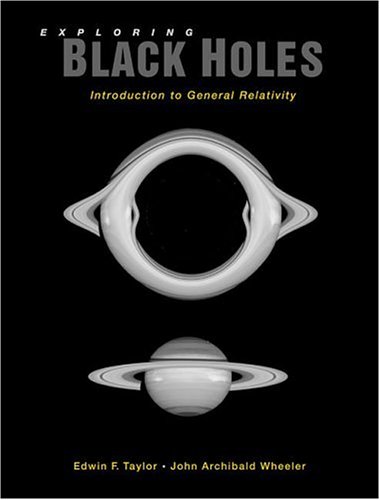
A concise, direct examination of general relativity and black holes, Exploring Black Holes provides tools that motivate tools that motivate readers to become active participants in carrying out their own investigations about curved spacetime near earth and black holes. The authors use calculus and algebra to make general relativity accessible, and use quotes from well-known personalities, including Einstein, to offer further insight.Five chapters introduce basic theory. The book also includes seven projects regarding the analysis of major applications. Discussions provide the background needed to carry out projects. The book’s projects guide readers as they fill in steps, compute outcomes and carry out their own investigations. For astronomers, mathematicians and people interested in learning about the relativity of black holes.
User’s Reviews
Editorial Reviews: Review American Journal of Physics, Vol. 69, No. 11, pp. 1212-1213, November 2001 (c)2001 American Association of Physics Teachers. All rights reserved. Most students embarking on a major in physics probably anticipate that they will have the opportunity to elect one or more semesters of study in relativity, and many students majoring in mathematics and computer science also have a strong interest in the subject. Among the introductory texts on special relativity, Taylor and Wheeler’s Spacetime Physics (SP), with its conversational tone and its emphasis on geometry, has long played an important role. However, there have been few if any books on general relativity that have managed to be both scholarly and truly introductory. Exploring Black Holes: Introduction to General Relativity (EBH) is just such a book. Through carefully chosen restrictions on coverage, the authors enable the serious study of general relativity by students who have completed a year of calculus and who are prepared for intellectual labor. The book has been years in the making; there were several self-published preliminary versions. Thomas Roman of Central Connecticut State University provided a post-use review of the 1995 version (Scouting Black Holes: Exploring General Relativity with Calculus) in this journal [63, 1053-1054 (1995)]. EBH retains the basic structure of that earlier version, but the authors have made many improvements, additions, and corrections. The process of refinement continues: I am informed that Edwin Taylor uses each new printing of the text to correct errors and polish explanations. I used EBH in a course entitled “Topics in Physics: Relativity” at James Madison University during the Fall 2000 semester; the prerequisites were one year each of physics and calculus. Fourteen students enrolled for the course, and twelve completed it (six seniors, three juniors, and three sophomores). All had encountered special relativity in the introductory physics survey, and the upper-division physics majors had also spent a couple of weeks studying special relativity in a one-semester modern physics course. EBH was one of three required texts, the other two being SP and Kip Thorne’s Black Holes and Time Warps (a narrative of the development of general relativity as witnessed by one of its foremost practitioners). Approximately half of the semester was devoted to a thorough discussion of special relativity using SP. The first few chapters of Thorne’s book werealso assigned in the first half of the semester, both to lighten the reading load during the second half and to accustom students to Einstein’s geometrical vision of gravitation. During the eight weeks devoted to general relativity, the class managed to cover all five chapters of EBH (Speeding, Curving, Plunging, Orbiting, and Seeing) and four of the seven “projects.” Students found the project on the Global Positioning System (GPS) fascinating, both because several of them had used GPS devices and because general-relativistic effects must be included in the analysis in order to for the GPS system to be accurate enough to be useful. Almost without exception, the students rated EBH as very clear and interestingly written. Their previous contact with GR (if any) was of the “gee-whiz” variety, and they took evident pride in being able to grapple with some of the intellectual challenges of the theory. The authors are careful to acknowledge the limitations of a treatment in which the mathematical apparatus is limited to a year of calculus, but the students and I were pleased at how much can be accomplished. Our experience suggests that any physics professor who is prepared to make the effort can provide a worthy undergraduate introduction to GR, with the help of Taylor and Wheeler. My only prior experience with general relativity was a two-semester sequence (based on Weinberg’s Gravitation and Cosmology) taken as a graduate student many years ago. The black and white text is replete with sample problems, well-drawn and amply captioned figures, and a good collection of end-of-chapter exercises. One idiosyncrasy that several students found annoying is that each chapter and project has its pages independently numbered. Because the chapters are identified by numbers and the projects are identified by capital letters, it is not always clear which way to turn when searching for a particular passage. Using EBH may also require an adjustment by those physics students and teachers who have come to expect that all physics texts should have a high ratio of equations to explanatory sentences. But the prose of this text is rich, sometimes whimsical, and always aimed directly at helping the reader develop an intuition for the physics that lives beneath the mathematical surface. Spacetime Physics is a jewel of an unconventional book on special relativity. With Exploring Black Holes, Taylor and Wheeler have presented the community of physics learners and teachers with another gem. VITAE William H. Ingham is Professor of Physics at James Madison University. His interests include astrophysics, computational fluid dynamics, and thehistory of science. From the Back Cover A concise, direct examination of general relativity and black holes, Exploring Black Holes provides tools that motivate tools that motivate readers to become active participants in carrying out their own investigations about curved spacetime near earth and black holes. The authors use calculus and algebra to make general relativity accessible, and use quotes from well-known personalities, including Einstein, to offer further insight. Five chapters introduce basic theory. The book also includes seven projects regarding the analysis of major applications. Discussions provide the background needed to carry out projects. The book’s projects guide readers as they fill in steps, compute outcomes and carry out their own investigations. For astronomers, mathematicians and people interested in learning about the relativity of black holes. About the Author Exploring Black Holes: An Introduction to General Relativity was written by Oersted Medal winnerEdwin Taylor and foremost relativist John Archibald Wheeler. Read more
Reviews from Amazon users which were colected at the time this book was published on the website:
⭐This book sidesteps the hard work needed to motivate and develop the Einstein field equations, and goes directly to one of the most important solutions of the equations, the Schwarzschild solution, which gives rise to the concept of a black hole. By exploring what observers in different parts of space-time would experience along their different trajectories (whether falling into a black hole or watching from a safe spot far away), Taylor and Wheeler manage to convey an intuitive understanding for such typical GR “paradoxes” such as the fact that the same “event” (the crossing over of an object through the event horizon) can be seen to take 15 minutes, or forever, depending on who’s watching it.Because of what it omits, this book is not a complete presentation of GR. It does present the most fun part of GR, however, in a way that is mathematically accessible.Along the way, a few side questions are adddressed, like “How painful would it be to be squished/torn apart as I fall into a black hole?” A lot of time is also spent explaining how the weird trajectories of light within the event horizon will transmogrify what is seen by the observer.This is a great book and a lot of fun. I am also left with a greater motivation to go back to a more complete presentation, to be convinced that “this is where you have to end up”. Although much longer, this book is a worthy successor to the original output of this dynamic duo, “Spacetime Physics”.
⭐A bit expensive, but effective
⭐I have been searching for an introductory book on general relativity suitable for an individual, of average ability, studying on his own, with a grasp of basic calculus. I was, therefore, looking for a book at the undergraduate level. I was very excited when I read some reviews of Exploring Black Holes: Introduction to General Relativity. From the reviews, it seemed to be an ideal introductory (but mathematically quantitative) book on the subject. Although the math as advertised was not daunting, limited to elementary calculus, I found that the book was conceptually very hard to follow. The book started employing an equation from special relativity that I had not seen in standard books on that subject. Moreover, contrary to standard physics, mixed units, e.g., units of length, time, mass, etc., were added indiscriminately, without any discussion of how this could be legitimate. Still, the book seemed intellectually very interesting and provocative; however, if the basic concepts are not understandable, at least to me, that does not do me any good. I understand that a new edition of the book will be coming out at the end of November, 2012. Perhaps the issues raised here, will be addressed in the new edition?
⭐Great book for an introduction to General Relativity. There is no tensor analysis, but everything is developed rigorously showing how and to what extent a curved spacetime can be approximated by a series of inertial frames. In this way, the authors are able to rigorously explain the proper motion of Mercury, the principle that governs the GPS, the Einstein Rings and more.
⭐Closing the circle initiated with Spacetime Physics. Excellent book.
⭐After I read a few pages I said to my self ” so thats what other book were saying. Very easy read.Highly recommnd the book those who want to uinderstand black holes and GR.
⭐No non-sense book with plenty of explanations and justified assumptions. One of the few books where you can actually “learn” general relativity, and make sense of it. Looking forward for the next edition. Thank you guys !
⭐This book was delivered in immaculate condition and is exactly how I was hoping it would be. Thank you for your product and i hope to do business with you again!Sincerely,Travis
Keywords
Free Download Exploring Black Holes: Introduction to General Relativity 1st Edition in PDF format
Exploring Black Holes: Introduction to General Relativity 1st Edition PDF Free Download
Download Exploring Black Holes: Introduction to General Relativity 1st Edition 2000 PDF Free
Exploring Black Holes: Introduction to General Relativity 1st Edition 2000 PDF Free Download
Download Exploring Black Holes: Introduction to General Relativity 1st Edition PDF
Free Download Ebook Exploring Black Holes: Introduction to General Relativity 1st Edition