

Ebook Info
- Published: 2013
- Number of pages: 904 pages
- Format: PDF
- File Size: 40.87 MB
- Authors: Victor Galitski
Description
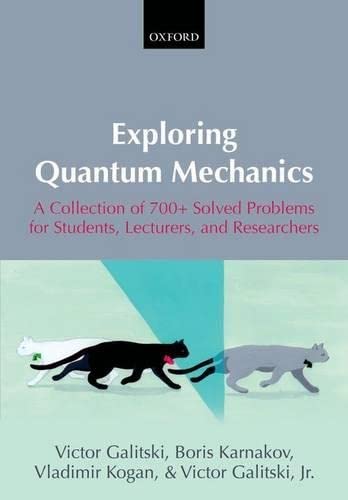
A series of seminal technological revolutions has led to a new generation of electronic devices miniaturized to such tiny scales where the strange laws of quantum physics come into play. There is no doubt that, unlike scientists and engineers of the past, technology leaders of the future will have to rely on quantum mechanics in their everyday work. This makes teaching and learning the subject of paramount importance for further progress. Mastering quantum physics is a very non-trivial task and its deep understanding can only be achieved through working out real-life problems and examples. It is notoriously difficult to come up with new quantum-mechanical problems that would be solvable with a pencil and paper, and within a finite amount of time. This book remarkably presents some 700+ original problems in quantum mechanics together with detailed solutions covering nearly 1000 pages on all aspects of quantum science. The material is largely new to the English-speaking audience. The problems have been collected over about 60 years, first by the lead author, the late Prof. Victor Galitski, Sr. Over the years, new problems were added and the material polished by Prof. Boris Karnakov. Finally, Prof. Victor Galitski, Jr., has extended the material with new problems particularly relevant to modern science.
User’s Reviews
Editorial Reviews: Review “Finally, the reader receives the English translation of this magnificent book, arguably, the best collection of working problems in Quantum Mechanics. My congratulations are going to thousands of students and working physicists who will definitely find here the material for exercises as well as an inspiration in original research.” – David Khmelnitskii, Cavendish Laboratory, Cambridge “Most physicists and physics students will affirm that they learned the subject by working the problems. Here is a treasure trove of quantum problems and solutions-a splendid resource for teachers trying to expand the repertoire of their problem sets and for students of all ages trying to deepen their understanding of the heart of modern physics.” – William D. Phillips, NIST, Nobel Laureate Physics 1997 “This is a must-have book for anybody who wants to gain working knowledge of quantum mechanics. It gives both fundamental physical understanding and concrete knowledge of specific technical methods and approaches.” – Eugene Demler, Harvard University “A treasure-trove of insightful problems and solutions, Exploring Quantum Mechanics provides a unique and rare perspective on quantum physics. Spanning a broad range of subfields, it is a testament to the mastery of the original authors, Galitski Sr. et al., and the translator, Galitski Jr. Students and specialists of quantum mechanics in the English speaking science world will greatly benefit from this invaluable collection.” – Gil Refael, CalTech “This collection of problems in quantum physics, probably the largest of its kind in the world, gives the reader the unique possibility to learn to feel at home in the world of quantum mechanics. It includes more than seven hundred problems of various difficulty accompanied by detailed solutions, ranging from elementary single-particle quantum mechanics in one dimension to relativistic field theory and advanced aspects of nuclear physics.” – Andrey Varlamov, Italian National Research Council “[A] gem of old-world craftsmanship, well-worth a place alongside the other classic texts of quantum mechanics in any physicist’s library.” –Physics Today About the Author Victor Galitski, Sr, (1924 – 1981) in the course of his 30-year long research career in theoretical physics, co-authored 77 papers in an amazing variety of fields of both nuclear physics and condensed matter physics. His famous results include the derivation of what now is called the Galitski-Feynman equations, the first theory of unconventional superconductivity, and the development of diagrammatic calculation methods in condensed matter physics. From 1961 until his death in 1981, Victor Galitski, Sr, was the head of the Theoretical Physics Department at the Moscow Engineering Physics Institute. From 1972 to 1981 he also was the director of the Nuclear Physics Department at the Kurchatov Institute for Atomic Energy in Moscow.Dr. Boris Karnakov is a Professor Emeritus at the Moscow Engineering Physics Institute. His research interests include nuclear physics, where he has more than 50 publications.Dr. Vladimir Kogan is a Professor Emeritus at the Moscow Engineering Physics Institute. His interests are primarily physics education and quantum mechanics. He was the co-author of the first edition of a much shorter problems and solutions book published jointly with Victor Galitski, Sr, in 1956.Dr. Victor Galitski, Jr, is a grandson of the first author of the book. His research interests include various aspects of theoretical condensed matter physics and cold atoms, with the focus on superconductivity, topological phases of matter, and spin transport. Galitski, Jr, is currently an Associate Professor of Physics at the University of Maryland, College Park. He is a Fellow of the Joint Quantum Institute and a member of the Center of Nanophysics and Advanced Materials there. He is a recipient of the NSF CAREER award.
Reviews from Amazon users which were colected at the time this book was published on the website:
⭐There are a number of older (now classic) quantum problem volumes, some available as Dover reprints very inexpensively. But none can even begin to compare to the currency and relevance of this fine collection. At nearly 900 pages, there really is NO relevant problem in QM that’s not touched on here.This volume will appeal to:– Job seekers expecting at least solution structure interview questions, which are very common today. No other book will bring you up to speed as quickly as this volume.– Students, researchers, physicists, professors, teachers, engineers… many others.– Science buffs who have autodidactically studied QM and are ready for the next step.The foundation math in almost all of QM relies on Hermitian linear operators acting in Hilbert space on state vectors or wave functions. This wonderful volume begins with those operators, then offers numerous, detailed problems and solutions in specifically applied areas including motion, momentum, spin, spectrum states, wave packets, magnetic fields, adiabatics, potential barriers and probabilities, wavefunction stats, atomic and molecular models, collisions, radiation and scattering, Dirac, Klein-Gordon, photon emission, and much more.Eg: “Find the ground term of an H ion by variational method, calculate the minimum energy, and then compare them to (given or observed) experimental values x/y/z. Using your results, is it possible to make any conclusions about the stability of the ion?”As you can see, the problems aren’t just integral jockeying, each one seeks to test deep insights into the nature of what solutions can and can’t do within their own bounds. This is wonderful both didactically and for interviews, which tend to probe not just solving skills, but knowledge about why you’re doing what you are, and it’s value and limits.I’m a mathematician and physicist who evaluates new technologies at payroy dot com to determine IP boundaries, and due to nano technology and miniaturization (we often see atom sized transistor proposals and postage size processors with a billion transistors in the design), QM is assuming more and more of a central role. Like our cousins over in biotech, who have to explain why no “side effects” were designed into biologicals, we often find that educating USPTO and the Federal Circuit ALJ is as important as having clearly defined prior art!This volume is highly recommended. The solutions are far from just: here’s the answer. They give many deep nuances that even the most experienced QM researcher will enjoy, including many practical applications and examples (in of course both prospective and current fields like quantum computing and diode displays). No one can really keep up with this whole field today to be very honest, and this volume does a great job of both breadth and depth, as a reference, review, and extremely utilitarian learning tool. I found NO issues with Russian translation, symbology, etc.– Oxford did a great job of editing. I can’t speak yet of accuracy vs. errors as we’ve only checked about 100 of the problems, which were flawless, but since they go back 60 years then forward to 2011, there is bound to be a variety of accuracy levels or newer methods. Will update this as we use daily.Library Picks reviews only for the benefit of Amazon shoppers and has nothing to do with Amazon, the authors, manufacturers or publishers of the items we review. We always buy the items we review for the sake of objectivity, and although we search for gems, are not shy about trashing an item if it’s a waste of time or money for Amazon shoppers. If the reviewer identifies herself, her job or her field, it is only as a point of reference to help you gauge the background and any biases.
⭐This is an extraordinary book. It covers a wide range of topics in quantum mechanics with reasonable depth for any student exposed to the subject at a graduate level in physics. Each chapter is started with a brief summary highlighting key issues to be considered in problems that follow and their solutions. Problems are solved with reasonable detail, leaving to the reader intermediate steps. An aspect which I notice most valuable are actual numerical estimates prior, during, or at the end of the solutions. Quantum mechanics is not mere linear algebra or differential equations with given boundary conditions. Therefore, any physical model needs to be placed in context in order to gauge its merits and limits, a consideration which is well achieved by Galitski et al. I would not only recommend this book to students, but colleagues as well.
⭐Everything OK !
⭐Good source to review QM
⭐Not clearly written.
⭐This is a challenge. At 83, I’m trying to understand lots of the QM which I couldn’t as a mature university student 20 years ago. This will do the trick, provided I don’t pop off first. At first glance, it seems to be a very comprehensive, detailed treatment of the classic and not so classic topics – which even most young, vigorous students will find challenging. Nevertheless, a great buy
⭐I really enjoyed the Corsera course and so I have bought the book to learn more by looking at the examples and questions
⭐good value, quick service
⭐It was not at all what I expected .It is my mistake to not research it enough.This manual is good for University Students ONLY.
⭐Perhaps the best problem book on the subject. As a physicist, I think these and the problems in the Cohen-Tannoudji/Lalöe/Diu books are the most enlightening for the Quantun Mechanics student. A dear memory to my QM teachers, R. Guardiola and M. Santander.
Keywords
Free Download Exploring Quantum Mechanics: A Collection of 700+ Solved Problems for Students, Lecturers, and Researchers in PDF format
Exploring Quantum Mechanics: A Collection of 700+ Solved Problems for Students, Lecturers, and Researchers PDF Free Download
Download Exploring Quantum Mechanics: A Collection of 700+ Solved Problems for Students, Lecturers, and Researchers 2013 PDF Free
Exploring Quantum Mechanics: A Collection of 700+ Solved Problems for Students, Lecturers, and Researchers 2013 PDF Free Download
Download Exploring Quantum Mechanics: A Collection of 700+ Solved Problems for Students, Lecturers, and Researchers PDF
Free Download Ebook Exploring Quantum Mechanics: A Collection of 700+ Solved Problems for Students, Lecturers, and Researchers