Ebook Info
- Published: 2012
- Number of pages: 174 pages
- Format: PDF
- File Size: 10.99 MB
- Authors: Gregory J. Chaitin
Description
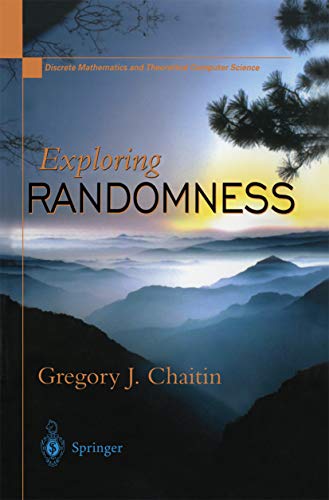
This essential companion to Chaitin’s successful books The Unknowable and The Limits of Mathematics, presents the technical core of his theory of program-size complexity. The two previous volumes are more concerned with applications to meta-mathematics. LISP is used to present the key algorithms and to enable computer users to interact with the authors proofs and discover for themselves how they work. The LISP code for this book is available at the author’s Web site together with a Java applet LISP interpreter. “No one has looked deeper and farther into the abyss of randomness and its role in mathematics than Greg Chaitin. This book tells you everything hes seen. Don miss it.” John Casti, Santa Fe Institute, Author of Goedel: A Life of Logic.’
User’s Reviews
Reviews from Amazon users which were colected at the time this book was published on the website:
⭐This admirably slender volume deserves to be much more widely appreciated by computer scientists than it appears to be. Dr. Chaitin explains the program in a single sentence in his preface—algorithmic information theory is constructive measure theory—then proves his point in a dialect of Lisp he designed for the purpose in the rest of the book. I disagree with Dr. Chaitin’s belief that Dr. Kolmogorov erred in thinking their results applied primarily to probability, but that’s really neither here nor there apart from suggesting a willingness to read the implications for probability where Dr. Chaitin is perhaps less explicit about them than I’d prefer may be helpful. In particular, this work single-bookedly connects the dots in Dr. Jaynes’ wonderful “Probability Theory: The Logic of Science,” in which the author rails against measure theory and infinite-set paradoxing and waxes rhapsodic about constructivism. My bet is one dinner over a good Argentine steak, with wine, would have resulted in Drs. Jaynes and Chaitin becoming friends and vital collaborators.That leads me to a final observation: this work benefits tremendously from Dr. Chaitin’s unabashed passion, which he goes so far as to liken to demonic possession (carefully pointing out you should hope to be possessed by a GOOD demon). It’s another quality Dr. Jaynes shared, and that is sorely lacking in most rigorous mathematical writing, with the inevitable stultifying effect.This book belongs on the shelf of everyone who has ever wondered why mathematics is as it is, who has wondered what “random” really means, who has thought about what learning (especially machine learning!) could possibly mean, and who has an experimental bent to go with their theorizing. Grab both it and Jaynes, pour yourself that glass of wine, and dig in!
⭐Hello, I’m Gregory Chaitin and I’m the author ofExploring RANDOMNESS, which is my attempt to explainthe technical heart of my theory of algorithmicinformation as understandably as possible. To makemy theory more concrete, I’ve converted it into atheory of the size in bits of real computer programs,programs that you can actually run. See also mynew book, “Conversations with a Mathematician: Math,Art, Science and the Limits of Reason”, which is acollection of my most wide-ranging and non-technicallectures and interviews.—Gregory Chaitin, IBM ResearchDivision
⭐The treatment of LISP and randomness is interesting.But it is deplorable the propagation of his inacceptablemesure of the complexity of a sequence as the size in bitsof the minimum program that reproduces it.According to that, the complexity of the sequence of apolynomial of 10th degree is greater than the complexityof the sequence of prime numbers.The list of the coeficients of the polynomial needs more bitsthat the whole program for prime numbers.Ludovicus
Keywords
Free Download Exploring RANDOMNESS (Discrete Mathematics and Theoretical Computer Science) in PDF format
Exploring RANDOMNESS (Discrete Mathematics and Theoretical Computer Science) PDF Free Download
Download Exploring RANDOMNESS (Discrete Mathematics and Theoretical Computer Science) 2012 PDF Free
Exploring RANDOMNESS (Discrete Mathematics and Theoretical Computer Science) 2012 PDF Free Download
Download Exploring RANDOMNESS (Discrete Mathematics and Theoretical Computer Science) PDF
Free Download Ebook Exploring RANDOMNESS (Discrete Mathematics and Theoretical Computer Science)