Ebook Info
- Published:
- Number of pages:
- Format: PDF
- File Size: 12.90 MB
- Authors: Gilles Deleuze
Description
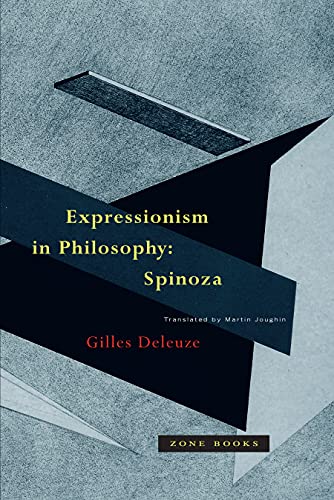
In this remarkable work, Gilles Deleuze, the renowned French philosopher, reflects on one of the thinkers of the past who most influenced his own sweeping reconfiguration of the tasks of philosophy. For Deleuze, Spinoza, along with Nietzsche and Lucretius, conceived of philosophy as an enterprise of liberation and radical demystification. He locates in Spinoza “a set of affects, a kinetic determination, an impulse” and makes Spinoza into “an encounter, a passion.”Expressionism in Philosophy was the culmination of a series of monographic studies by Deleuze (on Hume, Bergson, Nietzsche, Proust, Kant, and Sacher-Masoch) and prepared the transition from these abstract treatments of historical schemes of experience to the nomadology of Capitalism and Schizophrenia (Anti-Oedipus and A Thousand Plateaus, co-authored with Félix Guattari). Thus, Expressionism in Philosophy is both a pivotal reading of Spinoza’s work and a crucial text within the development of Deleuze’s thought.
User’s Reviews
Reviews from Amazon users which were colected at the time this book was published on the website:
⭐Though this book dates from the less well-known “academic” phase of Deleuze’s career, and thus completely lacks the stylistic exuberance of his later works, you can immediately see how it pre-figures many of the concepts he was to create with Guattari. It is interesting, then, both from the perspective of studying Deleuze, as well as for its clear, almost dry, presentation of Spinoza’s philosophy. In fact, the book can serve as a bridge between these philosophers irrespective of which of the two names drew you to the title: a Spinoza for the Deleuzians, and a Deleuze that even a Spinozist could love, the two tied together by a shared conception of pure immanence.The plan of the book is based around the structure of the Ethics and outlines all the main points of Spinoza’s masterpiece, starting with Substance and ending in Beatitude. Special care is taken to situate Spinoza with respect to his historical context, particularly next to the philosophies of Descartes and Leibniz. To this end, Deleuze develops his thesis that it is a shared philosophy of “expression” that, despite their differences, unites Leibniz and Spinoza in founding a post-cartesian philosophy. For readers of A Thousand Plateaus, the idea that Nature is expressive will come as no surprise, but seeing this in light of Spinoza adds a valuable depth to it.
⭐An excellent monograph by the great metaphysician, Deleuze. This elaborate text attempts to demonstrate the expressivity of Spinoza’s theory of immanence. Deleuze argues that the attributes of God express the essence of substance in its necessity and infinity. There is remarkable explication of finite modes in this text-Deleuze indicates that a mode’s essence is a determinate degree of intensity, an “irreducible degree of power.” I found this description helpful as the transition from infinite substance to finite modes has always been ambiguous for me. There is also some remarkable work on scholastic philosophy in this work-Deleuze incorporates some insightful comparisons with Scotus’ theology in the section on numerical and real distinction. Perhaps most importantly, Deleuze is able to synthesize expressivity in Spinoza with Leibniz and to show how these two figures successfully launched an anti-Cartesian movement. Although this text has been criticized for allowing too much conceptual work to take place at the level of attribution, I found it to be a remarkably precise exegesis.
⭐Spinoza was at a tipping point in the intellectual history of European thought. Every effort to define how to think was like a horse of a different color walking into a bar that does not serve strings. The only attributes of our mental accomplishments that can be fully comprehended are a frayed knot. Gilles Deleuze observed the step by step process of propositions in Spinoza’s Ethics to determine separate stages of thought that put anything numerical in an infinite range of changing variables that can’t have the univocity of a single ethic. It takes four lines in the index to list pages in which univocity is a key concept for what is being described as an expression of the essence of a substance that lacks numerical qualities.The big tipping point of a society that tries to count in ways that become meaningless for flashy bang gravy train bomb worship is called:the moral pseudo-lawis simply the measureof our misunderstandingof natural laws;the idea of rewardsand punishmentsreflects only ourignorance of the truerelationship betweenan act and its consequences;Good and Evil areinadequate ideas,and we form conceptions of themonly to the extent thatour ideas are inadequate. (pp. 253-254).
⭐This is very strange intersection of popular media (and its evaluative mechanisms) and somewhat esoteric philosophy. I mean, really, who buys Expressionism in Philosophy on the basis of an Amazon review? I guess all I can contribute is that, for those with disposable incomes and a desire to familiarise themselves with Deleuze, Nietzsche in Philosophy is a much better starting point. You can then work chronologically, through Bergson etc. up to Spinoza, or perhaps buy the shorter Practical Philosophy as a reference point to aid in the reading of Expressionism. The Spinoza books are certainly indispensible for reading the D/Guattari collaborative works. This is the first paper back edition, as far as I’m aware.
⭐It is not without reason that Deleuze called Spinoza the “prince of the philosophers”. The reason can be discerned from the very pages of this book. The importance of this work cannot be underestimated.Of profound significance is the idea that Being is explicative and does not become less in each of its expression. This affirms the sense of beings and gives voice to the power and beauty of “life”.Spinoza’s/ Deleuze’s philosophy is against everything that is life-negative, instead, it is life-affirmative and celebrates joy as a powerful and adequate response to the life that we are given.A reading of Hegel’s critique and Nietzsche’s Zarathustra would be sufficient as background to this complex but powerful and rewarding text. If I may suggest a further reading: Badiou’s “Clamour of Being” adds new dimensions to Deleuze’s thinking.
⭐Deleuze’s interpretation of Spinoza’s Ethics is lively and original; his description of the problem of attributes and modes as numerically distinct from substance but not ontologically so is helpful in understanding Spinoza’s metaphysics. His discussion of power, as “pouvoir” and “puissance” and their relationship to active affections, is also fascinating for what it suggests about the possibility of a rational community. A must read for Spinoza students and those interested in the history of philosophy.
⭐The first part is the least interesting, yet vital, the syllogisms described by the geometric method, are the basis for the more interesting second and third parts. Spinoza suggests that what is virtual in mathematics, is real in relation to things. The second part is a description of key issues in scientific methodology, and refers to earlier developments in Aristotle and neoplatonism. Spinoza’s ‘machine’ resembles the design specification for a database management system, the predicate logic comprising flows, parallelisms, pathways and circulations. Spinoza’s thought points to the possible conditions of science in the scholasticism of the middle ages. His scepticism towards signs, rejects romantic philology, as did Max Muller, presaging the emergence of linguistics in the mid-C19th. Similarly, conceptions of the finite and infinite, lead to transfinite numbers and set theory, central to the emergence of computer technology, in the C20th. The view of organic and continuous flows, is echoed in contemporary philosophy. In the third part, Spinoza describes the formation of adequate ideas, as an alternative to confused passions. Form, feeling, perception, concept, action; the transmutation of passive into active, is the sensory-motor schema described by Deleuze in ‘Cinema’. The book concludes suggesting that the triangulation of mind, body and world, within Leibniz and Spinoza overcomes the Cartesian duality, to produce a science and awareness beyond reductionism. Whereas Leibniz retains traces of an ideological cosmology, Spinoza emphasizes choice; internal specificity replaces external generality, an orientation vital to biological and human sciences in the modern era. A lovely book, well worth reading.
Keywords
Free Download Expressionism in Philosophy: Spinoza (Zone Books) in PDF format
Expressionism in Philosophy: Spinoza (Zone Books) PDF Free Download
Download Expressionism in Philosophy: Spinoza (Zone Books) PDF Free
Expressionism in Philosophy: Spinoza (Zone Books) PDF Free Download
Download Expressionism in Philosophy: Spinoza (Zone Books) PDF
Free Download Ebook Expressionism in Philosophy: Spinoza (Zone Books)