

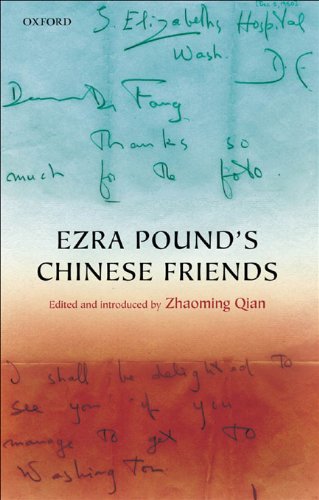
Ebook Info
- Published: 2008
- Number of pages: 269 pages
- Format: PDF
- File Size: 3.92 MB
- Authors: Zhaoming Qian
Description
No literary figure of the past century – in America or perhaps in any other Western country – is comparable to Ezra Pound in the scope and depth of his exchange with China. To this day, scholars and students still find it puzzling that this influential poet spent a lifetime incorporating Chinese language, literature, history, and philosophy into Anglo-American modernism. How well did Pound know Chinese? Was he guided exclusively by eighteenth to nineteenth-centuryorientalists in his various Chinese projects? Did he seek guidance from Chinese peers? Those who have written about Pound and China have failed to address this fundamental question. No one could do so just a few years ago when the letters Pound wrote to his Chinese friends were sealed or had not beenfound. This book brings together 162 revealing letters between Pound and nine Chinese intellectuals, eighty-five of them newly opened up and none previously printed. Accompanied by editorial introductions and notes, these selected letters make available for the first time the forgotten stories of Pound and his Chinese friends. They illuminate a dimension in Pound’s career that has been neglected: his dynamic interaction with people from China over a span of forty-five years from 1914 until1959. This selection will also be a documentary record of a leading modernist’s unparalleled efforts to pursue what he saw as the best of China, including both his stumbles and his triumphs.
User’s Reviews
Reviews from Amazon users which were colected at the time this book was published on the website:
⭐This well-compiled and edited book is a collection of correspondence between Ezra Pound and several other people, all Chinese “ethnic”. Achilles Fang, born in Korea to Chinese ethnic parents, especially stands out. He is remarkable both for his erudition and good temper, both requirements for dealing with the reactive and manifestly neurotic Pound, pointlessly confined, a genuine “political prisoner”, in a hospital for the criminally insane in Washington DC. Unfortunately, the Fang/Pound correspondence seemed to me to demonstrate two things:1) Pound’s knowledge of Chinese was that of an amateur (In fact, he seemed to be as interested in the history of dictionaries and the history of the “radical” system (i.e. determinative components of the Chinese characters) as he was in matter of genuine philology.) and,2) Pound was unable, by this time, to think rationally about anything.A large part of the correspondence, especially that between Fang and Pound, relates to the production of the Pound Confucious. Readers who follow this dialogue will pick up much useful information about Chinese philology and the ideas of Confucious, all of it from Fang, none of it from Pound. There is no evidence in the correspondence that Pound listened much to the younger and better-educated man or heeded anything he said. It’s a wonder that the book ever got assembled and published, whatever it may be worth.There are minor elements in the book, literary or sociological gossip one might say. Such as Anti-Semitism. This was evinced more by one of Pound’s young correspondents (not Achilles Fang) than by Pound himself. Imagine having to put up with a Jewish room-mate while attending an Ivy League school and corresponding with the famous poet who shouted over the airwaves that Hitler had dealt properly with the Jews of Europe and that the Jews of America would get theirs next! Well, that was in the past, by this time. But the tyke knew his master, he thought.Pound has remained, for some reason, a live wire in the academic world. That is a world with which I’ve retained only occasional and tangential contact, though I continue to love different and older cultures, and especially their literature. To some degree, this love of “multiculturalism” is something I owe to Ezra Pound. I’d like to believe that there are still genuine fans of the early Pound, even though I have come to agree, with George Orwell (see his statement on the Bollingen Prize awarded to Pound) that Pound was entirely spurious as a poet. But there was something about him that appealed to those of us stuck in the provincial (mine was only about 75 miles from Yoknapatawpha, to which I would move on, in time), and I must thank the man for freeing me from the merely Anglo-American.***A note: admirers of Pound’s Chinese translations/imitations might want to consult:”Ezra Pound’s Confucian translations”, by Mary Paterson Cheadle. (Ann Arbor : U of Mich Press, c1997). This excellent work covers Pound’s re-working of the Confucius corpus as such, the redaction of the Classic Anthology attributed to Confucius, and the influence of Pound’s “Confucianism” in the Cantos. This is, to my mind, a vital contribution to an understanding of Pound’s work. By the way, in her chapter “Translating Chinese”, Ms. Cheadle makes it clear that, for all of Pound’s preoccupation with the Chinese ideogram and Chinese dictionaries, his grasp of the language was limited and that he remained dependent on cribs (she mentions Legge and Karlgren) throughout the process. In Ms. Cheadle’s view, Pound’s result is philosophically and belletristically valuable.Unfortunately, this valuable book is out of print. ****** A further note (of January 12th 2015) : A.D. Moody’s work on Ezra Pound is now up into a second volume, covering the period into the Thirties. This is a detailed, even exhaustive work that doesn’t cover up Pound’s Anti-Semitism and general zaniness on matters outside Dichtumg An Sich. I hope that the author does in fact reach the epoch under consideration in the book reviewed here.
⭐Patrick Mahon’s review seems entirely fair and accurate to me, another non-academic reader with no Chinese but for many years a reader of Ezra Pound. The book is currently on offer for less than a pound + post, a bargain to snap up while it lasts.
Keywords
Free Download Ezra Pound’s Chinese Friends: Stories in Letters 1st Edition in PDF format
Ezra Pound’s Chinese Friends: Stories in Letters 1st Edition PDF Free Download
Download Ezra Pound’s Chinese Friends: Stories in Letters 1st Edition 2008 PDF Free
Ezra Pound’s Chinese Friends: Stories in Letters 1st Edition 2008 PDF Free Download
Download Ezra Pound’s Chinese Friends: Stories in Letters 1st Edition PDF
Free Download Ebook Ezra Pound’s Chinese Friends: Stories in Letters 1st Edition