

Ebook Info
- Published: 2008
- Number of pages: 411 pages
- Format: PDF
- File Size: 2.33 MB
- Authors: Arieh Ben-naim
Description
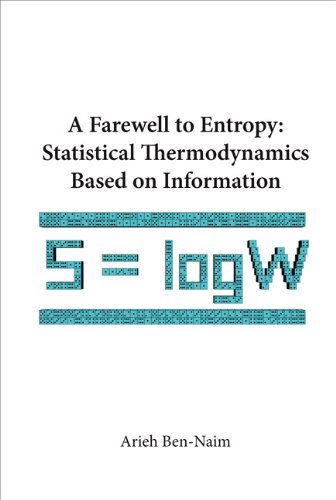
The principal message of this book is that thermodynamics and statistical mechanics will benefit from replacing the unfortunate, misleading and mysterious term “entropy” with a more familiar, meaningful and appropriate term such as information, missing information or uncertainty. This replacement would facilitate the interpretation of the “driving force” of many processes in terms of informational changes and dispel the mystery that has always enshrouded entropy.It has been 140 years since Clausius coined the term “entropy”; almost 50 years since Shannon developed the mathematical theory of “information” — subsequently renamed “entropy”. In this book, the author advocates replacing “entropy” by “information”, a term that has become widely used in many branches of science.The author also takes a new and bold approach to thermodynamics and statistical mechanics. Information is used not only as a tool for predicting distributions but as the fundamental cornerstone concept of thermodynamics, held until now by the term “entropy”.The topics covered include the fundamentals of probability and information theory; the general concept of information as well as the particular concept of information as applied in thermodynamics; the re-derivation of the Sackur-Tetrode equation for the entropy of an ideal gas from purely informational arguments; the fundamental formalism of statistical mechanics; and many examples of simple processes the “driving force” for which is analyzed in terms of information.
User’s Reviews
Reviews from Amazon users which were colected at the time this book was published on the website:
⭐”A Farewell to Entropy: Statistical Thermodynamics Based on Information” by Arieh Ben-Naim is really a great book. One can consider it a more technical and detailed version of the wonderful little book by the same author, “Entropy Demystified”. Although the concept of entropy has been around for almost 150 years, it still remains elusive and controversial. This can be easily seen by the large number of scientific articles, books, and scientific meetings that are currently dedicated to the foundations of the subject. The interpretation of entropy of a system as missing information about the system has been around for a long time, since the works by Brillouin and Jaynes in the 1950’s. However, it has been dismissed by many scientists as a subjective interpretation, although, as it is wonderfully explained by Ben-Naim, these same scientists sponsored even more subjective interpretations, such as a measure of the disorder of the system. The book by Ben-Naim provides a solid and lucid explanation of missing information as a very precise and objective concept. The connection between missing information and thermodynamic entropy is also very clearly explained. The book also contains several examples that are very illuminating. I think the book should be read by anyone interested in statistical physics and physics of complex systems.
⭐I’ve been trying to understand the concept of entropy ever since my first course in thermodynamics in the early 1960s. Tying it into the Shannon information concept and pointing out that temperature should have been defined to have the units of energy is a huge step in the right direction. I’m also now convinced that the Bayesian statistical concept that probability is a measure of the lack of subjective knowledge about the world is fundamental.
⭐The author is gifted in his ability to explain difficult concepts. I have done quite some readings on thermodynamics, thermal physics and statistical mechanics. No other books can make the concept of “entropy” so crystal clear to me. The clarity of the derivation of the Sackur-Tetrode equation in the book is also impressive.
⭐Ben-Naim really hits the nail on the head. This is an excellent book that makes clearer than any other the connection between information theoretic entropy and thermodynamic entropy. The derivation of the Sakur-Tetrode equation is terrific. His whole set of books are very useful.
⭐Such a fascinating topic. And the author has a real passion for explaining some challenging and deep topics.
⭐I read this book with great joy. I think an important contribution to the understanding of entropy as information loss. highly recommended
⭐In the Preface, the author states that there are many good books on statistical thermodynamics, and that this is not a textbook on this subject. However, though few other books exist that make use of the concept of “information” in statistical thermodynamics, this seems to be the first one that bases the full construction of the theory upon the information. For this reason, the approach by Arieh Ben-Naim is really modern and deserves a careful reading.Personally, I don’t think that this book can not be used as a textbook. Indeed, it is quite self consistent and builds step by step the core of the theory in such a way that any student is able to follow all arguments. Actually, it is true that it does not contain everything, but what is the textbook that really contains everything? May be, the only unpleasant thing for a student is the non negligible amount of time spent commenting the differences with other well known references, in particular the explanations of the probable reasons why Gibbs did not reach the very same results. But comments like these would be a valuable resource for teachers, on the other hand.If I had to choose one thing in this book, I would recommend to enjoy the derivation of the Sackur-Tetrode equation (chapter 4): it is really beautiful and does not have the “shadows” that classical derivations suffer. For the very first time, I should say, I think I have understood it, thanks to this book.However, the most important point of the whole book, the real starting point of the full construction, is the following. Shannon’s measure H of the missing information (MI) is a more general concept than the entropy S, that is a thermodynamic quantity defined _only_ for equilibrium states: H can be defined for _any_ probability distribution and it comes out that H=S for the equilibrium state. Hence, though in thermodynamics, only changes of S between different equilibrium states are defined, one can make use of the properties of H to perform derivations in a more general context. The results, when applied to thermodynamic equilibrium states, will be also valid for the entropy S.As the author explained in his introductory book
⭐, the fact that S can only increase is an experimental observation, whose explanation is provided by a framework in which matter is discrete and composed by intrinsically indistinguishable particles, with the postulate of equally probable microscopic states and the postulate that the system will be found more often in macroscopic (or “dim”) states with higher probability (the latter being the sum of the probabilities of all practically indistinguishable microscopic states, under the assumption that they are all independent).What it is known as “thermodynamic equilibrium state” is really a set of “dim states” (or “macro-states”, following Gibbs) for which the measurable quantities (that are inherently macroscopic) differ only by negligible amounts, so that they are practically (though not in principle) indistinguishable. In turn, these dim states are (in principle) different because they contain all “micro-states” (or “specific states”, for Ben-Naim) that features the very same values of the observable quantities. In the assumption that all microscopic states are equally probable (dating back to Boltzmann and fully used by Gibbs), it turns out that the macro-states containing more micro-states are more probable, so that the system will spend more time on them. The family of macro-states around the macro-state with the maximum number of micro-states is what it is called thermodynamic equilibrium state.The entropy S is defined _only_ for this set of macro-states, that is for the equilibrium state. However, the Shannon’s (missing) information theory is defined for _each_ individual macro-state. That is why H is more general than S. By following these arguments, the full theory of statistical thermodynamics can be built, as you will find in the book by Arieh Ben-Naim.
⭐I studied thermodynamics at university some 50 years ago.I really struggled with thermodynamics and in particular entropy. I’ve never got a good grasp on what it means or how it relates to anything else. When people started talking about thermodynamics in relation to black holes and ‘information loss’, that completely stumped me. I had to find out what this all meant.Now I know.The central thrust of this book is the fact that Entropy ‘grew up’ in the context of heat engines at a time when people did not understand that gasses are collections of fast-moving particles and that temperature is nothing more than (a measure of) the average energy of those particles. Entropy, being defined as energy/temperature is mixing units in a ridiculous fashion. As if we were to measure area by combining millimeters along one side of a rectangle and miles along the other – there’s no surprise it’s a confused mess.Anyway, this book sets it straight. It lays the groundwork for understanding the degree of uncertainty in statistical collections of particles, quantifying that and extending it to the case of continuous media (such as classical gasses or empty space-time). Entropy, as a dimensionless number similar to probability becomes a useful concept that’s easy to apply to a variety of situations whether ‘heat’ is involved or not.
⭐This text, while not intended as a textbook for lecturing in a university course, nevertheless has many aspects to it which would make the book a good teaching tool as well as excellent “extra reading” listed in many course outlines.It is intended to highlight the weaknesses of current approaches to statistical mechanics/thermodynamics. It approaches the subject not from the position of the second law and entropy as usually taught in such courses but rather from the more general position of Shannon Information which allows the objective study of information (without precisely defining it). This is constructed either for discrete or continuous probabilistic processes such as twenty question games which emphasise the usefulness of this approach.The author starts with probability, outlining the basic concepts required to understand its use in Information Theory as developed by Shannon. This includes the concepts of sample space, the field of events as well as conditional probability, relative frequencies, Bayes theorem, random variables and probability distributions. These ideas provide the basis for a study of Shannon’s information theory, especially the so-called H function and the concept of missing information (MI). This last concept plays a vital role in the ability to express the entropy in terms of such missing information meaning the number of questions one needs to ask in order to, for example, locate a given particle.In the following chapters he uses this approach to study the standard spontaneous processes explained in the usual statistical mechanics courses although from the more general viewpoint of MI which does not require a state of equilibrium in order to be useful. These include: expansion of an ideal gas, the mixing process, assimilation and deassimilation.An excellent book for university students trying to understand entropy and the second law of thermodynamics through the use of Shannon’s information theory. In some sense the other two booklets by the same author: “Entropy Demystified” and “Discover Entropy and the Second Law of Thermodynamics” are extra reading as supplements to this text in order to simplify the ideas as much as possible for the lay reader.It is remarkable how difficult these concepts can be to understand and how subtle some of the underlying main ideas are. This book does much to remove some of the more inaccurate expressions found in some textbooks including some university texts. For example, it delimits the use of the idea of “disorder” to understand the physical basis of entropy and the second law. It also puts paid to the use of the famous “splattered eggs don’t unsplatter” or the “teenagers messy bedroom” phrases so often used even by scientists who should know better.I highly recommend this book for its clarity and timely publication.
⭐アリーベン-ナイム自身の著作で非常に良く引用されている本で、かつ図書館になかったので買いました。必要部の前後数ページしか読んでないので評価すべきか悩みましたが、(たぶん)とても良い本です。少なくとも数学的に突っ込むべき点は見つかりませんでした。ちゃんと読む日が来ればまたしっかりレビューします。────────────[追記:2021年9月]ちょっとちゃんと覚えてないですが、学生生活の終盤は数理統計物理系の話題は結局日本人が最強だなって個人的には思ったりしてた気がします。田崎は系の示量性の特徴づけからエントロピーが本質的に唯一の物理量だと示したはずで、だとするとエントロピーの話題では直接的にこの研究より重大。熱統計やるならガチで日本人のTwitterで有名な人の本と論文読むが強い。ぶっちゃけこれはマジなんよ。なんでなんかわからんけど。
⭐Not found.
Keywords
Free Download Farewell To Entropy, A: Statistical Thermodynamics Based On Information in PDF format
Farewell To Entropy, A: Statistical Thermodynamics Based On Information PDF Free Download
Download Farewell To Entropy, A: Statistical Thermodynamics Based On Information 2008 PDF Free
Farewell To Entropy, A: Statistical Thermodynamics Based On Information 2008 PDF Free Download
Download Farewell To Entropy, A: Statistical Thermodynamics Based On Information PDF
Free Download Ebook Farewell To Entropy, A: Statistical Thermodynamics Based On Information