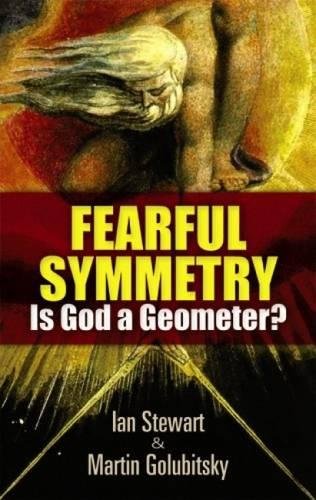
Ebook Info
- Published: 2011
- Number of pages: 320 pages
- Format: PDF
- File Size: 224.92 MB
- Authors: Ian Stewart
Description
This fascinating study explores a fundamental paradox behind the patterns of the natural world, in which symmetrical causes lead to asymmetrical effects. Lesser and greater patterns—the structure of subatomic particles, a tiger’s stripes, the shapes of clouds, and the vibrations of the stars—are produced by broken symmetry. This accessible exploration of the physical and biological world employs the mathematical concepts of symmetry to consider the deepest questions of modern physics.An active popularizer of mathematics, Ian Stewart is a university professor and former columnist for Scientific American’s “Mathematical Games” column. Martin Golubitsky is Distinguished Professor of Mathematics and Physical Sciences at the Ohio State University, where he serves as Director of the Mathematical Biosciences Institute. Both authors share an interest in the application of new mathematical ideas to scientific problems. More than 120 figures illustrate their illuminating survey of the interaction of symmetry with dynamics and the mathematical unity of nature’s patterns.
User’s Reviews
Editorial Reviews: About the Author Ian Stewart, an active popularizer of mathematics, is Professor of Mathematics at England’s University of Warwick and a former columnist for Scientific American’s “Mathematical Games” column. In 1995, he won math’s version of the Nobel Prize, the Michael Faraday Medal. Martin Golubitsky is Distinguished Professor of Mathematics and Physical Sciences at Ohio State University, where he serves as Director of the Mathematical Biosciences Institute. Ian Stewart: Winner of the Michael Faraday Medal Professor Emeritus at Britain’s University of Warwick, and Fellow of the Royal Society, Ian Stewart has entertained and instructed readers with a few dozen books, five of which have found their way to Dover: Catastrophe Theory and Its Applications (with Tim Poston, 1996); Concepts of Modern Mathematics, (1995); Another Fine Math You’ve Got Me Into (2003); Game, Set and Math (2007); and Fearful Symmetry (with Martin Golubitsky, 2011). His overall output has been wide and various with books on ‘straight’ mathematics, mathematics teaching, science fiction, as well as a very popular three-volume series, The Science of Discworld, with Terry Pratchett and Jack Cohen. In the Author’s Own Words:”By the 18th century science had been so successful in laying bare the laws of nature that many thought there was nothing left to discover. Immutable laws prescribed the motion of every particle in the universe, exactly and forever: the task of the scientist was to elucidate the implications of those laws for any particular phenomenon of interest. Chaos gave way to a clockwork world. But the world moved on. . . . Today even our clocks are not made of clockwork. . . . With the advent of quantum mechanics, the clockwork world has become a lottery. Fundamental events, such as the decay of a radioactive atom, are held to be determined by chance, not law.” — Ian StewartCritical Acclaim for Fearful Symmetry:”This book’s central theme involves two remarkably nonintuitive facts. First, a completely symmetric plane looks the same at every point and from every angle. We find this uninteresting and pay it no heed. Thus, what we detect as symmetry is, in fact, those symmetries that remain after the greater symmetry has been broken. Second, the study of symmetry is really the study of groups of transformations. Stewart and Golubitsky show how these modern mathematical concepts can be used to describe many of the most interesting features of the physical and biological world. This is not an easy book but well worth the effort.” — Library Journal
Reviews from Amazon users which were colected at the time this book was published on the website:
⭐A good book for anyone willing to work through it only because it’s highly detailed and in-depth. Especially for those who are fascinated with mathematics and physics (examples of symmetry in the natural world). I enjoyed Ian Stewart’s Does God Play Dice (Dynamical Systems/Chaos) more but as always, Stewart is an excellent writer.
⭐*****”Tiger, tiger, burning bright: In the forests of the night,What immortal hand or eye: Could frame thy fearful symmetry?” — William BlakeFearful symmetry? William Blake, alluded to the beauty of the fearful tiger! Nature’s patterns are a source of inspiration and awe; though with numerous scientific problems. Philosophers and scientists, impressed by the natural world’s prevalent patterns, have declared God a master mathematician. King Ptolemy inquired, somewhat attentively, after Euclid had shown him his treatise on geometry, “Cannot the problems be made easier?” to which the geometer replied, “There is no royal road to geometry.” This is true when applied to Symmetry, itself, a royal road leading us to divine wisdom, if we will but perceive its meaning and grasp its ideas . Have you ever wondered why tigers have stripes but leopards have spots? Did it ever occur to you that snails are seldom left-handed? If chaos is the signature of a Dicing Deity, then symmetry is the signature of a Geometer God.Symmetry exists in all facets of life, and we see it as a manifestation of harmony and beauty by proportionality and balance that aesthetics imparts. This accessible book employs the mathematical concepts of symmetry to portray fascinating aspects of the physical and biological world. Paradoxically, it is the breaking of symmetry that is responsible for many of nature’s patterns. Fearful Symmetry will zoom your focus on the broken symmetries that lie all around us, from the shapes in the clouds to the silken lines of a spider’s web, from the hoof beats of a galloping horse to the sparkling surfaces of a diamond. It will take your imagination into the microsphere of the atom, where broken symmetry controls the quantum forces of nature; and to the farthest reaches of the galaxies, where black holes cast doubt on current theories of the universe. It will bring you face to face with the deepest mysteries of cosmic science: the origins of biological form, a Clue to the left-handed protein root of life on earth.Almost a decade after his amazing historical overview of nonlinear science in, “Does God play dice?” comes Ian Stewart’s “Is God a Geometer,” full of brisk ideas and a fascinating expounding, while introducing the concept of Breaking Symmetry! The authors provide an introduction to symmetry within basic group theory in the early chapters, for readers who did not acquire a background in mathematics, but you don’t need much mathematics to drive you through the book. Group Theory is a mathematical method by which aspects of molecular symmetry can be determined, revealing information about its properties like structure, spectra, and polarity. The following chapters explore the application of such ideas to various fields of natural forms, crystals, astronomy, molecular biology, and animal canter, trot, or walk. There is a discussion on the relationship between symmetry and chaos, and finally a philosophical debate on the extent to which symmetry is in the mind of the beholder, and does it mean us or the intelligent Designer?Recently Golubitsky has focused his efforts on how symmetry and chaos combine to generate a new method for pattern formation. The two authors were drawn together by a common interest in the application of new mathematical concepts to scientific problems, working together for a year in Texas, collaborating on various projects ever since.
⭐Breaking Symmetry is certainly a magic term in this book. With the use of innumerable real-life examples and the use of dozens of pictures Stewart and Golubitsky try to illustrate the basic concept of the “Theory-That-Covers-Everything”. Being confronted with the dissection of physical phenomenon into degrees of symmetry, gives the reader enough reason to believe that the “big theory” might ultimately be uncovered by using the mathematical tool of Breaking Symmetry. But this book also points out that scientists are still far away from reaching this ultimate goal. The patterns discussed in this book takes you to the invisible world of quarks, then shows you the wonderful stripes on the fur of a tiger and finally let you surf the spiral-arms of our Galaxy. Clearly it gives the reader the opportunity to have a taste from more than one scientific discipline: Biology, Physic, Chemistry, Maths, they are all addressed in this book.But be aware: you must keep yourself very alert while reading it, because the train of thought is not always easy to follow. Apart from the sometimes strange jumps, the narration is very clear and easy to understand, which will certainly enable you to get more insight into the fascinating world of symmetry.
⭐I really didn’t knew exactly what to expect. I have to say I wasn’t disappointed, but was a little overwhelm with some new concepts (maybe it was just that I read this book while in my honeymoon). Anyway, I am no mathematics genius (I’m really far from that) but I’m a curious guy and this book fulfill my eager, while by the way make me use some slept neurons hibernating since my college days. My background is not mathematical, but you don’t need much mathematics to drive you through to book, besides it was really interesting to see biological applications of mathematical abstractions. This was a wonderful read without troubling with numbers and formulas.
⭐This book really improved my understanding of what physicists are talking about when they speak of Symmetry Breaking. The book makes it possible for you to understand the underpinnings of this concept whilst doing nothing more intellectual than pouring the milk onto your breakfast cereal. Lots of good illustrations.Nothing to be frightened of in this book.
⭐I have always struggled with the scientific concept of symmetry, and the breaking of it. This text enabled me to ‘at last’ , to fathom these idea’s. A good ancillary text for undergraduate physics students.
⭐Amazing book. Gives a very different perspective and really changes the way we look at things and life.The focus on pattern recognition as symmetry breaking is pretty interesting.
⭐This is the book which certainly enhances your insight into observing nature with its hidden mathematical beauty. I feel like reading it again and again.
Keywords
Free Download Fearful Symmetry: Is God a Geometer? (Dover Books on Mathematics) in PDF format
Fearful Symmetry: Is God a Geometer? (Dover Books on Mathematics) PDF Free Download
Download Fearful Symmetry: Is God a Geometer? (Dover Books on Mathematics) 2011 PDF Free
Fearful Symmetry: Is God a Geometer? (Dover Books on Mathematics) 2011 PDF Free Download
Download Fearful Symmetry: Is God a Geometer? (Dover Books on Mathematics) PDF
Free Download Ebook Fearful Symmetry: Is God a Geometer? (Dover Books on Mathematics)