

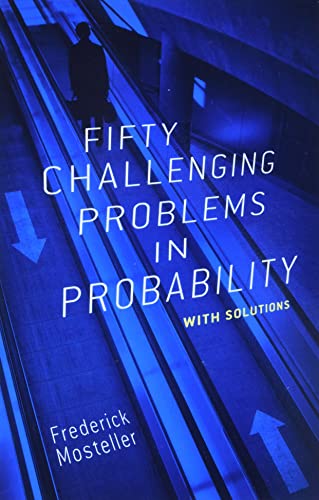
Ebook Info
- Published: 1987
- Number of pages: 96 pages
- Format: PDF
- File Size: 3.79 MB
- Authors: Frederick Mosteller
Description
Can you solve the problem of “The Unfair Subway”?Marvin gets off work at random times between 3 and 5 p.m. His mother lives uptown, his girlfriend downtown. He takes the first subway that comes in either direction and eats dinner with the one he is delivered to. His mother complains that he never comes to see her, but he says she has a 50-50 chance. He has had dinner with her twice in the last 20 working days. Explain.Marvin’s adventures in probability are one of the fifty intriguing puzzles that illustrate both elementary ad advanced aspects of probability, each problem designed to challenge the mathematically inclined. From “The Flippant Juror” and “The Prisoner’s Dilemma” to “The Cliffhanger” and “The Clumsy Chemist,” they provide an ideal supplement for all who enjoy the stimulating fun of mathematics.Professor Frederick Mosteller, who teaches statistics at Harvard University, has chosen the problems for originality, general interest, or because they demonstrate valuable techniques. In addition, the problems are graded as to difficulty and many have considerable stature. Indeed, one has “enlivened the research lives of many excellent mathematicians.” Detailed solutions are included. There is every probability you’ll need at least a few of them.
User’s Reviews
Editorial Reviews: From the Back Cover Can you solve the problem of “The Unfair Subway”?Marvin gets off work at random times between 3 and 5 p.m. His mother lives uptown, his girlfriend downtown. He takes the first subway that comes in either direction and eats dinner with the one he is delivered to. His mother complains that he never comes to see her, but he says she has a 50-50 chance. He has had dinner with her twice in the last 20 working days. Explain.Marvin’s adventures in probability are one of the fifty intriguing puzzles that illustrate both elementary ad advanced aspects of probability, each problem designed to challenge the mathematically inclined. From “The Flippant Juror” and “The Prisoner’s Dilemma” to “The Cliffhanger” and “The Clumsy Chemist,” they provide an ideal supplement for all who enjoy the stimulating fun of mathematics.Professor Frederick Mosteller, who teaches statistics at Harvard University, has chosen the problems for originality, general interest, or because they demonstrate valuable techniques. In addition, the problems are graded as to difficulty and many have considerable stature. Indeed, one has “enlivened the research lives of many excellent mathematicians.” Detailed solutions are included. There is every probability you’ll need at least a few of them. About the Author Charles Frederick Mosteller ( 1916–2006) was one of the eminent statisticians of the 20th century. He was the founding chairman of Harvard’s Statistics department. Dr. Mosteller wrote more than 50 books and more than 350 papers, with over 200 coauthors. Frederick Mosteller: Harvard Man Frederick Mosteller (1916–2006) founded Harvard University’s Department of Statistics and served as its first chairman from 1957 until 1969 and again for several years in the 1970s. He was the author or co-author of more than 350 scholarly papers and more than 50 books, including one of the most popular books in his field, first published in 1965 and reprinted by Dover in 1987, Fifty Challenging Problems in Probability with Solutions.Mosteller’s work was wide-ranging: He used statistical analysis of written works to prove that James Madison was the author of several of the Federalist papers whose authorship was in dispute. With then–Harvard professor and later Senator Daniel P. Moynihan, he studied what would be the most effective way of helping students from impoverished families do better in school — their answer: to improve income levels rather than to simply spend on schools. Later, his analysis of the importance to learning of smaller class sizes buttressed the Clinton Administration’s initiative to hire 100,000 teachers. And, as far back as the 1940s, Mosteller composed an early statistical analysis of baseball: After his team, the Boston Red Sox, lost the 1946 World Series, he demonstrated that luck plays an enhanced role in a short series, even for a strong team. In the Author’s Own Words:”Though we often hear that data can speak for themselves, their voices can be soft and sly.” — Frederick Mosteller
Reviews from Amazon users which were colected at the time this book was published on the website:
⭐I did one problem each morning. Really happy with most solutions, though some could have shown more steps. The author covers famous problems like Buffon’s needle and Molina’s urn, and also shows how simple probability problems can lead to several of the most common probability distributions.
⭐I was compelled to write a review as I found some of the lower-ranked reviews downright condescending. Some of the problems in the book are decidedly simple but with twists that may not be obvious at the outset. In hindsight, the solutions to these make them simple to understand and replicate. But several other problems discussed are difficult enough to be posed on Ph.D qualifiers at class 1 institutions. That is the appeal of the book. Its a great mix. I read some of the tough problems regularly to deepen my understanding of logically working through a solution. I have used Buffon’s needle (before I read this book, but it is discussed therein) on my 10 yr old’s school project and used the “breaking a stick” problem to illustrate Monte Carlo simulation in class. Granted that some knowledge of basic probability/mathematical statistics would be required to appreciate the solutions but even without such a background the problems themselves are fairly interesting. For example, I have posed the “tennis” problem to my 10 year old and have worked through the logic with him, which he understood sans any math. In summary, this is $7 and change more than well spent.
⭐This is recreational math at its finest. All problems are approachable with just elementary probability theory and high school mathematics with the occasional appearance of first-semester calculus. However, each problem is thought-provoking and lead to interesting generalizations, if the reader is so inclined. I have seen maybe six or seven of the problems in previous contexts (I’m not particularly well-read in this area of math), but the solutions provided by the author still gave me something the think about. The rest of the problems were brand new for me and were good to think about on a lazy Sunday afternoon. Good if you’re a math nerd, or you’re trying to get a new generation of young’uns hooked.A bit on the short side — it leaves you wanting more.
⭐I got this book because I enjoy programming challenges, probability and logical reasoning and wanted to strengthen my math skills. With that said, I struggled right out of the gate with the problems. I understood the problems and was able to solve them on my own but when reading the solution and trying to follow through with the mathematical approach I found myself completely confused. The math isn’t always intuitive and the author makes a few leaps during his explanations that not only could I not follow, but I couldn’t recreate in my own math. This was frustrating to no end and I still don’t understand a lot of the math he used to get to his solutions. It’s a great book if you like challenges and probability and those who have a stronger math background than myself might enjoy this book a lot. However, for me this book just didn’t quite make the cut and I’d really enjoy one with a better set of answers and explanations to go with.
⭐I enjoy solving probability puzzles. I considered myself to be pretty good- I could solve any problem that the GRE practice exams could throw my way. Until I opened this book.This book takes off where I ended up. The first problem is a variation on the “reach into a bag” probability problem. (Q: You reach into a drawer with red socks and black socks, and the probability of drawing 2 red socks is P=0.5. What is the minimum number of both colored socks?)You won’t find the typical probability problems that can be quickly solved with basic combinatorial analysis or the Bernoulli Coefficient. You’ll find variations and completely new worlds of probability. The explanations are thorough but succinct, and will arm you with a new skill set for solving such problems.There’s no other book like it on Amazon, and for $7…Comparable to Huff’s “How to Lie with Statistics” in its originality and straight-forwardness.
⭐I bought this book to prepare for data scientist job interview. Great book to brush up probability fundamental through solving a set of hand selected problems. Examples include Bernoulli, binomial, Poisson distributions, graphical approaches, basic stochastic process, all in settings of practical problems. Great explanation of some counter-intuitive results in probability. Also a good introductory book on probability that stimulates curiosity in this subject.
⭐The problems in this book are a master class in the variety of and intellectual robustness within even simply stated questions. Some solutions border on the whimsical. Many have multiple approaches to their solution. The solutions are complete, but not overly explained.Many solutions leave some small and other thoughtful “leaps” for the full details to be appreciated. At first this can be annoying, but once you “step it up”, you can’t help getting productively engaged.
⭐The majority of the problems (> 50%) are simple and would probably seem even trivial to some one who has taken a couple of college courses in probability and statistics (and still remembers them). There are a few interesting problems but the solutions are needlessly long winded with heavy reliance on algebra — often there were simpler and more intuitive ways of solving the same problem. The intended audience seems to be a high school senior or a beginning undergraduate with an interest in math.
⭐This is a very good collection of various problems with basic probability theory, typical of quantitative interviews in tech or finance companies. I recommend to everyone who is interesting in enhancing his/her own intuitive understanding of the subject without too much technicalities.It would have been great to have some exercises for the more advanced readers.
⭐56 questions with solutions. The areas touched upon cover quite a broad range of ideas. This is not a learning tool as such, but it is useful to test ones ability to apply knowledge given some base level of understanding of probability. The book is old but the questions are interesting, and the solutions can be enlightening.Word of warning: instead of the 56 questions listed and then 56 solutions follow, each solution comes immediately after each question. It saves flicking between pages more than necessary, but be careful not to accidentally read part of the solution when working through — I cover up the solution with a piece of paper until I have done the question myself.
⭐A book of small proportions that contains a wealth of knowledge.Well worth buying for any a level student or ,indeed, for anyone who is interested in the world around them.Most of the problems are old chestnuts but are dealt with in a way that is accessible to anyone with a modicum of mathematical grounding.Terrific value.
⭐Fabulous book. I have, since high school, had a strong interest in probability, and this book fed my appetite admirably, with a number of problems of varying difficulty.
⭐All good
Keywords
Free Download Fifty Challenging Problems in Probability with Solutions (Dover Books on Mathematics) in PDF format
Fifty Challenging Problems in Probability with Solutions (Dover Books on Mathematics) PDF Free Download
Download Fifty Challenging Problems in Probability with Solutions (Dover Books on Mathematics) 1987 PDF Free
Fifty Challenging Problems in Probability with Solutions (Dover Books on Mathematics) 1987 PDF Free Download
Download Fifty Challenging Problems in Probability with Solutions (Dover Books on Mathematics) PDF
Free Download Ebook Fifty Challenging Problems in Probability with Solutions (Dover Books on Mathematics)