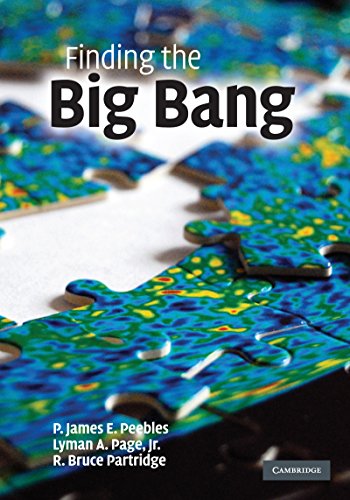
Ebook Info
- Published: 2009
- Number of pages: 596 pages
- Format: PDF
- File Size: 5.81 MB
- Authors: P. James E. Peebles
Description
Cosmology, the study of the universe as a whole, has become a precise physical science, the foundation of which is our understanding of the cosmic microwave background radiation (CMBR) left from the big bang. The story of the discovery and exploration of the CMBR in the 1960s is recalled for the first time in this collection of 44 essays by eminent scientists who pioneered the work. Two introductory chapters put the essays in context, explaining the general ideas behind the expanding universe and fossil remnants from the early stages of the expanding universe. The last chapter describes how the confusion of ideas and measurements in the 1960s grew into the present tight network of tests that demonstrate the accuracy of the big bang theory. This book is valuable to anyone interested in how science is done, and what it has taught us about the large-scale nature of the physical universe.
User’s Reviews
Reviews from Amazon users which were colected at the time this book was published on the website:
⭐This book is rich with information about the so-called “big bang” model of the origin of the current observable universe. It contains a mixture of relatively long treatises with fairly short reminiscences–the shorter ones include those of important Soviet radioastronomers and astrophysicists reaching back to the 1950s.This is an unusual mixture of edited papers, along with chapters by P.J.E. Peebles, F. Lyman, and R. Partridge and represents a tremendous amount of work delving back into the history of modern physical cosmology. This is generally considered by historians of science to have occurred in 1948. Ironically, 1948 was the year H. Bondi proposed the first rendering of what came to be called the “steady state” theory. His colleague F. Hoyle became its most vigorous proponent. “Steady Staters” generally agreed that “fossil” evidence of an early universe would falsify the theory. The Cosmic Microwave Background Radiation (CMBR) appears to have been measured many times, but not in a cosmological context. The measurement of Arno Penzias and Robert Wilson in 1964 (published in 1965) fairly cut the steady state theory off at the knees; simultaneously, the most reliable and accepted measurement of the CMBR supported the “big bang,” a term applied to a hot, dense, expanding universe by F. Hoyle in a BBC broadcast in 1949.This book will appeal to a broad range of people interested in cosmology and astrophysics. There are some important people missing in this book. Although many writers have attributed the neutron-capture theory of the formation of the elements to George Gamow, it was actually the independent dissertation of Ralph A. Alpher, one of his graduate students. This dissertation was defended in May, 1948–prior to this, there had already been one publication derived from it. Later that year, R. Alpher came up with the first theoretical prediction of the “fossil” radiation or CMBR, publishing all subsequent papers on the subject with his colleague at the Applied Physics Laboratory at Johns Hopkins University, Robert C. Herman. Herman had received his doctorate in 1940 at Princeton. As Gamow did not accept the validity of the concept of the CMBR for three years, Herman became an important more senior physicist for the kind of back and forth communication that is helpful for theoreticians. Such “blackboard” work done with chalk is rarely preserved. At one time, it was essential for those adept at speaking the language of mathematics and theoretical physics. Today, in many places, the whiteboard has replaced the blackboard, but with the similar problem of preservation of intermediate stages of development.Thus, 1948 was the year that cosmology passed from being a philosophical pursuit to a scientific one.Nonetheless, this work stand on the shoulders of prior theoreticians, such as Tolman, Lemaitre (there is a caret above the i that is not available here), and Aleksandr Friedmann of Russia.I found many of the chapters fascinating reading, such as the one by Robert Wilson. At the time of the 1964 CMBR measurment, he was a radioastronomer, not a cosmologist. Chapters by the Russian physicists Doroshkevich and Novikov make their early ideas readily accessible in English.Without being overly technical, this is a volume that should be an important reference source for many years to come. It is not sensational, as some recent books on the big bang have tended to be. It is factual, without answering many questions that historians of science have about the early development of the theory.
⭐The book has an introduction which the description of our knowledge knowledge on the eve of the discovery, and stories, told by 44 leading scientists involved on the discovery. All stories contain personal details which never are published in ‘standard’ scientific papers. The book shows haw science works, errors and misunderstandings which happen during the study, and the joy of people when something really new and important was found.Highly recommend to everyone interested to learn how science actually works.
⭐
Keywords
Free Download Finding the Big Bang 1st Edition in PDF format
Finding the Big Bang 1st Edition PDF Free Download
Download Finding the Big Bang 1st Edition 2009 PDF Free
Finding the Big Bang 1st Edition 2009 PDF Free Download
Download Finding the Big Bang 1st Edition PDF
Free Download Ebook Finding the Big Bang 1st Edition