

Ebook Info
- Published: 2013
- Number of pages: 410 pages
- Format: PDF
- File Size: 3.49 MB
- Authors: Andrew McInerney
Description
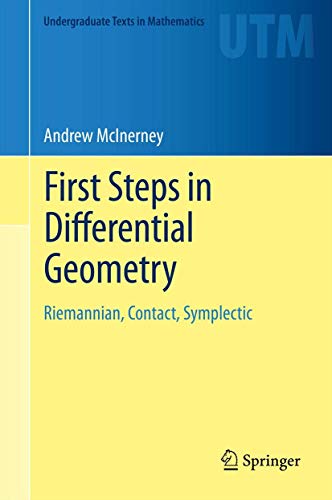
Differential geometry arguably offers the smoothest transition from the standard university mathematics sequence of the first four semesters in calculus, linear algebra, and differential equations to the higher levels of abstraction and proof encountered at the upper division by mathematics majors. Today it is possible to describe differential geometry as “the study of structures on the tangent space,” and this text develops this point of view. This book, unlike other introductory texts in differential geometry, develops the architecture necessary to introduce symplectic and contact geometry alongside its Riemannian cousin. The main goal of this book is to bring the undergraduate student who already has a solid foundation in the standard mathematics curriculum into contact with the beauty of higher mathematics. In particular, the presentation here emphasizes the consequences of a definition and the careful use of examples and constructions in order to explore those consequences.
User’s Reviews
Editorial Reviews: Review From the book reviews:“This books presents an alternative route, aiming to provide the student with an introduction not only to Riemannian geometry, but also to contact and symplectic geometry. … the book is leavened with an excellent collection of illustrative examples, and a wealth of exercises on which students can hone their skills. Each chapter also includes a short guide to further reading on the topic with a helpful brief commentary on the suggestions.” (Robert J. Low, Mathematical Reviews, May, 2014)“This book is a distinctive and ambitious effort to bring modern notions of differential geometry to undergraduates. … Mclnerney’s writing is well constructed and very clear … . Summing Up: Recommended. Upper-division undergraduates and graduate students.” (S. J. Colley, Choice, Vol. 51 (8), April, 2014)“The author does make a considerable effort to keep things as accessible as possible, with fairly detailed explanations, extensive motivational discussions and homework problems … . this book provides a different way of looking at the subject of differential geometry, one that is more modern and sophisticated than is provided by many of the standard undergraduate texts and which will certainly do a good job of preparing the student for additional work in this area down the road.” (Mark Hunacek, MAA Reviews, January, 2014)“This text provides an early and broad view of geometry to mathematical students … . Altogether, this book is easy to read because there are plenty of figures, examples and exercises which make it intuitive and perfect for undergraduate students.” (Teresa Arias-Marco, zbMATH, Vol. 1283, 2014) From the Back Cover Differential geometry arguably offers the smoothest transition from the standard university mathematics sequence of the first four semesters in calculus, linear algebra, and differential equations to the higher levels of abstraction and proof encountered at the upper division by mathematics majors. Today it is possible to describe differential geometry as “the study of structures on the tangent space,” and this text develops this point of view. This book, unlike other introductory texts in differential geometry, develops the architecture necessary to introduce symplectic and contact geometry alongside its Riemannian cousin. The main goal of this book is to bring the undergraduate student who already has a solid foundation in the standard mathematics curriculum into contact with the beauty of higher mathematics. In particular, the presentation here emphasizes the consequences of a definition and the careful use of examples and constructions in order to explore those consequences. About the Author Andrew McInerney is a mathematics professor at Bronx Community College of the City University of New York. Read more
Reviews from Amazon users which were colected at the time this book was published on the website:
⭐I think this book is very good for beginners, principally I am interested in contact geometry and Symplectic Geometry and this text is ok for an crash introduction
⭐I like the writing style with its many examples. However, only what’s easy to prove is proven; otherwise there are simply references to the literature. For instance, there is no proof of Poincare’s Lemma and there is no proof of the Gauss-Stokes theorem for differential forms. Mathematical technicalities are ignored so as to keep things simple and easily understandable. But sometimes I believe this is taken too far, as when stating the Gauss-Stokes theorem for differential forms, the author simply states “with boundary ∂D oriented consistently with that of D”, which completely avoids the question. And there are a few careless errors, such as in Example 4.5.8, which evaluates the integral of the two-form i(r)(dx^dy^dz) over one hemisphere of the unit sphere using pullback and two angles as parameters and ends up with the volume rather than the surface area. And there are places where there should be a pushforward rather than a pullback (e.g., last line in Example 4.6.14) or vice versa. or having the wrong order of function composition, or having a sign error or an error in the order of the arguments (e.g., the Lie derivative should be the first argument in the last term of the equation following equation (B) in the proof of Proposition 4.7.22). But these errors are easily spotted. For a more in-depth treatment of many of the topics, I recommend the book The Geometry of Physics Third Edition by Theodore Frankel. And of course the classic Differential Forms by Harley Flanders is still excellent with a proof of the Gauss-Stokes Theorem, with constructive proofs of Poincare’s Lemma and the Frobenius Theorem, and having an excellent treatment of the Riemann tensor as (1,1) tensor valued curvature two-forms which enables an easy derivation of the Bianchi identity and the Einstein tensor. Differential forms make obtaining these results concise and elegant. Differential forms do to Riemannian geometry what vector analysis did to Maxwell’s equations. The author has a non-standard form of the Riemann tensor. Also, the Riemann tensor doesn’t have to be presented using the metric tensor. A more general approach using moving frames and connection coefficients is presented in Flanders and leads more quickly and directly to the matrix of curvature two-forms.
⭐Whether you’re a professor seeking approaches to teaching these concepts, or a student encountering the foundational concepts, this book is a must have. Elegant, well written, concise and carefully organized, who could imagine a book in advanced mathematical concepts would be such a joy to encounter?
⭐Excelente texto básico de Geometría Diferencial con un enfoque actual.Easy to read introduction to differential geometry that doesn’t rely on a knowledge of mathematical jargon – all definitions and notation appear carefully explained within the text. If you have a decent working knowledge of calculus and linear algebra, you could do worse things with your time.
⭐Je suis profondément déçu de découvrir qu’à la toute fin de ce livre de 430 pages, il y a brusquement un saut de la page 359 à la page 395 (cf photo) avec une trentaine de pages qui n’ont rien à voir avec le sujet du livre, et il manque ainsi 50 pages utiles à ce livre. Springer ne veut pas remplacer ce livre qui a été mal imprimé, encore une entreprise visiblement à l’écoute de ces clients !
⭐
Keywords
Free Download First Steps in Differential Geometry: Riemannian, Contact, Symplectic (Undergraduate Texts in Mathematics) 2013th Edition in PDF format
First Steps in Differential Geometry: Riemannian, Contact, Symplectic (Undergraduate Texts in Mathematics) 2013th Edition PDF Free Download
Download First Steps in Differential Geometry: Riemannian, Contact, Symplectic (Undergraduate Texts in Mathematics) 2013th Edition 2013 PDF Free
First Steps in Differential Geometry: Riemannian, Contact, Symplectic (Undergraduate Texts in Mathematics) 2013th Edition 2013 PDF Free Download
Download First Steps in Differential Geometry: Riemannian, Contact, Symplectic (Undergraduate Texts in Mathematics) 2013th Edition PDF
Free Download Ebook First Steps in Differential Geometry: Riemannian, Contact, Symplectic (Undergraduate Texts in Mathematics) 2013th Edition