

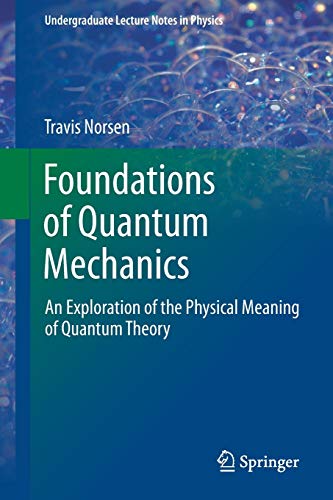
Ebook Info
- Published: 2017
- Number of pages: 325 pages
- Format: PDF
- File Size: 8.53 MB
- Authors: Travis Norsen
Description
Authored by an acclaimed teacher of quantum physics and philosophy, this textbook pays special attention to the aspects that many courses sweep under the carpet. Traditional courses in quantum mechanics teach students how to use the quantum formalism to make calculations. But even the best students – indeed, especially the best students – emerge rather confused about what, exactly, the theory says is going on, physically, in microscopic systems. This supplementary textbook is designed to help such students understand that they are not alone in their confusions (luminaries such as Albert Einstein, Erwin Schroedinger, and John Stewart Bell having shared them), to sharpen their understanding of the most important difficulties associated with interpreting quantum theory in a realistic manner, and to introduce them to the most promising attempts to formulate the theory in a way that is physically clear and coherent.The text is accessible to students with at least one semester of prior exposure to quantum (or “modern”) physics and includes over a hundred engaging end-of-chapter “Projects” that make the book suitable for either a traditional classroom or for self-study.
User’s Reviews
Editorial Reviews: Review “Travis Norsen’s Foundations of Quantum Mechanics could be the spark that ignites a revolution. … How adequate is Norsen’s exposition? The writing is not just so clear and straightforward that a non-expert can understand it; it is so clear and straightforward that an expert cannot manage to misunderstand it.” (Tim Maudlin, American Journal of Physics, Vol. 86 (12), December, 2018)“The present work is indeed a textbook intended to help the students both to appreciate ‘the concerns that people like Einstein, Schrödinger, and Bell have had with traditional formulations’, and to have a glimpse of ‘the several extant formulations of quantum theory which purport to address at least some of the concerns’.” (Nicola Cufaro Petroni, zbMATH 1408.81003, 2019)“The book is intended as the main text for an undergraduate course on the foundations of quantum physics, but it would also serve well as a supplemental text in a regular undergraduate quantum mechanics course. … Reading this book should be a priority for all physicists who want to deepen their understanding of their most fundamental theory.” (Jean Bricmont, Physics Today, April, 2018)“I do think this is a book worth buying for anyone interested in the foundations of quantum mechanics. … Foundations of Quantum Mechanics is an excellent addition to the library of physicists and philosophers working on these problems, and makes a very good supplemental text for related advanced undergraduate courses.” (Ian Durham, FQXi Community, fqxi.org, January, 2018)“It covers all the important issues in that field. … reading this book should be a priority for every physicist who wants to know what the most fundamental physical theory is all about.” (Jean Bricmont, International Journal of Quantum Foundations, ijqf.org, December, 2017) From the Back Cover Authored by an acclaimed teacher of quantum physics and philosophy, this textbook pays special attention to the aspects that many courses sweep under the carpet. Traditional courses in quantum mechanics teach students how to use the quantum formalism to make calculations. But even the best students – indeed, especially the best students – emerge rather confused about what, exactly, the theory says is going on, physically, in microscopic systems. This supplementary textbook is designed to help such students understand that they are not alone in their confusions (luminaries such as Albert Einstein, Erwin Schroedinger, and John Stewart Bell having shared them), to sharpen their understanding of the most important difficulties associated with interpreting quantum theory in a realistic manner, and to introduce them to the most promising attempts to formulate the theory in a way that is physically clear and coherent.The text is accessible to students with at least one semester of prior exposure to quantum (or “modern”) physics and includes over a hundred engaging end-of-chapter “Projects” that make the book suitable for either a traditional classroom or for self-study. About the Author Travis Norsen graduated as a physics-philosophy double-major from Harvey Mudd College in 1997 and then earned his PhD in theoretical nuclear astrophysics from the University of Washington in 2002. Since then he has worked on the foundational issues surveyed in the book and brought his uniquely conceptual, historical, and philosophical approach to physics into the classrooms of Marlboro, Mount Holyoke, and Smith Colleges. Read more
Reviews from Amazon users which were colected at the time this book was published on the website:
⭐I use Travis Norsen’s book as one of the main textbooks for my philosophy of quantum mechanics class at Caltech—the other book is Tim Maudlin’s Philosophy of Physics: Quantum Theory. I particularly like Norsen’s book, because it introduces all the necessary math without being too technical. In this sense, it is closer to a standard physics textbook, but it doesn’t indulge in mere calculations merely for the sake of calculations. The math is always used to make conceptual problems and arguments more precise and clearer.The first half of the book discusses the three main problems with quantum mechanics: the measurement problem, the locality problem, and the ontology problem. Having read these chapters, the reader, I hope, should be convinced that these are severe problems of quantum mechanics that require a solution. The second half of the book introduces, four proposals for a solution in the form of four different interpretations, or rather theories, of quantum mechanics: the Copenhagen interpretation, the de Broglie-Bohm pilot-wave theory, the GRW spontaneous collapse theory, and Everett’s many-worlds theory.One of the main strengths of the book are the exercises at the end of every chapter. They all are clearly related to the topic of the chapter (which is sometimes not the case in other physics textbooks); they focus on important, mainly conceptual, issues (which is often not the case in other physics textbooks, either); and they can be solved in reasonable time. Therefore, these exercises were a central part of my class.There is much more to be said about this wonderful textbook, as it contains a myriad of physical and philosophical insights into the mysteries of quantum mechanics. I wished all physics textbooks were written with this level of clarity and pedagogical value.Dr. Mario HubertPostdoctoral InstructorCaltech
⭐Quite frankly this is a book that is a must have in anyone’s library concerning Quantum Mechanics.When I first heard of it it looked intriguing but as a layperson with limited experience with math I was wondering if I could really understand it all. I will say this, though the math is written in a language that is often beyond me the author somehow summarizes, reiterates, and pictures things in such a way that quite frankly I had a hard time being lost and he does this without any feeling of repetitiveness. Even the math that I didn’t know I often understood quite easily. I honestly doubted whether that could be done and well I think this book shows it can and for that reason I can highly recommend it even for just a very interested layman such as myself. He covers topics not usually discussed and clears away confusions and misconceptions concerning Quantum Theory.This book is divided into 9 Chapters they are as follows:1. Pre-Quantum Theories: This Chapter was very eye-opening to me. I’ve read other books on Quantum Physics that talk about Pre-Quantum Theories but seldom do they link them to Quantum Theory. For example Travis will often mention things that are similar or sort of precursors to concepts in Quantum Theory which is extremely helpful as a bridge to it and gets you familiar to concepts to come so that you already have the resources to understand and picture it.2. Quantum Examples: This is where he then takes you to Quantum Theory and explains many things in Quantum Theory that were both similar to Pre-Quantum Theory but also what separates it in general so is an overview. You learn more key concepts. The pictures here and the fact that he taught from Chapter 1 the way he did makes this much easier and fun to understand.3. The Measurement Problem: This is where it really starts to take off. Armed with what you learned, Travis introduces a problem that has plagued Quantum Theory. You also see many examples of thought experiments that were implored to understand the issues and this again makes it quite easy to grasp. He also talks more about issues of Hidden Variables and of an interpretation favored by people like Einstein called the Ignorance Interpretation. These are keys for understanding later solutions and you get a glimpse of the Paradoxes if you will in Quantum Theory.4. Locality Problem: This to me was one of the most fascinating as Travis goes even more into history and the thoughts of people like Einstein and Bohr, particularly concerning the EPR experiment. It is often stated that Bohr bested Einstein here but Travis dispels that quite convincingly and shows that Bohr hardly understood Einstein and when he did he did little more than give convoluted sentences that helped nothing. Travis also implores David Bohm and John S. Bell to better explain the experiment with Bohm’s easier Reformulation of it and Bell’s Re-telling of these events which again has Travis reiterating things but in a more clear yet accurate way that you will feel the force of the mystery and through these great men.5. The Ontology Problem: I’ve heard of this problem but yet again many things are brought up that are seldom brought up that I was quite pleased with this section. Travis shows that merely having a wave function that evolves according to the Schrödinger Equation will not solve the issues as a matter of fact it contradicts experiment. Moreover he talks about Schrödinger’s attempt to explain things in a real empirical way instead of just talking instrumentally and some issues encountered.6. Copenhagen Interpretation: Here the Standard view of Quantum Physics is explained. Interestingly he shows the differences between certain Fathers of it such as Bohr and Heisenberg thus having one see the confusion involved. This is interpretation is not only confused and unintelligible at times but also what it says about reality if anything isn’t even agreed upon by its Fathers. He shows Bohr’s confused/muddled reply to the EPR experiment in more detail and contemporary perspectives on it. They often give lip service to the Standard interpretation that the particle wasn’t anywhere till observed in which it is compelled to a definite outcome. However when pushed they tend to fall back to Agnosticism and stop the conversation. As Travis points out Science is more than just shutting up and calculating and that this isn’t a matter of idle philosophical speculation, indeed it is the Copenhagenists who should be doing just that in the “Shut up and Calculate!” Approach as they often dogmatically hold to Bohr’s Philosophy.Pilot-Wave Theory: The Copenhagen camp said that it couldn’t be done, that one couldn’t give an accurate and real and clear physical description of the world in terms of Quantum Theory. Travis here shows they were simply too dogmatic and wrong. The Pilot-Wave Theory is a Theory that has a clear Physical Ontology that avoids the measurement problem and completes Quantum Theory. It was unfortunately abandoned by de Broglie and was picked up and advanced by David Bohm who completed it. I learned that it was a Theory that starting with De Broglie was prior even to the Copenhagen Interpretation and after Bohm’s completion of it was taken back up by De-Broglie who wrote a forward for David Bohm’s work on it. Travis points out some issues such as whether the abstract spaces can be given real physical descriptions or not and that it is incompatible with Einstein’s local Relativity Theories because of this Einstein did not like this theory.8. Bell’s Theorem: Here is where John Bell takes more of a center stage. Here Travis shows that Locality like that of Einsteinian Relativity is in fact violated as the Pilot-Wave Theory says but not leaving it at that Travis goes even on to explain to my shock a rival Relativity Theory of Hendrik Antoon Lorentz in its updated form called neo-Lorentzian Relativity that is infact consistent with all the experiments including non-locality. Placing Pilot-Wave Theory right before this was ingenious as you can see very clearly the non-locality issue in Bohm and its problem with Einsteinian Relativity, here Travis points out that these aren’t much problems at all. Moreover Bell unlike Bohr was clear and unlike Einstein was concise this Chapter due to that is a breath of fresh air.9. The Spontaneous Collapse Theory: This Theory is similar to Pilot-Wave Theory and the Copenhagen Interpretation almost like a hybrid. Like Pilot-Wave Theory it is non-local and realistic, unlike it but like Copenhagen it is Indetermistic and has collapse. However it isn’t really a Quantum Theory but an alternative since the maths are different and due to this it can be distinguished and falsified. It has issues also in being ad hoc, also how things are in the real world in terms of Ontology differs depending on the version either Massy or Flashy. It has an interesting feature of being compatible with Einstein’s Relativity theories however.10. The Many-Worlds Interpretation: I already wasn’t a fan of this interpretation due to Philosophical reasons but the Empirical reasons against it are much more formidable than even I thought. Proponents often implore it as being the simplest in terms of the maths as it uses only a wave-function without other beables and such but tries to keep it consistent via multiple branches, unfortunately Travis points out that again only having a wave-function has various issues all of which to me seem very problematic. One would need to take it as being merely a mathematical description without a physical base, but then you would need to add extra Ontology which takes away its supposed simplicity or one would have to take the macroscopic world as illusory or other. Also due to its many-worlds so to speak it has problems with probability that seem to have no good solution. Moreover while proponents claim it is a local Theory, Travis points out that this is extremely questionable, whether it is local, non-local or as it seems just unclear is very much unresolved.I think this book was extremely fair and written in such a way that you can both understand and enjoy. It also has end projects which I really enjoyed as it helps one to study and contemplate what was read. I noticed for example how wrong Wikipedia entries often get it as Travis will sometimes use it as examples. The only issue I found was lack of an index but with such an array of amazing and clear information this book cannot be overlooked.If you haven’t decided on it yet I give it a resounding yes!
⭐I would highly recommend this book to anyone interested in the foundations of Quantum Mechanics. It first introduces us to the conceptual issues that have plagued Quantum Mechanics from the beginning, namely the measurement problem, the locality problem, and the ontology problem. It then explores various interpretations of Quantum Mechanics and how they fare with respect to these issues.Travis writes eloquently and with ease. Probably the biggest merit of this work is the clarity of exposition (on topics which often leave readers perplexed and confused).For students of Quantum Mechanics, this is the perfect place to start. For those already immersed in the topic, an invaluable reference and perhaps a challenge to their views.I thoroughly enjoyed reading this book and, once again, highly recommend it!
⭐This book is in my opinion one of the best books on the subjects in years (we are flooded by books on the ‘weirdness’ of QM, but very few are the good and worth-reading ones…). I find it really excellent, stimulating, well written and with the right blend of philosophy and physics, with a welcome but selected attention also for some of those episodes in the history of physics that turned out to have also deep philosophical and foundational implications. The whole community of philosophers and physicists aloke should be grateful for such a book, which deserves to become in the years a classic.
⭐This is a great book for anyone who truly wants to understand quantum mechanics and go beyond the pure technicalities (and occasional mysticism) found in other publications. It is intelligent, well-written and covers a lot of important material, including Bell’s theorem, the measurement problem and the most important “interpretations” of quantum mechanics that are rarely covered in university courses. I think anyone interested in quantum mechanics can profit from reading this book, though some background in physics (at least an introductory class on quantum mechanics) is certainly advantageous.
⭐
⭐This is a very interesting and accessible book on the foundations of quantum mechanics.The book is highly simulating and helps you understand difficult concepts with great ease. It starts by clearly explaining the notions of configuration space and locality in the context of classical physics. Then, after introducing the quantum formalism and some simple examples, the book explains with a cristal clear clarity the three main difficulties in Quantum Mechanics: the measurement problem, the locality problem and the ontology problem. Then, the book provides conceptual, formal and highly objective explanations on the Copenhagen interpretation, Bell’s theorem, the de Broglie Bohm pilot-wave theory, the GRW spontaneous collapse theory and the Everett many-world theory. This is a must read book for anyone who has some background in physics and desires to understand the perplexing problems of the foundations of quantum mechanics. I greatly enjoyed reading this book and, I highly recommend it.
⭐Disclosure. I am a Ph.D. student working on foundations of quantum mechanics, and I recently wrote a letter to the author asking for some help with my work. My decision to reach out to him came partially from my opinion about the book.The book is a deep introduction to the foundations of quantum mechanics. It covers the measurement problem, the problem of how to physically interpret the formalism of quantum mechanics, quantum non-locality, Bell’s theorem, and the most popular/discussed interpretations of quantum mechanics (Copenhagen, Bohmian mechanics, objective collapse, and many worlds). In my opinion, it is the best introduction to the foundations of quantum mechanics at the moment.The book has a good balance between formal rigor and conceptual clarity. It does not shy away from the formal aspects, and it does not waste time on insignificant details. At the end of each chapter, there are engaging problems that allow you to go deeper on many issues.I think this book can be used to design courses on the foundations of quantum mechanics. I will certainly use it for that purpose.
Keywords
Free Download Foundations of Quantum Mechanics: An Exploration of the Physical Meaning of Quantum Theory (Undergraduate Lecture Notes in Physics) in PDF format
Foundations of Quantum Mechanics: An Exploration of the Physical Meaning of Quantum Theory (Undergraduate Lecture Notes in Physics) PDF Free Download
Download Foundations of Quantum Mechanics: An Exploration of the Physical Meaning of Quantum Theory (Undergraduate Lecture Notes in Physics) 2017 PDF Free
Foundations of Quantum Mechanics: An Exploration of the Physical Meaning of Quantum Theory (Undergraduate Lecture Notes in Physics) 2017 PDF Free Download
Download Foundations of Quantum Mechanics: An Exploration of the Physical Meaning of Quantum Theory (Undergraduate Lecture Notes in Physics) PDF
Free Download Ebook Foundations of Quantum Mechanics: An Exploration of the Physical Meaning of Quantum Theory (Undergraduate Lecture Notes in Physics)