

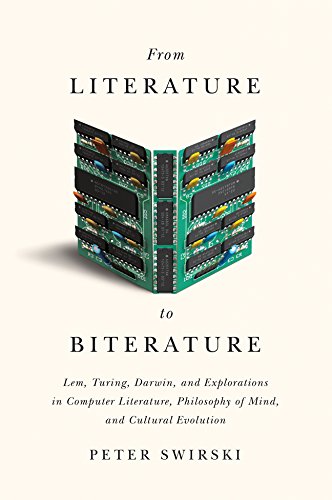
Ebook Info
- Published: 2013
- Number of pages: 244 pages
- Format: PDF
- File Size: 2.52 MB
- Authors: Peter Swirski
Description
From Literature to Biterature is based on the premise that in the foreseeable future computers will become capable of creating works of literature. Among hundreds of other questions, it considers: Under which conditions would machines become capable of creative writing? Given that computer evolution will exceed the pace of natural evolution a million-fold, what will such a state of affairs entail in terms of art, culture, social life, and even nonhuman rights?Drawing a map of impending literary, cultural, social, and technological revolutions, Peter Swirski boldly assumes that computers will leap from mere syntax-driven processing to semantically rich understanding. He argues that acknowledging biterature as a species of literature will involve adopting the same range of attitudes to computer authors (computhors) as to human ones and that it will be necessary to approach them as agents with internal states and creative intentions. Ranging from the metafiction of Stanislaw Lem to the “Turing test” (familiar to scientists working in Artificial Intelligence and the philosophers of mind) to the evolutionary trends of culture and machines, Swirski’s scenarios lay the groundwork for a new area of study on the cusp of literary futurology, evolutionary cognition, and philosophy of the future.
User’s Reviews
Reviews from Amazon users which were colected at the time this book was published on the website:
⭐Have you ever wondered about Mozart’s 42nd; or why birds of the future might feel compelled to learn Chinese (even though currently , ‘no single pigeon can be charged with knowing Chinese’); or how Wernicke’s aphasia bears on Derridean iterability? Have you ever had a yen to translate the term ‘osculating plane’ from geometry into a literary setting? Then Peter Swirski’s From Literature to Biterature (2013) is the book for you.There is definitely a plan, a unifying outlook, and I recommend learning about it sooner rather than later, i.e., do not repeat the mistake I made and defer reading the introductory material till last. Pages 10-13 in particular are important (also the author’s ‘cards on the table’ passage on p. 118, re the Chinese Room cottage industry). However, HERE I’ll be ignoring that ‘plan’ and simply list a few highlights, by way of giving you an un-review. The reason for not attempting a conventional review is explained indirectly by the Marvin Minsky passage that Swirski uses as his epigraph, from which I’ll provide an excerpt later. (Page references for the items listed in my first paragraph above are: 37, 118, 78, 25, respectively, by the way.)Swirski’s title alludes to Lem’s ‘A History of Bitic Literature’ in Imaginary Magnitude (pp. 39-76). If you are a Lem fan, you will find plenty of ‘approving’ references to him, but be prepared for some surprisingly firm push-backs on him, too, regarding the likely nature and appearance of actual biterature (pp. 76-77). There are indirect Lem connections, too: Sometimes Swirski’s own writing has a Lemian flavor or resonance. A passage I would flag as ‘required reading’ (for any thinking person) is the one on pp. 190-191 re accretion in Egyptian hieroglyphics (which might put one in mind of the negative gradient in evolution as per Golem XIV’s inaugural lecture, pp. 144-149 in Imaginary Magnitude). Another case: Swirski’s imagery on pp. 66 and 197 might recall Lem’s favorite ‘diamond on a heap of shattered glass’ metaphor (as in One Human Minute p. 38 and other works).Discussions of the Turing Test occupy a large chunk of the book (pp. 91-129, and passim). It strikes me that ‘Turing 1950’ is precisely one of those classics that “Everyone talks about but no one wants to read.” In contrast, Swirski clearly has read it. In particular, he brings Turing’s original Imitation Game out of mothballs (p. 95-97) for the public to see, as it were. (Personal bias: For me, the Imitation Game is a kind of embarrassment and disappointment, but Swirski takes a positive approach and finds ways to bring it into the current milieu and give it new life and meaning, if not for the present then the near future.)As hinted above, the Chinese Room also plays a big role in this book. One of the most amusing (and devastating) passages occurs on pp. 115-116, where Swirski proves that Searle’s own body, no better yet, Searle’s own brain is THE Chinese Room par excellence (i.e., it consists only of mindless unthinking neurons, n’est-ce pas?) That discussion is closely linked to one of the best emergentism metaphors I’ve encountered: ‘Riverness,’ Swirski argues (p. 116), is an emergent property that grows somehow out of mere ‘droplets’ (sans phase-transition, that is, just as turbulence simply ‘happens’ without a phase-transition; pp. 121-123).Now for the Minsky epigraph, as promised:‘Most of the statements in this book are speculations […] Accordingly, this book should be read less as a text […] more as an adventure story for the imagination.’ This is an abbreviated version of Swirski’s page-one epigraph, where he quotes the full 90-word thought from Minsky. (Source: The passage appears originally in Minsky’s The Society of Mind, on p. 323, where it is part of his ‘Postscript and Acknowledgement’ occupying pp. 322-325.) Anyway, it is in that context that I thought it would not make sense to do a conventional review-review of Swirski, rather have some fun with a few favorite passages. (Of which I have many. I’ve deliberately skipped over some choice images/concepts/exotic vocabulary items etc. so that I won’t feel guilty for having indulged in too many ‘spoilers’ and thus deprived the reader of the pleasure of coming across them on his/her own. The book’s many carefully chosen illustrations, for instance, I haven’t even touched on. They are distinctive and numerous enough to serve as a kind of secondary ‘index’ to rely on, if one gets lost in navigating the text itself, which can easily happen, given its richness.)
⭐Robotics, super-computers, artificial-intelligence…yep…what about Robo-literature? How would it be like? Art of non-humans…could it be something untraceable, hardly even understandable in human eyes and mind. Especially mind. May be for example logarithms make the world already for us too complex…stock markets are good venue for their art…fun book to read, but so To-Day Or Future with epistemology of ground standing changes happening in our social structures too, and even in philosophy of science. What are the limits of brain capacity, or our reasoning..and how can we know where are we going and how?
⭐
Keywords
Free Download From Literature to Biterature: Lem, Turing, Darwin, and Explorations in Computer Literature, Philosophy of Mind, and Cultural Evolution in PDF format
From Literature to Biterature: Lem, Turing, Darwin, and Explorations in Computer Literature, Philosophy of Mind, and Cultural Evolution PDF Free Download
Download From Literature to Biterature: Lem, Turing, Darwin, and Explorations in Computer Literature, Philosophy of Mind, and Cultural Evolution 2013 PDF Free
From Literature to Biterature: Lem, Turing, Darwin, and Explorations in Computer Literature, Philosophy of Mind, and Cultural Evolution 2013 PDF Free Download
Download From Literature to Biterature: Lem, Turing, Darwin, and Explorations in Computer Literature, Philosophy of Mind, and Cultural Evolution PDF
Free Download Ebook From Literature to Biterature: Lem, Turing, Darwin, and Explorations in Computer Literature, Philosophy of Mind, and Cultural Evolution