

Ebook Info
- Published: 2018
- Number of pages: 176 pages
- Format: PDF
- File Size: 5.54 MB
- Authors: Lienig
Description
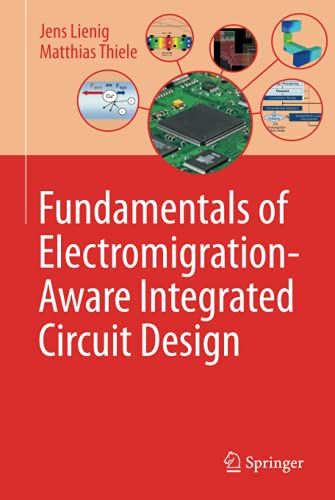
The book provides a comprehensive overview of electromigration and its effects on the reliability of electronic circuits. It introduces the physical process of electromigration, which gives the reader the requisite understanding and knowledge for adopting appropriate counter measures. A comprehensive set of options is presented for modifying the present IC design methodology to prevent electromigration. Finally, the authors show how specific effects can be exploited in present and future technologies to reduce electromigration’s negative impact on circuit reliability.
User’s Reviews
Editorial Reviews: Review “This unique book provides the fundamental science necessary for a sound grounding from which to make practical use of the complete and indispensable application-oriented information regarding the electromigration-aware design of electronic systems. It is a foundational reference for today’s design professionals, as well as for the next generation of engineering students.” Prof. Worthy Martin, University of Virginia “This is a long-awaited book bridging the design and reliability methodologies imperative for generating robust and high-performing semiconductor devices. A deep insight into physics of the electromigration induced degradation of on-chip interconnect components as well as explaining a design specific failure development are beneficial for both the chip-design and materials engineering communities.” Dr. Valeriy Sukharev, D2S Calibre Division of Mentor, a Siemens Business “As digital electronic circuits scale down, it is getting increasingly difficult to maintain digital abstractions against a variety of physical phenomena, such as electromigration. This book summarizes our current understanding of electromigration and how its effects can be moderated in practice. Particularly important and valuable are techniques that can address electromigration in modern automated design flows.” Prof. Igor Markov, University of Michigan “This timely book builds a fundamental knowledge of electromigration as well as discussing methods for designing robust integrated circuits. It covers electromigration, methodologies for electromigration-aware design for analog and digital circuits, and methods for mitigating electromigration during the physical design, all in-depth. Rarely, one can find a book with such scope and such practical applications. This book is an excellent resource for new and experienced IC designers.” Prof. Laleh Behjat, University of Calgary “Good to have this book that walks the readers through a wonderful journey from understanding the basics and background of electromigration in circuit reliability to its physical process and the counter measures in physical design. It can help greatly people in different disciplines to understand these important topics and work towards better solutions in future technologies.” Prof. Evangeline F.Y. Young, The Chinese University of Hong Kong Review “This unique book provides the fundamental science necessary for a sound grounding from which to make practical use of the complete and indispensable application-oriented information regarding the electromigration-aware design of electronic systems. It is a foundational reference for today’s design professionals, as well as for the next generation of engineering students.” (Prof. Worthy Martin, University of Virginia)“This is a long-awaited book bridging the design and reliability methodologies imperative for generating robust and high-performing semiconductor devices. A deep insight into physics of the electromigration induced degradation of on-chip interconnect components as well as explaining a design specific failure development are beneficial for both the chip-design and materials engineering communities.” (Dr. Valeriy Sukharev, D2S Calibre Division of Mentor, a Siemens Business)“As digital electronic circuits scale down, it is getting increasingly difficult to maintain digital abstractions against a variety of physical phenomena, such as electromigration. This book summarizes our current understanding of electromigration and how its effects can be moderated in practice. Particularly important and valuable are techniques that can address electromigration in modern automated design flows.” (Prof. Igor Markov, University of Michigan)“This timely book builds a fundamental knowledge of electromigration as well as discussing methods for designing robust integrated circuits. It covers electromigration, methodologies for electromigration-aware design for analog and digital circuits, and methods for mitigating electromigration during the physical design, all in-depth. Rarely, one can find a book with such scope and such practical applications. This book is an excellent resource for new and experienced IC designers.” (Prof. Laleh Behjat, University of Calgary)“Good to have this book that walks the readers through a wonderful journey from understanding the basics and background of electromigration in circuit reliability to its physical process and the counter measures in physical design. It can help greatly people in different disciplines to understand these important topics and work towards better solutions in future technologies.” (Prof. Evangeline F.Y. Young, The Chinese University of Hong Kong) From the Back Cover The book provides a comprehensive overview of electromigration and its effects on the reliability of electronic circuits. It introduces the physical process of electromigration, which gives the reader the requisite understanding and knowledge for adopting appropriate counter measures. A comprehensive set of options is presented for modifying the present IC design methodology to prevent electromigration. Finally, the authors show how specific effects can be exploited in present and future technologies to reduce electromigration’s negative impact on circuit reliability. Enables readers to understand and meet challenges of electromigration, including its effects on the reliability of electronic systemsAccessible to readers of varying backgrounds and experience levels, combining practical application with theoretical underpinnings.Extensive use of multi-color illustrations, for rapid and clear understandingMultiple examples and hands-on instructions for the practical application of counter measures. “This unique book provides the fundamental science necessary for a sound grounding from which to make practical use of the complete and indispensable application-oriented information regarding the electromigration-aware design of electronic systems. It is a foundational reference for today’s design professionals, as well as for the next generation of engineering students.” Prof. Worthy Martin, University of Virginia “This is a long-awaited book bridging the design and reliability methodologies imperative for generating robust and high-performing semiconductor devices. A deep insight into physics of the electromigration induced degradation of on-chip interconnect components as well as explaining a design specific failure development are beneficial for both the chip-design and materials engineering communities.” Dr. Valeriy Sukharev, D2S Calibre Division of Mentor, a Siemens Business “As digital electronic circuits scale down, it is getting increasingly difficult to maintain digital abstractions against a variety of physical phenomena, such as electromigration. This book summarizes our current understanding of electromigration and how its effects can be moderated in practice. Particularly important and valuable are techniques that can address electromigration in modern automated design flows.” Prof. Igor Markov, University of Michigan “This timely book builds a fundamental knowledge of electromigration as well as discussing methods for designing robust integrated circuits. It covers electromigration, methodologies for electromigration-aware design for analog and digital circuits, and methods for mitigating electromigration during the physical design, all in-depth. Rarely, one can find a book with such scope and such practical applications. This book is an excellent resource for new and experienced IC designers.” Prof. Laleh Behjat, University of Calgary “Good to have this book that walks the readers through a wonderful journey from understanding the basics and background of electromigration in circuit reliability to its physical process and the counter measures in physical design. It can help greatly people in different disciplines to understand these important topics and work towards better solutions in future technologies.” Prof. Evangeline F.Y. Young, The Chinese University of Hong Kong About the Author Jens Lienig is the director of the Institute of Electromechanical and Electronic Design at Dresden University of Technology, Germany. He received his Ph.D. in the field of computer-aided physical design of multi-chip modules and was employed as a researcher at University of Virginia, Charlottesville and Concordia University, Montreal. Afterwards he worked as project manager at Tanner Research, Inc. and Robert Bosch GmbH. His main research subjects are design of electronic systems and electronic design automation. Matthias Thiele is a scientific assistant at Dresden University of Technology, Germany. He received his Ph.D. in the field of electromigration. Currently he works on the reliability of electronic and mechatronic systems. Read more
Reviews from Amazon users which were colected at the time this book was published on the website:
⭐The book is written in an easy-to-understand style that allows any circuit designer, even those normally not familiar with physical/material theory, to grasp the physics and root causes of EM. This is critical, because only by understanding the underlying physical causes can one select the most effective counter-measures. The book clearly summarizes these counter-measures, after providing the knowledge to really understand them.The authors do a great job at the beginning of the book in motivating the topic of EM, showing convincingly that EM is THE challenge if we want to continue producing reliable ICs in the future. This sets the stage for the chapters that follow, which describe in further detail the causes of EM, and effective measures to prevent and mitigate its occurrence.The book is very current, and contains a sub-chapter on the new topic of mission profiles, which allow a designer to derive realistic, i.e., application-oriented, design rules, such as current-density limits. This has not been covered elsewhere – but is crucial for practical applications, and here real environments are taken into account. From my experience, regular EM papers never even mention environmental factors, and instead typically show (theoretical) values applicable to lab conditions, that are little help to IC designers developing for the real-world.I also appreciated how the authors presented the combined consideration of EM with stress and thermal migration, because EM “never acts alone”. This discussion provides interesting insights into their mutual dependencies, as this has not been investigated well in the technical literature.The chapter “Migration Analysis Through Simulation” covers simulation techniques in a hierarchical way, from coarse to fine grained. This knowledge is a “must” for anyone investigating EM in circuits: after all, you cannot really see EM, so it must be simulated to visualize its effects and damages. I found the presentation well-structured, the authors doing a great job with this (normally) complicated topic.Moreover, I found the entire book well structured. Individual chapters are self-contained and can be read in any order, to dive deeply into a topic right now. For example, Chapter 2 is very helpful if you want to learn about EM, while Chapter 3 describes how EM relates to the broader topic of IC physical design. If your interest is counter-measures, Chapter 4 describes these, and how they can be applied. And so on.I really enjoyed the final Outlook section, where the authors give reason for some optimism that we will have solutions when it comes to producing reliable circuits in the future, despite an alarming increase in current densities. They present viable paths ahead, which any circuit designer will want to know more about.In summary, this book can be recommended to any engineer or student who wants to really understand this increasingly serious reliability challenge. Contrary so many of to the EM papers I have read, with their limited views, this book considers EM from all sides, in a clear and comprehensive way. It is a welcome addition to your bookshelf, and will save you time (and frustration) in truly becoming an expert in this subject.
⭐Electromigration (EM) is a subject that is often discussed in conferences and journal papers and less often in our daily lives. If not tamed, EM is a physical phenomenon that can debilitate the longevity of the semiconductor devices omnipresent our smart phones, ipads, cars, smart home edge devices, etc. Fundamentals of Electromigration-Aware Integrated Circuit Design offers an insightful journey into the world of electromigration. More specifically material migration caused by the presence of an electric field. EM is sort of a disease that can erode or distort the wires connecting semiconductor devices together causing to fail or short. To draw an analogy on a grander scale, imagine a sprawling metropolis where the joints or trusses in freeways or bridges start to erode causing catastrophic failures. The authors elegantly paint the following description of EM:”current flow through a conductor produces two forces to which the individual metal ions in the conductor are exposed, the first of which is an electrostatic force field caused by the electric field strength in the metallic wire interconnect. Since the positive metal ions are shielded to some extent by the negative electrons in the conductor, this static force can safely e ignored in most cases. The second force is generated by the momentum transfer between conduction electrons and metal ions in the crystal lattice. This wind force, which one may visualize by analogy as a breeze or wind blowing through the leaves of a tree, acts in the direction of the current flow and is the primary cause of EM.”According to the 2014 International Technology Roadmap of Semiconductors Review Board, the maximum current density tolerable without EM is at the 2026 node technology level is 0.3 amp/cm^2, while the maximum current density beyond which EM solutions are not known is 1.2 amp/cm^2. At that technology node, the required current density of driving a four-inverter gate will be 4.5 amp/cm^2! That is, investigating design methodologies to prevent EM is a MUST-HAVE to ensure the phenomenal progress we have witnessed over the past 5 decades or so. The authors present a cohesive analysis of the causes of EM, its interactions with the other three types of material migration (chemical diffusion, thermal diffusion, and mechanical stress), known scenarios of EM, and a finite-element simulation framework to analyze conditions for general structures along with recommendations to alter the physical design flow to mitigate EM. This manuscript is clearly written, with an excellent use of charts, tables, and figures, and is self-contained in its exposition of EM. I believe it is an excellent guide for students, researchers, and professional IC designers and practioners.
⭐As an engineer, I have to cope with reliability issues all the time. As more and more migration problems are showing up in our circuits, and here especially electromigration, I was looking for a book that gives me a concise, but nevertheless deep-enough background on its causes and solutions. A colleague recommended “Fundamentals of EM-Aware Integrated Circuit Design” to me — and I was not disappointed. I learned a lot on the causes of EM (including the differences to electrolytic EM), but more importantly, how to avoid it. I especially like the (easy-to-read) sections on simulations, as I am afraid that one day I have to deal with it as well. All in all, this is a book that I can recommend to anyone who cares about reliability in ICs and PCBs.
Keywords
Free Download Fundamentals of Electromigration-Aware Integrated Circuit Design in PDF format
Fundamentals of Electromigration-Aware Integrated Circuit Design PDF Free Download
Download Fundamentals of Electromigration-Aware Integrated Circuit Design 2018 PDF Free
Fundamentals of Electromigration-Aware Integrated Circuit Design 2018 PDF Free Download
Download Fundamentals of Electromigration-Aware Integrated Circuit Design PDF
Free Download Ebook Fundamentals of Electromigration-Aware Integrated Circuit Design