

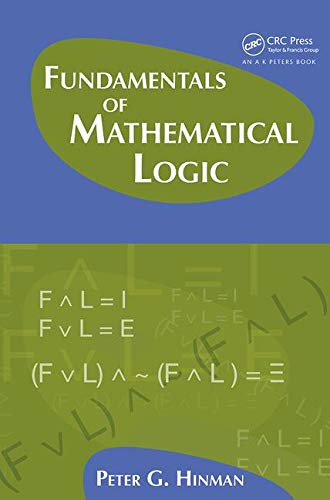
Ebook Info
- Published: 2005
- Number of pages: 894 pages
- Format: PDF
- File Size: 62.71 MB
- Authors: Peter G. Hinman
Description
This introductory graduate text covers modern mathematical logic from propositional, first-order and infinitary logic and Gödel’s Incompleteness Theorems to extensive introductions to set theory, model theory and recursion (computability) theory. Based on the author’s more than 35 years of teaching experience, the book develops students’ intuition by presenting complex ideas in the simplest context for which they make sense. The book is appropriate for use as a classroom text, for self-study, and as a reference on the state of modern logic.
User’s Reviews
Editorial Reviews: Review ” expect this book to become the standard graduate logic text for the new century, based on the enthusiastic reception from students in our course last year.”” -Doug Cenzer, University of Florida, July 2005 book is the long awaited successor to Shoenfield’s book. At last under one cover is all one needs for an advanced introduction to mathematical logic. I will recommend it to all my beginning students.”” -Gerald Sacks, Harvard University, November 2005 “”The book develops students’ intuition by presenting complex end difficult ideas in the simplest context for which they make sense. Each part of the text contains useful remarks, illustrative examples ond related exercises … the author’s style is quite clear and approachable. No previous experience with logic is presumed, only the maturity and capacity for abstraction. Consequently, this book seems to be ideal to graduate students of both mathematics ond theoretical computer science, as well as to students of philosophy and a large circle of specialists working in the field of mathematical logic.”” -Branislav Boricic, Zentralblatt MATH, July 2006 “”Based on the author’s more than thirty-five years of teaching experience at the University of Michigan, and nearly twenty years in the writing, this book incorporates what he has leamed about enabling students with varying levels of interest and ability to come to a deep understanding of this beautiful subject.”” -Peter Fillmore, CMS, February 2007 “”Based on the author’s more than thirty-five years of teaching experience at the University of Michigan, and nearly twenty years in the writing, this book incorporates what he has learned about enabling ‘students with varying levels of interest and ability to come to a deep understanding of this beautiful subject.’ Among the testimonials from users: At last under one cover is all one needs for an advanced introduction to mathematical logic (Gerald Sacks, Harvard).”” -Canadian Mathematical Society, February 2007″ About the Author Peter G. Hinman earned his B.A. in mathematics from Harvard University in 1959. He studied mathematics at the graduate level in Berkeley at the University of California. In 1966, under the guidance of Professor John Addison, he received his Ph.D. in Mathematical Logic with a particular focus on Recursion Theory. He is currently a professor at the University of Michigan where he has taught since 1966 and advised seven successful Ph.D. students. In 1978 he published his first book Recursion-Theoretic Hierarchies.
Reviews from Amazon users which were colected at the time this book was published on the website:
⭐If I were a young graduate student in mathematics looking for that one “perfect” graduate text on mathematical logic to purchase with my (very) limited income, I would buy a copy of Professor Hinman’s book. In just under 900 pages, Hinman provides an extremely well written and informed introduction to propositional logic, first order mathematical logic, axiomatic set theory, model theory, and recursion theory. Indeed, the book is written so well that a motivated student with the requisite background can easily profit from independent study—a statement that simply cannot be made about many of the other “classic” references in this difficult field. One great virtue of having a single reference that introduces these diverse but interconnected areas is the uniformity of notation and definitions; the reader need not pull his hair out cross-referencing between texts that use wildly different notation and, occasionally, different definitions.I studied mathematical logic at the University of Colorado–Boulder in the late 1970s. In those days, the logic students all depended on a standard list of references to prepare for the PhD qualifying examinations, and it is significant that all or nearly all of those works are still in print. At the introductory level we read the magnificent books on mathematical logic and set theory by Herbert Enderton. At the graduate level, we read Shoenfield, Monk, Mendelson, and Manin for mathematical logic, Chang and Keisler for Model Theory, Jech (and to a lesser extent, Kunen) for set theory, and Hartley Rogers for recursive function theory. In the course of plodding through these references, I discovered a wonderful comprehensive text by John Bell and Moshe Machover and quickly elevated it to primary status on my reading list. Bell and Machover remains my favorite among the older references today, nearly thirty years later, both in terms of comprehensive coverage and clarity of prose; when I reach for a reference to clarify an issue on foundations, Bell and Machover is the first book I turn to.The new book by Hinman achieves the same comprehensive goals of Bell and Machover, providing a rigorous and coordinated introduction to logic, set theory, recursion theory and model theory. However, Hinman incorporates some research topics that have emerged in the years since the 1977 publication of Bell and Machover, and it includes some more traditional topics that were difficult to find in the earlier texts. To give one example, Hinman provides a brief introduction to the axiom of determinacy. This topic was made available to non-specialists in two papers published in the AMS Notices of June and July, 2001, where Hugh Woodin of Berkeley discussed the axiom of projective determinacy and other hypotheses within the context of possible enlargements of ZFC that would resolve Cantor’s famous continuum hypothesis. A second example is Hinman’s very lucid treatment of forcing; this writer has always had difficulty understanding the very few presentations of Paul Cohen’s forcing technique that have been available in the older texts, but I found Hinman’s treatment exceptionally clear and easy to follow.Professor Hinman states that this book resulted from his nearly 40 years of experience teaching mathematical logic to graduates and undergraduates. The truth of this claim is reflected in the exceptional clarity of the prose and the coherence as one skims across different chapters. It is apparent that serious thought, consideration for the reader, and years of experience in the classroom shaped the final form of this text. Given the paucity of new texts in mathematical logic and foundations, the publication of this book is truly a cause for celebration. If you can only afford one text on the subject, purchase this one; if you are burdened with an abundance of spare change, I recommend buying Bell and Machover as a second reference to supplement Hinman.
⭐This book is an excelent exposition of propositional logic, first-order logic, Gödel’s incompleteness theorems, axiomatic set theory, model theory and recursion theory. This is the book you should use if you want to dive deep in mathematical logic after having an elementary introduction to logic and informal set theory.
⭐Quoting the author Hinman (page xi): “A notable lacuna is Proof Theory,which fails to appear largely due to the incompetence of the author in this area”.And he is correct: there is no proof theory in this book, no Hilbert axioms,no Gentzen natural deduction nor sequent calculus, nothing (except for a cursory13 page section out of 878).So, on the one hand, we have the largest logic book I have ever seen– and yet, ironically, the most incomplete.I’m sure there’s a lot of good stuff in this book and it is written well but it’smissing half the story, i.e., it is missing an exposition of how one manipulatessymbols formally to prove theorems. Even the semantic, model-theoretic side is incomplete:there’s no semantic tableaux, no resolution. Also, at 878 pages, plausiblya considerable portion is at an advanced level.So, this is not a good introduction to logic.By far the best introduction to logic I’ve found is “Mathematical Logic forComputer Science” by Mordechai Ben-Ari. Serious/pure mathematicians of course willwant to continue with the likes of “An Introduction To Mathematical Logic”by Elliott Mendelson.
Keywords
Free Download Fundamentals of Mathematical Logic 1st Edition in PDF format
Fundamentals of Mathematical Logic 1st Edition PDF Free Download
Download Fundamentals of Mathematical Logic 1st Edition 2005 PDF Free
Fundamentals of Mathematical Logic 1st Edition 2005 PDF Free Download
Download Fundamentals of Mathematical Logic 1st Edition PDF
Free Download Ebook Fundamentals of Mathematical Logic 1st Edition