

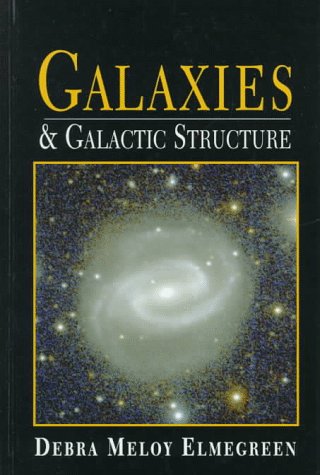
Ebook Info
- Published: 1997
- Number of pages: 306 pages
- Format: PDF
- File Size: 7.56 MB
- Authors: Debra Meloy Elmegreen
Description
Developed for undergraduate astronomy students, this volume introduces observational and theoretical perspectives on galaxies, and their formation, structure, evolution and distribution. Twelve chapters cover galaxy morphology and kinematics including: galaxy classification, star light, integrated and differential galaxy light, gases, rotation, the kinematics of the Milky Way and spiral wave galaxies, large-scale star formation, starbursts and active galaxies, and large-scale distributions. Basic physics and calculus ideas are introduced in the text where relevant. Annotation c. by Book News, Inc., Portland, Or.
User’s Reviews
Editorial Reviews: From the Back Cover Key Benefit: Comprehensive in scope, the book considers the formation, structure, evolution, and distribution of galaxies, and is particularly strong it its approach to analyzing light distributions in galaxies and in developing a theoretical framework in which to interpret the observations. Key Topics: A general description of galaxies is followed by a detailed examination of their light distributions, and then kinematic data allow an interpretation of the cause of the structure. Later chapters deal with interactions of galaxies and their distribution in the cosmos. The book also integrates discussions of different types of galaxies throughout.
Reviews from Amazon users which were colected at the time this book was published on the website:
⭐The two main topics in GALAXIES AND GALACTIC STRUCTURE ARE:I. Galaxy Morphology with chapters 1-6 Ch 1. Overview Ch 2. Galaxy Classification Ch 3. Starlight Ch 4. Integrated Galaxy Light Ch 5. Differential Galaxy Light Ch 6. GasII. Galaxy Kinematics with chapters 7-12 Ch 7. Galaxy Rotation Ch 8. Milky Way Kinematics and Structure Ch 9. Spiral Kinematics Ch 10. Star Formation Ch 11. Active Galaxies Ch 12. Large-Scale Galaxy DistributionFor me, GALAXIES AND GALACTIC STRUCTURE was an advanced level textbook in the sense that many chapters contained equations presented “as-is” with no explanation of where the equations came from or their derivation. For me, in many instances I would also have appreciated more clarrification explaining how the equations could be used. I found this mildly irritating but realize showing derivations of everything would probably triple the size of the book. As a result I wound up skimming some of the later chapters trying only to follow the general concepts. The author admits derivation of many of the equations are “beyond the scope of this text.” The author, Debra Elmegreen, is obviously extremely knowledgeable about galaxies but I found some of the content hard to follow just reading it. If I were a student in her class having heard her explanation it would probably have been easier to follow than just having the book to read.Although the book contains exercises at the end of each chapter no answers are given which makes it hard for self-study. Many of the exercises require looking up data from various sources on the internet. For me, a great many of the problems seemed to be quite involved and difficult.There is an extensive reference list of research articles and books for “Further Reading” available at the end of each chapter.
⭐Of the textbooks on Galaxies which have a lot of equations in them, this is the one which gives the most simplified versions of these equations – as such, it is understandable to anyone whose schooling included algebraic manipulation and complex graphs and some basic physics. This book explains a good portion of what you need to know in order to be able to understand the professional literature of Milky Way and extragalactic astronomy. It gives the reader insight into how professional astronomers think numerically about things like: distance modulus, galaxy magnitudes, galaxy isophotes, radial intensity profiles of galaxies, broadband colors of galaxies, spiral galaxy morphology (e.g. bars, spiral arms), the star formation rate in a galaxy, and the interstellar medium within galaxies. Elmegreen’s text achieves this without recourse to a lot of calculus, and with maximum hand-holding from the author. As such, it is suitable for Very Advanced amateur astronomers and for people undertaking a really serious study of galaxies at the college or lower-undergraduate level.Often in this text, the presented equations and calculations of galactic parameters (e.g. of the inclination of spiral galaxies, of the extinction within galaxies, of Galaxy magnitudes and colors) are pared down and simplified to the extent that they do not represent the way these things are currently calculated by professional astronomers. This approach has decided pluses and minuses:- the frustration of not getting the full story about a calculation. (a minus)- the greater ease of understanding of a simplified equation. (a plus)- adequate information to start the reader on the journey towards knowing how to work with galaxies in a quantitative manner. (a plus)To its credit, this book is clear enough to provide the insight a person needs in order to be able to follow up with further reading about how calculations are actually done by today’s astronomers. The reader is taught, albeit in a simplified way, how to use numbers and equations to figure out some worthwhile things about galaxies.This book does however exemplify the all-too-common limitations of approach which are caused by a book having an over-specialized Scientist author who is bravely trying to explain incredibly vast fields of knowledge within a single slim volume. For example, several of the tables and graphs contain very very very Old (and inaccurate) galaxy data which is not the best that is currently available; data which was already out-of-date when this book was written! A much more significant flaw in this book is that those sections of the book that the author is less of an expert on……. are less detailed and less up-to-date than they should be.Accordingly, this text has a few important limitations:- as is the case in virtually every textbook about galaxies written at the undergraduate level, the section on the Classification of Galaxies is too simplified to be really useful, and very out of date.- the section on elliptical galaxies represents the state of knowledge 20 years before this book was written, rather than what was known about elliptical galaxies by the mid- to late- 1980s. This part of the book is therefore grossly oversimplified and also wrong in several places.- some basic information presented in this book is actually not correct.It may actually be unavoidable in a slim volume such as this, which is written at a beginning physical/mathematical level, that some topics will be dealt with in an oversimplified or somewhat out-of-date manner, so perhaps this book’s Significant Weaknesses may not actually be a great problem.Elmegreen does indeed explain many things about Galaxies. She explains galaxies in a lucid introductory-level quantitative manner, with physical/algebraic/graphical explanations that are easy to follow if you have had prior exposure to some algebra and physics.
⭐This book it’s the best to what it’s level is UNDERGRADUATE. Clarity, lot’s of pictures for that, pretty academic taste. It is a little expensive!
⭐It is one of the best books to introduce the subject, very easy to read and learn even without instructor, I highly recommend it undergraduate level, in spit of it a little bit expensive but it is worth it.
Keywords
Free Download Galaxies and Galactic Structure 1st Edition in PDF format
Galaxies and Galactic Structure 1st Edition PDF Free Download
Download Galaxies and Galactic Structure 1st Edition 1997 PDF Free
Galaxies and Galactic Structure 1st Edition 1997 PDF Free Download
Download Galaxies and Galactic Structure 1st Edition PDF
Free Download Ebook Galaxies and Galactic Structure 1st Edition