

Ebook Info
- Published: 2011
- Number of pages: 288 pages
- Format: PDF
- File Size: 28.11 MB
- Authors: L. C. Thomas
Description
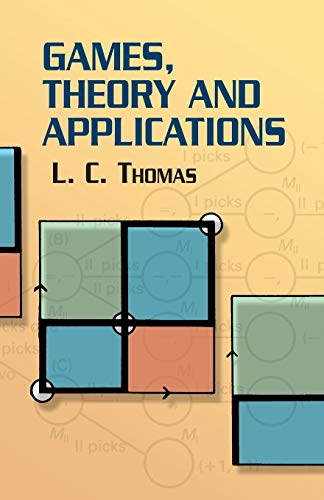
Anyone with a knowledge of basic mathematics will find this an accessible and informative introduction to game theory. It opens with the theory of two-person zero-sum games, two-person non-zero sum games, and n-person games, at a level between nonmathematical introductory books and technical mathematical game theory books. Succeeding sections focus on a variety of applications — including introductory explanations of gaming and meta games — that offer nonspecialists information about new areas of game theory at a comprehensible level. Numerous exercises appear with full solutions, in addition to an extensive bibliography, 80 problems with worked solutions, and over 30 illustrations useful for the theory of non-zero and n-person games. 1986 edition.
User’s Reviews
Reviews from Amazon users which were colected at the time this book was published on the website:
⭐good
⭐Thomas’ 274 page, 6″x9″ textbook was written explicitly for undergraduates such as those he taught at University of Manchester in England. In way of a mathematics background only a solid grounding in differential and integral calculus is assumed. Nevertheless, because there are many subtle concepts explored in this book I suspect that it might be most appropriate for third year American college students majoring in such math-intensive disciplines as mathematics, physical sciences, and engineering.I actually sought out this book after seeing the movie
⭐starring Russell Crowe and then reading
⭐by Sylvia Nasar. John Nash’s Nobel-prize winning work is addressed primarily in Chapter 3 “Two person Non-zero-sum Games” that spans pp.53-84. The preceding Chapter addresses “Two person Zero-sum Games”. It is noteworthy that Nash’s Theorem deals with conflicts and competitions in which the two players might both benefit from certain cooperative strategies.Thomas helps the reader by “sketching” a proof of Nash’s Theorem with the aid of Brouwer’s Fixed Point Theorem. Brouwer’s contribution is a topological theorem that is akin to the observation that a person is unable to get all the hair on his head to lie flat, for at some point, such as at the cowlick or base of the part, the hair must stand up–a bane to small boys everywhere. It is at this “cowlick” that a function maps a point onto itself (i.e. f(x)=x). It is at this self-mapping point that the two competitors find the most mutually advantageous situation.This textbook provides many games and situations to illustrate its points, as well as a number of appropriate problems to solve at the end of each chapter. Ten pages of references are also provided for the reader who wants to look up the original journal articles, such as those authored by John Nash.
⭐Good book
Keywords
Free Download Games, Theory and Applications (Dover Books on Mathematics) in PDF format
Games, Theory and Applications (Dover Books on Mathematics) PDF Free Download
Download Games, Theory and Applications (Dover Books on Mathematics) 2011 PDF Free
Games, Theory and Applications (Dover Books on Mathematics) 2011 PDF Free Download
Download Games, Theory and Applications (Dover Books on Mathematics) PDF
Free Download Ebook Games, Theory and Applications (Dover Books on Mathematics)