Ebook Info
- Published: 2002
- Number of pages: 422 pages
- Format: PDF
- File Size: 4.34 MB
- Authors: I.J.R. Aitchison
Description
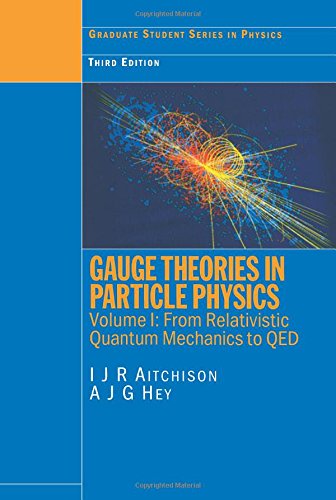
Gauge Theories in Particle Physics, Volume 1: From Relativistic Quantum Mechanics to QED, Third Edition presents an accessible, practical, and comprehensive introduction to the three gauge theories of the standard model of particle physics: quantum electrodynamics (QED), quantum chromodynamics (QCD), and the electroweak theory. For each of them, the authors provide a thorough discussion of the main conceptual points, a detailed exposition of many practical calculations of physical quantities, and a comparison of these quantitative predictions with experimental results.For this two-volume third edition, much of the book has been rewritten to reflect developments over the last decade, both in the curricula of university courses and in particle physics research. Substantial new material has been introduced that is intended for use in undergraduate physics courses. New introductory chapters provide a precise historical account of the properties of quarks and leptons, and a qualitative overview of the quantum field description of their interactions, at a level appropriate to third year courses. The chapter on relativistic quantum mechanics has been enlarged and is supplemented by additional sections on scattering theory and Green functions, in a form appropriate to fourth year courses. Since precision experiments now test the theories beyond lowest order in perturbation theory, an understanding of the data requires a more sophisticated knowledge of quantum field theory, including ideas of renormalization. The treatment of quantum field theory has therefore been considerably extended so as to provide a uniquely accessible and self-contained introduction to quantum field dynamics, as described by Feynman graphs. The level is suitable for advanced fourth year undergraduates and first year graduates.These developments are all contained in the first volume, which ends with a discussion of higher order corrections in QED; the second volume is devoted to the non-Abelian gauge theories of QCD and the electroweak theory. As in the first two editions, emphasis is placed throughout on developing realistic calculations from a secure physical and conceptual basis.
User’s Reviews
Editorial Reviews: Review “The third edition volume 1 is a classic. All three editions are worth having. . . There are things which change and develop, as well as the inclusion of new material, as the editions appear. The clarity of exposition and the language of explanation gets even better, as the editions appear. The insights, some added in the later editions, broaden and challenge one’s understanding. Above all, the excitement that one gets by being guided through the advanced theoretical concepts by the authors is unique. . . The book focuses much more of its attention on understanding. It is this feature that makes Gauge Theories in Particle Physics’ so invaluable.” — Professor John Dainton FRS, University of Liverpool . .” . . the authors have substantially enlarged the text to reflect developments both in university curricula and the field of particle physics.” — CERN COURIER “Reading the book of Aitchison and Hey one can see that the authors have taken a lot of pains to achieve their work to be understandable by undergraduate students. We believe that the authors were successful in this aspect and their book is very suitable into later stages of undergraduate studies of students of theoretical physics with inclination to particle physics. However, it can still be useful also for graduate PhD students and more educated scientists, who would like to be more familiar with some of the presented problems of particle physics.”
Reviews from Amazon users which were colected at the time this book was published on the website:
⭐Excellent service on a classic that is somewhat a rare edition
⭐This book (2nd edition) has 15 chapters . I have just finished chapter 4 entitled QFT and I am compeled to write this review! After a year of studying of QFT informally I can report that this is the way to introduce yourself to the topic. I’ve been through Mandl & Shaw, Peskin & Schoeder, Ryder, Weinberg and a few others and this is heads and tails the BEST intro available. In 42 pages, Aitchison & Hey make the transistion from classical to QM and from QM to QFT as gracefully as I can conceive. For example, the transition from the discrete Lagrangian to the field Lagrangian is very explicit. One benfit of this is that the dependence of L on partial of phi wrt x is clearly motivated leading to the manifestly relativistically invariant form of L. They explicitly develop physical intuition at every step of the way – for example, this is the only book that I have found that explicitly asks the question where is QM’s wavefunction in the QFT formalism? Answer – The vacuum to one-particle matrix elements of the field operators. The transistion from free fields to interacting fields is far clearer than any other treatment I’ve seen. I also appreciated that the problems were used to basically fill in details left out of the text. I was able to ‘practice’ the various kinds of manipulations that are required.
⭐Buena referenciaI wholeheartedly agree with the other reviewers. I did my degree in Maths and Physics over 30 years ago and have had no professional connection with physics since. After brushing up on quantum mechanics and relativity I wanted to tackle Quantum Field Theory. I must have tried about a dozen alternative texts, many highly recommended, before I finally found Aitchison & Hey.The authors really seem to be able to put themselves in the position of someone who is completely new to all of this. They go very easy on things like 4-vector notation, often writing out equations in more familiar vector calculus form, especially at the start of the book, until the reader feels more comfortable with covariant notation.The appendices are particularly helpful and fall into two categories: those which summarise what you should already know, and those that teach the basics of techniques that might be unfamiliar. All the appendices are useful but I found those on the Dirac delta function, contour integration (they teach you what you need to know for this book in only six pages!) and Greens functions particularly so. Thanks to the appendices, I found the book to be almost entirely self contained.However, a warning: QFT is probably one of the most difficult subjects that anyone can try to master on their own. Even A&H I found to be quite challenging in places. It has taken me nearly a year and I still haven’t quite got to the end of volume one, with one chapter alone taking me nearly three months to complete.It is often said that no one book can teach you QFT. That may be true, but A&H have come, by far, the closest of the many volumes that I have tried.
Keywords
Free Download Gauge Theories in Particle Physics, Vol. 1: From Relativistic Quantum Mechanics to QED, 3rd Edition in PDF format
Gauge Theories in Particle Physics, Vol. 1: From Relativistic Quantum Mechanics to QED, 3rd Edition PDF Free Download
Download Gauge Theories in Particle Physics, Vol. 1: From Relativistic Quantum Mechanics to QED, 3rd Edition 2002 PDF Free
Gauge Theories in Particle Physics, Vol. 1: From Relativistic Quantum Mechanics to QED, 3rd Edition 2002 PDF Free Download
Download Gauge Theories in Particle Physics, Vol. 1: From Relativistic Quantum Mechanics to QED, 3rd Edition PDF
Free Download Ebook Gauge Theories in Particle Physics, Vol. 1: From Relativistic Quantum Mechanics to QED, 3rd Edition