

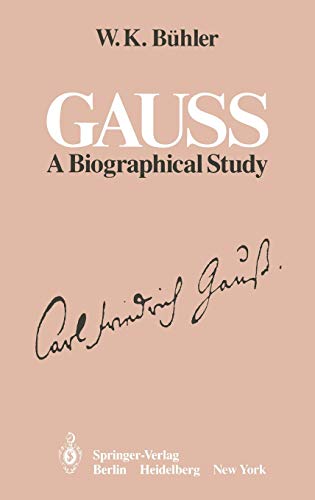
Ebook Info
- Published: 1981
- Number of pages: 216 pages
- Format: PDF
- File Size: 15.69 MB
- Authors: W. K. Bühler
Description
Procreare iucundum, sed parturire molestum. (Gauss, sec. Eisenstein) The plan of this book was first conceived eight years ago. The manuscript developed slowly through several versions until it attained its present form in 1979. It would be inappropriate to list the names of all the friends and advisors with whom I discussed my various drafts but I should like to mention the name of Mr. Gary Cornell who, besides discussing with me numerous details of the manuscript, revised it stylistically. There is much interest among mathematicians to know more about Gauss’s life, and the generous help I received has certainly more to do with this than with any individual, positive or negative, aspect of my manuscript. Any mistakes, errors of judgement, or other inadequacies are, of course, the author’s responsi bility. The most incisive and, in a way, easiest decisions I had to make were those of personal taste in the choice and treatment of topics. Much had to be omitted or could only be discussed in a cursory way.
User’s Reviews
Editorial Reviews: Review “This biography is addressed to the contemporary professional mathematician who is assumed to be a specialist with limited historical interests and knowledge. Although the fifteen chapters, supplemented by several shorter interchapters, are basically chronological, particular aspects of Gauss’s work are stressed in particular chapters (e.g., potential theory in Chapter 11) so that for most of the book the reader will be outside his narrow specialty. Inevitably the life of the “Prince of Mathematicians” raises many important historical questions, such as the relationship between pure and applied mathematics and of both to the political and economic background, communication and cooperation, conservatism and innovation, and personal and social life…” — MATHEMATICAL REVIEWS
Reviews from Amazon users which were colected at the time this book was published on the website:
⭐In the first six pages of the book, Bühler tells us about the background of Gauss’s family, his family’s place in society, and about Gauss’s early schooling. Bühler admirably explains the significance of the various information he gives. I didn’t know how common it was for a child from a family like Gauss’s to attend elementary school, or what careers someone like him would have hoped for. Knowing this helps me get a better feel for Gauss’s early years than reading trite and unsubstantiated stories about how clever Gauss was as a child. Bühler’s comments about the change in German life caused by the Napoleonic wars are helpful to those like myself who have only a scattered knowledge of this time.There are other places where a less disciplined author would have either passed over a topic without explaining its significance, or misinterpreted what happened, perhaps to sensationalize it. Bühler notes that Gauss’s decision to go to Göttingen rather than to stay in Brunswick-Wolfenbüttel was not unusual, that a friend of his had done the same, and that Gauss continued to receive a stipend from the Duke (and Bühler had mentioned before that receiving a stipend was itself not unusual) . The reader would have been left by a worse author to decide whether getting a stipend was an outstanding accomplishment.Bühler describes just the important points about the works of Gauss he discusses. The reader will probably only get a sketchy idea, but these descriptions will be very helpful for someone who wishes to study Gauss’s works in detail. I didn’t get any firm understanding from Bühler’s explanation of the connection between elliptic integrals and the arithmetico-geometric mean, but I would certainly return to this description if I were later to examine the topic more deeply. And anyone wishing to write on the history of modular forms should read Bühler’s analysis in this book, which in summary says that Gauss was led to modular forms through the theory of quadratic forms, leading to his “Summatorische Funktion”. Bühler gives a useful paragraph by paragraph summary on Section VII of Gauss’s Disquisitiones Arithmeticae, which is about cyclotomy. I hope later to examine Gauss’s “Summatio quarundam serierum singularum”, which I had come across before in my study of Euler’s pentagonal number thoerem and in which Gauss deals with what we now call Gauss sums, and Bühler’s book will be on my desk when I do this.
⭐
Keywords
Free Download Gauss: A Biographical Study 1981st Edition in PDF format
Gauss: A Biographical Study 1981st Edition PDF Free Download
Download Gauss: A Biographical Study 1981st Edition 1981 PDF Free
Gauss: A Biographical Study 1981st Edition 1981 PDF Free Download
Download Gauss: A Biographical Study 1981st Edition PDF
Free Download Ebook Gauss: A Biographical Study 1981st Edition