Ebook Info
- Published:
- Number of pages:
- Format: PDF
- File Size: 1.48 MB
- Authors: N.M.J. Woodhouse
Description
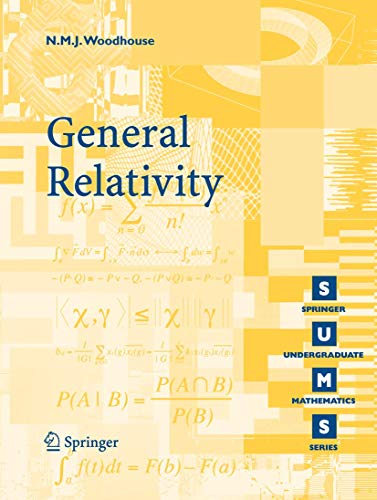
Based on a course taught for years at Oxford, this book offers a concise exposition of the central ideas of general relativity. The focus is on the chain of reasoning that leads to the relativistic theory from the analysis of distance and time measurements in the presence of gravity, rather than on the underlying mathematical structure. Includes links to recent developments, including theoretical work and observational evidence, to encourage further study.
User’s Reviews
Reviews from Amazon users which were colected at the time this book was published on the website:
⭐I really like N. M. J. Woodhouse’s two books on relativity:
⭐and
⭐. They’re both short, well organized, exceptionally clear and mathematically impeccable. Woodhouse is a very gifted writer: he knows how to get to the point!Even though the book is short and mathematically oriented, it does not neglect physics motivation, as you can see via the Look Inside this Book function. Woodhouse manages to cover the basic or essential aspects of many key topics in just 178 pp. For example, Einstein’s Equation is introduced and discussed in chapter 6 (pp. 89 – 94); the curvature tensor is discussed on pp. 96-98 and Killing Vectors on pp. 102-104. Other chapters deal with Spherical Symmetry, Orbits in Schwarzschild Space-time, Black Holes, Rotating Bodies, Gravitational Waves, Redshift.Fast pace, yes; but he makes every word, definition, equation and theorem count! Anyone like me who has been frustrated by the many introductory general relativity books that are either confusing — mathematically or otherwise — or else just too detailed (I love GR but am not gonna become a physicist :), should find this relatively new (2007) introductory book a “breath of fresh air”.Be forewarned though that they’re written for senior math majors and so not suitable for anyone whose math skills are sub-par. But if your math skills are honed, both books are really a pleasure to read, especially compared to the mathematically inadequate, long-winded and sometimes downright confusing expositions of many other books.Also, in some places I think the book is too terse, and because of this, is best used as a supplement to a book providing more complete details on certain key topics, e.g., Christoffel symbols, parallel transport, covariant derivatives, and Riemann tensor (curvature tensor).Because of these limitations, I have taken away one star, hence the 4 star total.[If your special relativity isn’t up to par, I also recommend his book
⭐as a “prequel”.]
⭐This book has its origins in a careful course on general relativity given at Oxford University. Practically speaking, it would be very reasonable to regard the volume “Special Relativity” by the same author as a prerequisite for a proper reading of this text. It gives a complete and very concise explanation, introducing the reader to “real” general relativity and not to some watered down version made for mass consumption. It makes general relativity as simple as possible, but not simpler. Because it is concise, it cannot cover all the topics readers will eventually want to explore. The textbook “Gravitation” by Misner, Thorne, and Wheeler (MTW) is truly voluminous and is itself an indispensable part of the professional literature. Woodhouse’s book is a much more direct and potentially much less confusing place to begin. Wald’s famous text is probably the best graduate text. Again, Woodhouse is a kinder, gentler introduction, and gives more direct intuition. With Woodhouse, you can easily notice that a geodesic is just the solution to Lagrange’s equation with a null potential. That makes sense directly, physically. We can “see” that or “feel” it (if a particle isn’t acted on by a force, it goes as straight as it can). In Wald’s text, you get the geodesic equation and you get to form your intuition as you can. MTW tries to give more explanation, but nothing about it is really concise. One gains understanding, but it is gained slowly. Confidence also comes slowly. Woodhouse gives students a real leg up. Isn’t that what University is supposed to be for—teaching something????? Not every university feels that way. At least one famous professor told me “we’re not here to TEACH—our purpose is to EXPOSE MATERIAL.” Of course, I held that professor in very low esteem indeed. Woodhouse is not like that. His book is a treasure, a gem. No one should be without it.
⭐It is quite hard to understand the notations used. You must have some backgrounds about the notations so that you can get along with it. Also, I think it is not suitable to self-learners.
⭐* PhysicalThe book is very well bound for a paperback and has good paper within its covers. The font is well – sized for those of us that need spectacles to read.* The construction pre-degree, undergraduate, post graduate?As before, no book can cover every bit of the topic its written to explain, but this book uses a familiar mathematical background of a ‘level and undergraduate degree math and builds securely upon this. It will help you greatly if you can handle matrices and differential equations with both partial and standard a’ level or engineering / Math degree level differential equations and Vector Calculus. The Math degree student may have an easier time with parts of this book. This topic method i am trying to comprehend in ‘layers’ and not the whole concepts all at the same time. So i will return to this book after other in depth studies.* Its constructionThe book is divided into two main parts, the preliminary explanation of the math’s required to help later on, and the theory underpinning what it is describing mathematically. The author has spread of both new and familiar together designed to strengthen your overall knowledge. These preliminary bits stretch from Chapter one to chapter 5. Personally, I found the tensors introductory (chapter 5) and spread through the book just is a bit too brief to be used as it is on its own, and may need more work elsewhere or its my weakness at this time? See the latter part of this review for books that helped my comprehension of Tensors, for example. I have now a working knowledge though just not absolutely rock – hard!* Example of the level of mathematical workingThe motion of fluids and particles is clearly explained and the preliminary stuff is up to chapter 5 this is linked to further examinations. For example, it applies 4 x 4 matrices in symbolic format. In particular, i am fascinated with the 4 x 4 symbolic matrix showing an strong, symmetrical construction for the properties of Electromagnetism on page 23.* What the mathematics is applied to explainFor example subjects with a strong mathematical content than are flown through – in a positive manner – as follows; Curvature, Space time of the forth dimension, Riemann Tensors, Hyperbolic Minkowski space, Einstein’s Equation, The ‘Schwarzschild Radius’ and its connection to black holes and more, Rotation of the perihelion of the planet Mercury an other stuff that’s interesting to read and comprehend at this level. The later topics are a lot briefer and its curtailed in both descriptively and mathematically. The form of these equations take is an art in its self, and you need an understanding of the equation’s and what its related too and what its driving to explain.* SummaryThe book has a lovely mix of simplified math techniques strongly built upon previous levels of understanding. Its fun, but tough in places to read!This book has been a pleasure to tackle and I have learned a good amount of new understanding and linking to math skills. The SUMS seriesof books have proved again a great way to tackle topics in a well chosen way, carefully explained and designed. I humbly recommend that your read it start throughto the end as its broadly resistant to jumping over topics.* Update: If you in the market for a glorious in – a – minds – eye book of both General and Special relativity, i humbly recommend the followingEinstein’s Universe: The Layperson’s Guide Paperback – 24 Feb 2005by Nigel Calder* You may find these volumes of help tooA Student’s Guide to Vectors and Tensors Paperback – 22 Sep 2011by Daniel FleischA Student’s Guide to Lagrangian and Hamiltonian Paperback – 21 Nov 2013by Patrick Hamill* SummaryIf, however you study, you feel this area needs more help than this book is giving you, I have found it helpful to access a well – known video sharingwebsite, and enter into its search engine, say ‘Tensors’, or ‘General Relativity’. This combined help may be just enough to explain it to you in terms you can comprehend. Its a great lift to have a streamed videos AND you need to read the linked books too at the same time. This is based on in – depth studies from Dec ’14 to May ’15, covering Tensor Analysis, and General Relativity too. I feel an understanding for these topics and its been six months of almost daily studying to reach this state. I admit that its been hard at times but definitely fun to try.
⭐Tha mun ge it! t’s summat oreight
⭐Nothing special about this book. There are much better introductions on the market like Hobson et al.
⭐This book describes clear the fundamentals of general relativity and can be used together with more advanced books on general relativity
⭐Ottimo libro
⭐
Keywords
Free Download General Relativity (Springer Undergraduate Mathematics Series) in PDF format
General Relativity (Springer Undergraduate Mathematics Series) PDF Free Download
Download General Relativity (Springer Undergraduate Mathematics Series) PDF Free
General Relativity (Springer Undergraduate Mathematics Series) PDF Free Download
Download General Relativity (Springer Undergraduate Mathematics Series) PDF
Free Download Ebook General Relativity (Springer Undergraduate Mathematics Series)