

Ebook Info
- Published: 2012
- Number of pages: 386 pages
- Format: PDF
- File Size: 6.86 MB
- Authors: Stephen Willard
Description
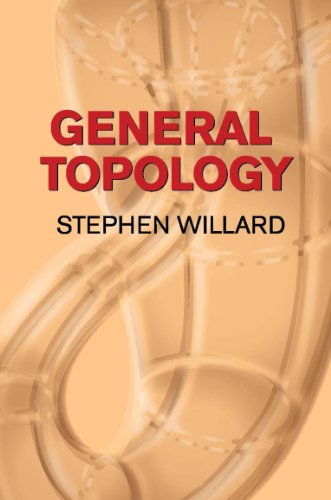
Among the best available reference introductions to general topology, this volume is appropriate for advanced undergraduate and beginning graduate students. Its treatment encompasses two broad areas of topology: “continuous topology,” represented by sections on convergence, compactness, metrization and complete metric spaces, uniform spaces, and function spaces; and “geometric topology,” covered by nine sections on connectivity properties, topological characterization theorems, and homotopy theory. Many standard spaces are introduced in the related problems that accompany each section (340 exercises in all). The text’s value as a reference work is enhanced by a collection of historical notes, a bibliography, and index. 1970 edition. 27 figures.
User’s Reviews
Reviews from Amazon users which were colected at the time this book was published on the website:
⭐This is certainly one of the best books on general topology available. It requires more maturity from the reader than the usual Munkres/Armstrong standard, but IMHO it is perfectly adequate for a first contact with the subject. It is a dense book, and it does not talk much like other books, but the exposition is so clear that this is actually a quality. Being succint, it manages to cover a lot more ground than the standard references; there is much more here than a one-semester course can cover. The exercises are usually difficult; some of them are real challenges (e.g. can you find an order in which the real numbers are well-ordered? This question pops out in the first set of exercises). The exercises are actually the purpose why this book leaves its rivals far behind. They provide the reader with a deep topological way of thinking in many ways: by forcing the reader to construct counterexamples himself (an essential skill for a topologist) and generalizing the theorems presented in the text, often to explore a new technique or construction. Sometimes this may provide the reader with multiple ways to look at a particular problem, which is certainly an useful skill (not to say inspiring!). A good example is the way the author explores the interconnection between nets and filters, which provide two different frameworks for describing topologies by means of convergence. Most other books describe just one approach or the other, and even when they do both they seldom explicit how they are related. A careful reader who works throughout the whole text, or at least through most of it, will have a better understanding of topology than the reader of the more usual texts. For the sake of comparison, I should say I found the discussion here about quotient spaces far clearer than Munkres’s. Willard makes clear from the beggining the distinction between the “quotient approach” and the more intuitive “identification approach”, which is the formalization of the intuitive grasp of cutting and pasting spaces. The author carefully develops both points of view, to show in the end they are really the same (in the sense of an universal property – i.e., up to homeomorphism). It becomes absolutely clear then that the first, more abstract approach, gives an effective way for manipulating mathematically problems arising in the second, hence its not-so-obvious-at-a-first-glance importance.Readers who are already familiar with the methods and results of general topology and basic algebraic topology will also benefit from this book, specially from the exercises. This, together with “Counterexamples in Topology”, by Steen and Seebach, form the best duo for studying general topology for real; this is the best option available for the ambitious student and the aspiring topologist. Also, as they are both Dover, the prices are ridiculously low. For a couple of bucks you may have access to some of the most beautiful treasures of mathematics.
⭐Willard’s text is a great introduction to the subject, suitable for use in a graduate course. I am personally not training to be a topologist but I must say that I enjoyed this book thoroughly and walked away with a firmer appreciation of the subject than I had previously had.There is quite a bit of content ranging from subject matter and an extensive bibliography to a collection of historical notes. The exercises are suitable and doable; I have personally found that most of them range from being easy to moderately challenging but there are plenty of difficult problems as well.It is important to note, however, that this text is primarily focused on point-set topology. There is a brief exposition of homotopy theory and the fundamental group but nothing compared to, say Munkres. But this is by no means a drawback. Willard thoroughly examines many topics that Munkres sometimes allocates to the exercises. A good example of this is net convergence, a topic that in my opinion, ought to be treated in any introductory topology course. In fact, Willard’s development of nets makes for a nice, quick proof of the Tychonoff Theorem while Munkres’s approach necessitates the development of a few technical lemmas.Overall, this book is quite pleasant to read. It is also quite pleasant to purchase compared to several other introductory texts that run anywhere from 50.00-100.00. There are many nontrivial aspects to topology and this book has a way of gently nudging the reader into some of the more technical and delicate aspects of the theory. But as I mentioned before, while this book is a great introduction to point-set topology, this is not the text to read if one is searching for an introduction to algebraic or differential topology. In the latter case, Munkres or Fulton would be a good bet.
⭐Fantastic book, it was the book for my three person presentation-based General Topology course, in which we basically had to do all of our learning from the book, and this book was very easy to learn from. It obviously takes effort and thought to read through everything, but I left every section with a thorough understanding of the topic. There are proofs for all major results, but they leave out the gritty details that you may want to go through on your own, a feature I liked. I can’t imagine a better book to use to learn General Topology, or really any subject, on your own than this. From now on when I look for a good book to try to learn something independently, I will look for “the one most like Willard.”
⭐The back cover blurb describes this book as “among the best available reference introductions to general topology.” Notice that word “reference.” I find using this book as a reference to be incredibly painful. The problem is simply that it was written in 1970, when word processors didn’t exist. Therefore whenever I look up anything in the index, I get something like “uniformity of compact convergence, 43.5, 43.6, 43.11, 43C.” That is, there are no page numbers. 43.5 is a definition of the term. 43.6 is a theorem. 43.11 is another theorem. 43C is an exercise. To find any of these, I have to laboriously flip back and forth, searching for the desired decimal-numbered definition or theorem, or numbered and lettered exercise. Starting ca. 1985, there was no longer any excuse for producing a book without a proper index referring to page numbers; the word-processor would do it for you. Since ca. 2005, it’s hard to see the utility of a book like this as a “reference” at all, because I can find a better treatment of any given topic on Wikipedia.
⭐Great book with a lot of good stuff, especially in the exercises. However, if you’re not willing to work through the relatively dense exercises, you might want to look for something that reads more easily and come back to this book later.
⭐A sound investment
⭐After 25 years of teaching, I consider this one of the best explained, most comprehensive treatments of a subject I have come across. Definitely not a first book to understand metric and topological spaces, but for a more advanced treatment absolutely superb.
⭐classic, but author tries to put so much in little pages.
⭐Noting to say about the contents of the book. But the copy that has been delivered to me is very old. Pages has become reddish, dusty and smelly. The covers of the book also indicate how old the copy is. The corner also got bended. Moreover, I think the seller has written down the original price (Rs.595) of the book at the corner of the very last page with pencil, and forgot to remove it. But I have paid Rs. 660(+65 delivery fee) for that. So, I would highly recommend everyone if you want to purchase the book, please avoid the seller ALPANA ENTERPRISE.
⭐The subject ain’t easy and the motivation usually given in books lack motivation, but here the author gives a real motivation and all of this with the highest degree of rigor. Munkres book is not bad, but its too wordy sometimes and you can easily miss the point and is of course less advanced than this text. Nevertheless, this is an introductory text and should be available to a beginner on the subject. Just make sure you get a problem book on the subject since only doing the proofs and exercises will get you the knowledge (There is a “Solutions Manual” on the web for this, but in my opinion isn’t enough.) A particularly good problem book is the one by Mohammed Hichem Mortad named “Introductory Topology : Exercises and Solutions”.Es mi libro de cabecera para topología general, tiene discusiones breves pero concisas y muchos apéndices donde se abordan temas avanzados. Me fue muy útil incluso a nivel posgrado.
⭐
Keywords
Free Download General Topology (Dover Books on Mathematics) in PDF format
General Topology (Dover Books on Mathematics) PDF Free Download
Download General Topology (Dover Books on Mathematics) 2012 PDF Free
General Topology (Dover Books on Mathematics) 2012 PDF Free Download
Download General Topology (Dover Books on Mathematics) PDF
Free Download Ebook General Topology (Dover Books on Mathematics)