

Ebook Info
- Published: 2007
- Number of pages: 594 pages
- Format: PDF
- File Size: 6.20 MB
- Authors: Chris Doran
Description
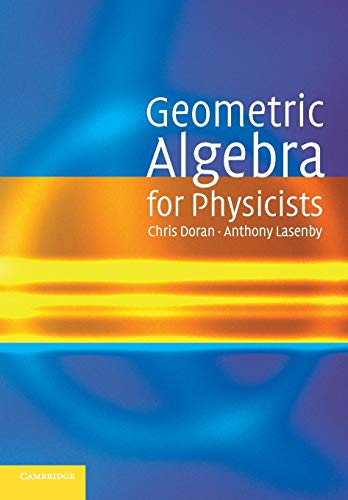
This book is a complete guide to the current state of geometric algebra with early chapters providing a self-contained introduction. Topics range from new techniques for handling rotations in arbitrary dimensions, the links between rotations, bivectors, the structure of the Lie groups, non-Euclidean geometry, quantum entanglement, and gauge theories. Applications such as black holes and cosmic strings are also explored.
User’s Reviews
Editorial Reviews: Review Review of the hardback: ‘I would therefore highly recommend this book for anyone wishing to enter this interesting and potentially fundamental area.’ Mathematics Today’The range of topics presented in the book is astonishing. … The present book is intended for physicists, but mathematicians will also find it highly valuable. The exposition of Grassmann’s algebra given at the beginning of the book is exceptionally clear and is written with a light touch. … It is extraordinarily well written and is a beautifully produced piece.’ The Mathematical Gazette Book Description The first fully self-contained introduction to geometric algebra by two leading experts in the field. About the Author Chris Doran obtained his PhD from the University of Cambridge, having gained a distinction in Part II of his undergraduate degree. He was elected a Junior Research Fellow of Churchill College, Cambridge in 1993, was made a Lloyd’s of London Fellow in 1996 and was the Schlumberger Interdisciplinary Research Fellow of Darwin College, Cambridge in 1997 and 2000. He is currently a Fellow of Sidney Sussex College, Cambridge and holds an EPSRC Advanced Fellowship. Dr Doran has published widely on aspects of mathematical physics and is currently researching applications of geometric algebra in engineering and computer science.Anthony Lasenby is Professor of Astrophysics and Cosmology at the University of Cambridge, and is currently Head of the Astrophysics Group and the Mullard Radio Astronomy Observatory in the Cavendish Laboratory. He began his astronomical career with a PhD at Jodrell Bank, specialising in the Cosmic Microwave Background, which has been a major subject of his research ever since. After a brief period at the National Radio Astronomy Observatory in America, he moved from Manchester to Cambridge in 1984, and has been at the Cavendish since then. He is the author or coauthor of nearly 200 papers spanning a wide range of fields, from early universe cosmology to computer vision. His introduction to geometric algebra came in 1988, when he encountered the work of David Hestenes for the first time, and since then he has been developing geometric algebra techniques and employing them in his research in many areas. Read more
Reviews from Amazon users which were colected at the time this book was published on the website:
⭐I think this book is a good introduction to the subject, but in my opinion it is not exactly self-contained. There is a fair bit of handwavery, and pushing through the mathematical material requires a significant amount of reading between the lines if you want to take it seriously and aren’t already familiar with some geometric algebra. I also think there could be more substantial and instructive exercises, and some of the language is not precise or rigorous enough to my personal satisfaction. Occasionally notations are used that are not defined, but they may be understood by physicists. In general it is not altogether easy access, but it’s clear that the authors are well-versed and knowledgeable, and the material is fascinating to say the least.
⭐In chapter five, after typesetting much following of text and problems, I found myself correcting a section and doing grade-0 derivation simplification thinking.Chapter six, I am hoping, is some sort of milestone. I am hoping it is some sort of prelude to general relativity generalization versus gauge theory of gravity choice. Perhaps there I will get intimations of tangent space at each point of spacetime in index free geometric invariants and a similar coordinate free description of the spacetime river falling rendering time asymmetry in something more general than Newtonian gauge so gtg could yield interesting compact topologies.I had already written a sort of review, so this is my current impression.
⭐I’ve only read Chapter 1 so far – been on the road with other responsibilities. But Doran is the one who wrote a PhD thesis on how to re-formulate a wide variety of physics in Geometric Algebra; he’s taught at Cambridge in the 25 years since, and just gotten better at explaining things clearly. His co-authors teach beside him, and have gotten better as well.
⭐Provides a very interesting point of view, absolutely necessary for grasping the bolts and plumbing of modern physics.The material covered was not present in other texts that I had a look at so this book serves as a good corner stone to build advanced undergraduate and graduate courses on.
⭐The main author has given up on theoretical physics and now runs a software development company specializing in lighting/shading routines for video games. His new work is amazing, and I wish him all the best.I’m hoping that one day Chris Doran’s software company releases a killer GA package for Mathematica/Maple, similar to Digiarea’s Atlas2 for differential forms.
⭐Highly recommend. Will one day be considered a classic
⭐vey clear
⭐I love this book as a reference for the application of geometric algebra or Clifford algebras to problems of mathematical physics. It’s scope is mind boggling and perhaps that’s one of it’s problems. Nevertheless this book is a great addition to your library and I’m glad clifford analysis and quaternions are finally getting their due.However the book is not for the novice scientist. Some of the exposition is very terse and the conclusions are not always obvious. Moreover a lot of the proofs are simply omitted. For this reason I recommend reading a more thorough math primer on the topic prior to fully engaging this. I wish I could recommend such a text that isn’t overly pedantic or doesn’t assume PhD level work in either math or physics.I made some progress with Holomorphic Functions in a plane and N-dimensional space http://www.amazon.com/Holomorphic-Functions-Plane-n-dimensional-Space/dp/3764382716/ref=sr_1_1?s=books&ie=UTF8&qid=1450383926&sr=1-1,although this focuses on Cl(0,n) and not Cl(1,3), which is the main Clifford algebra used these days by physicists along with it’s sibling Cl(3,0).One of the topics this volume does omit is the computational physics side of things. In particular there is no mention of Feuter polynomials or useful worked examples for solutions of the Dirac equation that covers a lot of physics problems, particularly electromagnetics. A lot of those problems were worked out in the past for biquaternions based on analytic function theory for real quaternions. This will use a Dirac operator that differs a bit from the one presumed here, though the theories dovetail if you burrow into the details.The book only hints at the strong connection between standard complex analytic function theory and the theory of 4D analytic functions. Again you have to go to outside references to find this. Moreover there is a conformal mapping theory that is emerging that would presumably help for all kinds of boundary value problems in this area.I do also have one final complaint not related to the books content. The font that is used in the book is not very readable being quite cramped. Furthermore the kindle version is atrocious, though perhaps better than some other math oriented textbooks. The fact that they render the math fonts as blurry bit maps, not always centered in the text is extremely aggravating. Why you wouldn’t use a decent typesetter like Latex for the math fonts is bizarre, but that is just one pet peeve. Since my kindle doesn’t handle pdf very well either this remains a problem for math oriented text.
⭐A bit of a sensational title but, at least at the present time, I can’t think of any other books that match it (and this is coming from a Physics graduate who used to love the Feynman lectures).This book is by no means the first to reveal the explanatory power of Geometric Algebra (if you want the frontier go to Grassmann, Clifford, or Hestenes) but this is the first book which feels like it’s written in a world where Geometric Algebra could actually be the norm.It’s not a page-turner, but that’s not because the writing is too dense, it’s because geometric algebra provides such succinct answers to questions that you have to stop reading and spend a year learning the alternative standard-taught overly-complex approach to let the truth sink in and confirm to yourself that the author isn’t lying.There are certainly places were a few more examples would clarify things, and it’s no doubt a little too dense for beginners but, overall, the amount of uncertainty this text has removed from my mind deserves every star.
⭐I think is a shame that more physicists (and mathematicians) do not know about the power and beauty of Clifford or geometric algebras. Doran and Lasenby’s book is a systematic attempt to cast physics in terms of geometric algebra, and is expansive, well written and thoughtful. The problem with algebras is that their representations can vary, and sometimes (as is the case in general relativity) the representation can seem a little arbitrary. The authors’ approach is to find a representation which looks elegant and which works, but it would have been interesting to see the authors see if they could identify canonical or natural representations of the geometric algebras to do not suffer from arbitrariness.
⭐This book gives an excellent presentation of the topic, the physical and intuitive approach to Clifford and Grassman’s algebras for geometry originally developed by Riesz and Hestenes. It is generally clear and intuitive, with many practical applications through to general relativity and cosmology and conformal geometry. These demonstrate well the strengths of the geometrical approach to advanced physical applications (not least direct vector/exterior product notation free of subscripts, and the availability of explicit geometric inverses) compared to the more conventional algebraic outlook in mainstream “Clifford algebra” texts.The pedagogical quality of the book highlights this reviewer’s disappointment at the apparent schism in the approach to geometry between the two approaches, which mainly seems to derive from historical accident – the long gap between Clifford’s early death and Riesz’s fresh look at the possibilities. Given the clarity and high originality of Clifford’s remaining work is seems unlikely that he would have left the untidy diversity that seems to have resulted. This seems to leave a greater gap between the methodologies of mathematicians and working physicists than seems necessary.If the book has a limitation it is in not discussing further the differences between this and the more conventional approach to – the absence of discussion of the homology and cohomology considerations ubiquitous in conventional algebraic approaches, and the underlying reasons for their omission. Given the substantial size and scope of the text already, and its advanced undergraduate/graduate audience this is forgivable, though would enhance both its value and that of the geometric algebra literature.
⭐A great intro to geometric algebra and nicely shows its application to various areas of physics. Highly recommend this.
⭐This is an excellent book but buy the paperback version unless you have 10+ year old iPad. The problem is the formulas are in a tiny font which is almost unreadable. This suggests an old Ebook format, download the sample to check readability on your device. The book itself gives a good introduction to the basics of Geometric Algebra compared to other books. My expectation is that this will continue onto physics applications of GA. I would have given 4.5 stars if reviewing the paperback version.
Keywords
Free Download Geometric Algebra for Physicists 1st Edition in PDF format
Geometric Algebra for Physicists 1st Edition PDF Free Download
Download Geometric Algebra for Physicists 1st Edition 2007 PDF Free
Geometric Algebra for Physicists 1st Edition 2007 PDF Free Download
Download Geometric Algebra for Physicists 1st Edition PDF
Free Download Ebook Geometric Algebra for Physicists 1st Edition