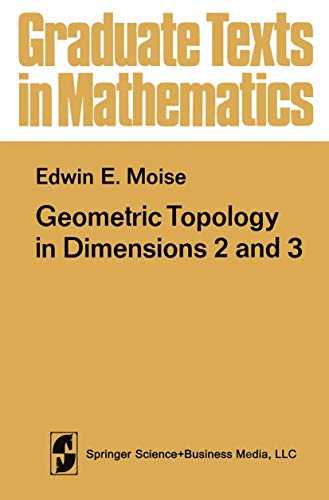
Ebook Info
- Published: 2013
- Number of pages: 272 pages
- Format: PDF
- File Size: 5.81 MB
- Authors: E.E. Moise
Description
Geometric topology may roughly be described as the branch of the topology of manifolds which deals with questions of the existence of homeomorphisms. Only in fairly recent years has this sort of topology achieved a sufficiently high development to be given a name, but its beginnings are easy to identify. The first classic result was the SchOnflies theorem (1910), which asserts that every 1-sphere in the plane is the boundary of a 2-cell. In the next few decades, the most notable affirmative results were the “Schonflies theorem” for polyhedral 2-spheres in space, proved by J. W. Alexander [Ad, and the triangulation theorem for 2-manifolds, proved by T. Rad6 [Rd. But the most striking results of the 1920s were negative. In 1921 Louis Antoine [A ] published an extraordinary paper in which he 4 showed that a variety of plausible conjectures in the topology of 3-space were false. Thus, a (topological) Cantor set in 3-space need not have a simply connected complement; therefore a Cantor set can be imbedded in 3-space in at least two essentially different ways; a topological 2-sphere in 3-space need not be the boundary of a 3-cell; given two disjoint 2-spheres in 3-space, there is not necessarily any third 2-sphere which separates them from one another in 3-space; and so on and on. The well-known “horned sphere” of Alexander [A ] appeared soon thereafter.
User’s Reviews
Reviews from Amazon users which were colected at the time this book was published on the website:
⭐Geometric topology deals with questions of the existence of homeomorphisms to paraphrase the author. The author is credited with the first proof of the existence of triangulations for 3-manifolds(3-manifold triangulation theorem). A topological space(subspace or possibly manifold) has a triangulation if a homeomorphism can be found which maps it onto a polyhedral or simplicial complex(possibly infinite). Though the proofs are detailed this is still I’d say a graduate level text. Just from this brief description you’re already dealing with general topology and the topology of polyhedra or complexes, i.e., homology of complexes or simplicial homology. The author cites the Seifert/Thelfall text for much of this material but this is hard to find and/or pricey. Adequate coverage of general topology and the fundamental group(including the Seifert-Van Kampen theorem) can be found in Munkres’
⭐. Simplicial homology is covered in the first few chapters of Munkres’
⭐. In fact Theorem 26.6 in chapter 3 of the Munkres topology text is frequently used in establishing the existence of a homeomorphism. This same theorem can be found in Rudin’s
⭐as Theorem 4.17 in chapter 4 though homeomorphism is not mentioned. Hopefully since you’re reading this review, these books are already in your library. I’ll just give a brief example which is meant to bolster your confidence at least in regard to the level of general topology used in this book. If a set is open, it follows that its intersection with the closure of its complement is empty. Why? This is the same as saying that the closure of the complement of the set must be a subset of the complement of the set. Since the set is open, its complement is closed. We have now a closed set which contains the set’s complement and they’re the same. But the closure of the complement is the intersection of all closed sets which contain the complement and this closure is necessarily a subset of any one of these closed sets, i.e. the closure of the complement of the set is a subset of the complement of the set. Q.E.D. This is used on p. 20 of chapter 2 in a proof dealing with the frontier of a set.The author presents and rigorously proves many hard to find classical results. The piecewise linear topology needed for many of these is presented in a self contained manner though he recommends Hudson for those venturing beyond the text. Many results-Jordan Curve Theorem, Jordan-Schoenflies, 2-manifold triangulation-are presented but all this really assembles the machinery used to establish his textbook simplified 3-manifold triangulation theorem proof. The proof is based on Peter Shalen’s 1971 proof which simplified the original via integral use of the Loop Theorem. Stalling’s simplified Loop Theorem proof is presented to this end.This book and possibly some internet research will give you most of the 3-manifold ideas needed in studying the magnificent work of Perelman and Hamilton. You could supplement this book with Hempel’s
⭐for many modern results like the Sphere Theorem but it may be overkill.
⭐Moise’s “Geometric Topology in Dimensions 2 and 3” was somewhat of an anachronism even when it was first published in 1977, containing no result from after 1960, and with much of it dating from decades earlier. This introductory text in low-dimensional PL topology is both inadequate as a PL topology book (the standard references are Rourke and Sanderson or Hudson for this now-disused subject) and hopelessly outdated as a 3-manifold topology book. But it does have one major saving grace: It contains just about the only modern and complete coverage of classical theorems such as the Hauptvermutung and triangularization theorem of Rado that are frequently cited but not proved.The main topics in 2-dimensions are the Jordan Curve Theorem, the Schoenflies Theorem, Rado’s triangularization theorem for 2-manifolds (i.e., topological 2-manifolds are PL), the Hauptvermutung (i.e., any 2 triangularizations are PL equivalent), and the well-known classification of compact 2-manifolds. There are also chapters on PL approximations of homeomorphisms, tame imbeddings, and homeomorphisms of Cantor sets. In 3 dimensions the highlights are the PL Schoenflies Theorem (the originally conjectured topological version is false), the Loop Theorem and the Dehn Lemma, PL approximations, triangularization of 3-manifolds, and the Hauptvermutung, the latter 2 being the culmination of the last 100 pages of the book. There’s also an entertaining account of Antoine’s wild sphere imbedding and Stallings’s counterexample for a simpler version of the Loop Theorem. While the classification of compact 2-manifolds is found in many undergraduate books in topology (such as that of Massey), virtually never is it really completely proven, but instead the triangularization of 2-manifolds is assumed – here one can see a complete proof without reading papers from the ’30s in unfamiliar notation.Aside for the treatment of these well-known but rarely demonstrated results, there are a few other advantages: Even though this is a Springer Graduate Text in Mathematics, the level is more like that for undergraduates. Very little previous knowledge is assumed – even connectivity is defined and explored in the first chapter, while there are other brief chapters (and I mean brief – some “chapters” are only 2 pages) on homotopy, homology (very little – no cohomology), and covering spaces, with everything being defined for the PL category only. Occasionally a fact from algebraic topology is cited, such as the Van Kampen Theorem, so it is assumed that the reader is not encountering this material for the first time. The proofs and examples are explained in much more detail than is generally found in the literature, as one can see, e.g., by comparing his treatment of Stallings’s example with Stallings’s original paper, or his for Antoine’s necklace. There are also exercises at the end of almost every chapter; most are straightforward, some are tricky, being of the “prove or disprove” type, and the results of a few are cited elsewhere in the text.My main complaints about the book, as I have already mentioned, are that it is missing much of the most significant results about PL topology, such as the proof of the h-cobordism theorem, as well as about 3-manifold topology, such as Thurston’s Geometrization Theorem, Haken manfiolds, manifold decompositions, Heegaard splittings, etc. (not to mention of course the Poincare conjecture, which one could hardly fault him for not including 30 years ago) – even the Sphere Theorem is missing. There’s also no mention at all of differential topology – not even tangent spaces, vectors, or derivatives – and just the slightest taste of knot theory and a hint of handlebodies (the term is used in a different sense). Moreover, there’s an annoying dearth of figures, which becomes more pronounced as the book progresses – while there are more than a few, this kind of work should have at least one figure for virtually every lemma or theorem, yet there are stretches of 20 pages or more without any. Toward the end of the book there’s also a preponderance of typos in the mathematical notation that can be confusing (and on pg. 212 he writes “finite” when he means “cyclic”), as well as an increasing tendency to skip steps in proofs. With this kind of material, since so much of what is being proven seems intuitively obvious, it takes a lot of discipline to really make everything airtight, and while he is much more thorough than most, not always perfect.
⭐good
Keywords
Free Download Geometric Topology in Dimensions 2 and 3 (Graduate Texts in Mathematics, 47) in PDF format
Geometric Topology in Dimensions 2 and 3 (Graduate Texts in Mathematics, 47) PDF Free Download
Download Geometric Topology in Dimensions 2 and 3 (Graduate Texts in Mathematics, 47) 2013 PDF Free
Geometric Topology in Dimensions 2 and 3 (Graduate Texts in Mathematics, 47) 2013 PDF Free Download
Download Geometric Topology in Dimensions 2 and 3 (Graduate Texts in Mathematics, 47) PDF
Free Download Ebook Geometric Topology in Dimensions 2 and 3 (Graduate Texts in Mathematics, 47)