

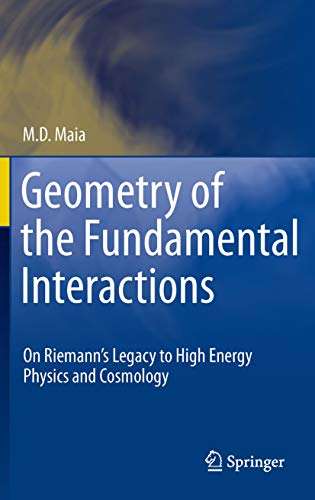
Ebook Info
- Published: 2011
- Number of pages: 192 pages
- Format: PDF
- File Size: 1.08 MB
- Authors: M. D. Maia
Description
The Yang-Mills theory of gauge interactions is a prime example of interdisciplinary mathematics and advanced physics. Its historical development is a fascinating window into the ongoing struggle of mankind to understand nature. The discovery of gauge fields and their properties is the most formidable landmark of modern physics. The expression of the gauge field strength as the curvature associated to a given connection, places quantum field theory in the same geometrical footing as the gravitational field of general relativity which is naturally written in geometrical terms. The understanding of such geometrical property may help one day to write a unified field theory starting from symmetry principles. Of course, there are remarkable differences between the standard gauge fields and the gravitational field, which must be understood by mathematicians and physicists before attempting such unification. In particular, it is important to understand why gravitation is not a standard gauge field.This book presents an account of the geometrical properties of gauge field theory, while trying to keep the equilibrium between mathematics and physics. At the end we will introduce a similar approach to the gravitational field.
User’s Reviews
Reviews from Amazon users which were colected at the time this book was published on the website:
⭐Maia does not mince any words in declaring Riemann the foundation of the unifying math between three of the four forces (strong/weak/electromag, sans gravity). The book, with a good amount of rigor, takes a “slice” of all the aspects of the unifying math, and aligns them with Riemann geometry, and especially the Riemann tensor. Interestingly, a pretty amazing case is made for validity of this contribution without too much bending of the credibility curve!In 150 or so pages the presentation covers Riemann curvature and tensor as they apply to manifolds, Lie groups and algebras (preparing for gauge), general relativity space-time, scalars, Nielsen-Olesen and spinors, Noether, connections, gauge fields and finally gravitation. I couldn’t find the discussion promised by the publisher and in the title on “Cosmology” — unless you count the very well thought out “Riemann gravity” section at the end and suggestions about new approaches to “gauge gravitation” — arguing that Einstein gravity is demonstrably not gauge because it would have to follow the rigor of a Yang-Mills type Lagrangian, curvature operators, defined local gauge symmetry as a Lie group, construct the corresponding Lie algebras and curvature operator, then solve the generated Yang-Mills equations. The author makes the interesting point that moving beyond this model to another type of gauge for gravity might involve the Leibniz “smoothest geometry” conjecture for our daily reality, corresponding to the minimal Riemann curvature variations.I’ve long believed that we inevitably swing back to geometry in all our theories, and peering through the Riemann legacy’s looking glass certainly is exciting, instructive and thought provoking. The hidden “hint” about cosmology might be in the frequently unspoken chicken or egg question of whether math is a tool by which we investigate the universe or a tool used BY the universe. In quantum chemistry, for example, there are places where the math becomes an integral part of the “reality” — in some really strange, living in the matrix kinds of ways. The author actually has the courage to raise this issue re Lie Algebras!One positive that is a negative: There are only 21 illustrations, and they are some of the best I’ve ever seen! In my day job I animate math for physics, and these are some of the best anywhere, each giving an “aha” that the formulas can’t convey. The downside is I wish the author had included 99, not 21! Highly recommended for those who want a fresh view of the real, current applications and value of Riemann, all the way beyond quaternions to octavians! When I began, I was skeptical; the author has managed to convince me that we’re not nearly done tapping Riemann’s contributions any more than Gauss or Dirac. Math takes postgrad level effort, but is worth it.Note: Amazon has little about M.D Maia on their site. If you Google and Bing Marcio R. de Garcia Maia (Márcio R. de Garcia Maia), you’ll find over 100 books and citations (University of Brasil) on scholar dot google and academic dot research dot microsoft. His contributions to nuclear physics are significant and current.Library Picks reviews only for the benefit of Amazon shoppers and has nothing to do with Amazon, the authors, manufacturers or publishers of the items we review. We always buy the items we review for the sake of objectivity, and although we search for gems, are not shy about trashing an item if it’s a waste of time or money for Amazon shoppers. If the reviewer identifies herself, her job or her field, it is only as a point of reference to help you gauge the background and any biases.
Keywords
Free Download Geometry of the Fundamental Interactions: On Riemann’s Legacy to High Energy Physics and Cosmology 2011th Edition in PDF format
Geometry of the Fundamental Interactions: On Riemann’s Legacy to High Energy Physics and Cosmology 2011th Edition PDF Free Download
Download Geometry of the Fundamental Interactions: On Riemann’s Legacy to High Energy Physics and Cosmology 2011th Edition 2011 PDF Free
Geometry of the Fundamental Interactions: On Riemann’s Legacy to High Energy Physics and Cosmology 2011th Edition 2011 PDF Free Download
Download Geometry of the Fundamental Interactions: On Riemann’s Legacy to High Energy Physics and Cosmology 2011th Edition PDF
Free Download Ebook Geometry of the Fundamental Interactions: On Riemann’s Legacy to High Energy Physics and Cosmology 2011th Edition