

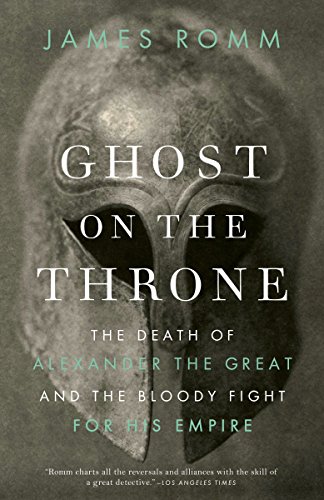
Ebook Info
- Published: 2012
- Number of pages: 416 pages
- Format: PDF
- File Size: 7.80 MB
- Authors: James Romm
Description
When Alexander the Great died at the age of thirty-two, his empire stretched from the Adriatic Sea in the west all the way to modern-day India in the east. In an unusual compromise, his two heirs—a mentally damaged half brother, Philip III, and an infant son, Alexander IV, born after his death—were jointly granted the kingship. But six of Alexander’s Macedonian generals, spurred by their own thirst for power and the legend that Alexander bequeathed his rule “to the strongest,” fought to gain supremacy. Perhaps their most fascinating and conniving adversary was Alexander’s former Greek secretary, Eumenes, now a general himself, who would be the determining factor in the precarious fortunes of the royal family. James Romm, professor of classics at Bard College, brings to life the cutthroat competition and the struggle for control of the Greek world’s greatest empire.
User’s Reviews
Editorial Reviews: Review “Romm charts all the reversals and alliances with the skill of a great detective.” —Los Angeles Times“Thrilling. . . . But Ghost on the Throne is [also] a careful work of fine scholarship.” —The New Criterion“Offering well-paced and often-dramatic narratives, up-to-date research, and thorough documentation. . . . [Romm] lends a vividness and passion to his narrative.” —The Wall Street Journal “Romm is a gifted storyteller as well as a respected scholar.” —Choice“[Romm has] mastered the knack that all classicists should have: He can get inside the sources and bring them alive. . . . This is history every reader should know, and this is exactly how it should be written.” —Open Letters Monthly “Romm’s saga of the tumultuous years immediately following Alexander’s relatively sudden death . . . becomes something of a thriller: [Who] will survive until the next chapter in this roller coaster of an imperial succession story?” —History Book Club “Romm . . . is one of a few historians worldwide who can be numbered among the Alexander experts.” —Westfair Online “Written more as a thriller than a history tome.” —The Daily Freeman “Fast-paced and absorbing . . . Captivating . . . A sterling account of a little discussed era in ancient history.” —Publishers Weekly “Lively. . . . [A] scholarly but colorful account of the toxic fallout from the untimely demise of a continent-striding conqueror. . . . Romm paints a vivid portrait of ancient politics.” —Kirkus Reviews About the Author James Romm is James H. Ottaway Jr. Professor of Classics at Bard College. He has received fellowships from the Guggenheim Foundation, the National Endowment for the Humanities, and the Dorothy and Lewis B. Cullman Center for Scholars and Writers. He has written two books on the ancient Greek world, The Edges of the Earth in Ancient Thought and Herodotus, and edited Arrian’s Campaigns of Alexander, part of the distinguished Landmark series of works by ancient Greek historians. www.jamesromm.com Excerpt. © Reprinted by permission. All rights reserved. 1Bodyguards and CompanionsBabylonMay 31-June 11, 323 b.c.No one knew what was killing Alexander. Some thought he could not die; his conquests during his twelve-year reign had been more godlike than mortal. It was even whispered he was the son not of Philip, his predecessor on the throne of Macedonia, but of the Egyptian god Ammon. Now, as Alexander grew more sickly during the first week of June 323, it seemed that he could die, indeed, was dying. Those closest to Alexander, his seven Bodyguards, and the larger circle of intimates called his Companions watched his decline helplessly, and watched one another carefully. They were able commanders, leaders of the most successful military campaign ever fought, and were accustomed to managing crises. At this moment, to judge by later events, none knew what to do, what the others had in mind, or what would happen next.Amid the gloom of the deathbed watch, their thoughts went back to the previous year and to an incident that had seemed unimportant at the time. Alexander’s army was then on the march, returning from India (eastern Pakistan today), the farthest reach of its conquests. (Maps at the beginning and end of this book show all the major regions of Alexander’s empire.) Accompanying the troops was an Eastern holy man named Calanus, an elderly sage who had become a kind of guru to some of the senior officers. But Calanus fell ill as the army reached Persia and, foreseeing a slow decline toward death, arranged to commit suicide by self-immolation. In a solemn ceremony he said farewell to each of his devotees, but when Alexander approached, he drew back, saying cryptically that he would embrace the king when he saw him in Babylon. Then he climbed atop a tall pyre before the entire Macedonian army, and all forty thousand watched as he burned to death, sitting calmly and still amid the flames.Now they had come to the wealthy city of Babylon (in the south of modern Iraq), and Calanus’ words had begun to make sense. Other recent incidents, too, suddenly took on ominous meaning. A few days before Alexander fell ill, an interloper never seen before dashed into the palace throne room, put on the diadem and royal robes-left by Alexander when he went to take exercise-and seated himself on the throne. Under interrogation he claimed to have followed the instructions of an Egyptian god called Serapis, or perhaps (according to a different account) merely to have acted on a whim. Alexander, however, suspected a plot and ordered the man’s execution. Whatever its motives, the act seemed vaguely threatening, a portent of danger to the state.The throne room in which the bizarre episode took place was famous for such portents. The great Babylonian king Nebuchadnezzar had built this room three centuries earlier as the grand central hall of his palace. It was here that Belshazzar, his descendant, held a vast banquet at which guests saw a disembodied finger write a mysterious sentence on the wall: mene mene tekel upharsin. The message, decoded by a seer named Daniel (one of the Hebrew captives taken to Babylon from Jerusalem), was that Belshazzar had been weighed in the balance and found wanting; his empire would fall and be divided among the new powers contesting dominion in Asia, the Medes and the Persians. The prophecy came to pass that very night, according to the biblical version of the tale. Belshazzar was killed in a sudden invasion, and his throne was occupied by Persian kings-Cyrus the Great, Darius, Xerxes, and others-for more than two hundred years.Now the Persians too had fallen, and the great throne room belonged to the new rulers of Asia, the Macedonians, and to their king, Alexander. And though the writing on the wall had long faded from view, this new omen, the stranger on the throne, seemed to hold a similarly troubling meaning. As all who witnessed the episode knew, there was no one in line to inherit that throne, no one to take command of an empire stretching from the shores of the Adriatic to the Indus River valley, three thousand miles in breadth. And there was no one fit to command the army that had won that empire, a terrifyingly destructive fighting force, other than Alexander himself. In the past two years even he had barely kept it controlled. What chaos might it unleash on a still- nascent world order without his leadership?A legend found in several ancient sources tells that Alexander, on his deathbed, was asked to whom his power should pass. “To the strongest,” he replied. In some versions the conqueror added that he foresaw an immense contest over his tomb, referring with grim double meaning to the Greek custom of holding athletic competitions at the burial of a hero. Perhaps these words are apocryphal, but they nonetheless hold an essential truth. Lacking an obvious heir or a plan for succession, Alexander would, with his death, ignite a struggle for power such as the world had never seen, with the world itself-dominion over Asia, Africa, and Europe-the prize of victory.The funeral games of Alexander were indeed to become one of the most intense and complex contests in history. In the years following the king’s death, half a dozen generals would box with one another in wars fought across three continents, while half a dozen members of the royal family would wrestle for the throne. Generals and monarchs would team up for mutual expediency, then switch sides and combat each other when that was more advantageous. The contest would become a generational relay race, with military leaders handing off their standards to sons, queens passing scepters to daughters. It would be nearly a decade before winners began to emerge, and these would be a wholly different set of contestants from those who stood at the starting line, in Babylon, at the side of the dying king.Alexander’s return to Babylon in the spring of 323, when Chaldaean priests warned him he would incur doom by entering the city, posed a sober contrast to his first visit there seven and a half years before. Alexander was then twenty-five, with superhuman energy and ambition. A few weeks before, he had defeated the Persians in the largest battle the world had yet seen, personally leading a cavalry charge aimed right at Darius, the Great King of Persia, and putting him to flight. Alexander, still wary of his new Asian subjects, approached Babylon with his army deployed for battle, but the Babylonians welcomed him as a liberator from Persian rule, not as a new conqueror. They thronged the road to welcome him, strewing flower petals in his path, singing hymns, and lighting silver incense burners all along the approach to the great Ishtar Gate. If one had to choose the Macedonian army’s most triumphant day in the whole of its eleven-year march through Asia, the day in October 331 when it first entered Babylon would be a top contender.A month of feasting and celebration gave Alexander’s troops their first taste of the wonders of the East. The Macedonians had been a provincial people, shepherds and farmers for the most part; few had ever left their rocky land before Alexander brought them into Asia. They were astounded by the great palaces and towers that were Nebuchadnezzar’s legacy; by the Hanging Gardens atop one palace’s roof, watered by an elaborate system of buckets and pulleys; and by the massive triple walls ringing the city, adorned with reliefs of lions, bulls, and dragons. The commanders Alexander billeted in the great Southern Palace found themselves in a labyrinth of more than six hundred rooms, many facing onto vast, echoing courtyards. At the center of the maze was the great throne room of Nebuchadnezzar, its walls of glazed brick depicting palm trees and lions against a dark blue background. There they watched as Alexander first took his seat upon an Asian throne.Alexander had done what he had set out to do. After becoming king of Macedonia at age twenty, he wasted no time picking up where his father, Philip, assassinated just as he prepared to lead an invasion of the Persian empire, had left off. Taking a force of forty-five thousand across the Hellespont (now known as the Dardanelles), Alexander fought the Persians three times over three years and won resounding victories each time. Amid these battles he made a six-month excursion into Egypt, where he was hailed as a liberator and claimed by the god Ammon as a son (according to some reports of his visit to the god’s oracle in the North African desert). Perhaps he began to believe himself he had sprung from Ammon, for he had won power and wealth beyond mortal measures. His defeat of the Persians unleashed a cascade of gold and silver, tribute amassed for centuries and hoarded in the great palaces of Susa and Persepolis. His seeming invincibility attracted powerful allies, including many former Persian enemies, to his side.Alexander might have stopped there, in Babylon, content with his already epochal achievements, but he was only halfway done. He led his army north and east, into Bactria and Sogdiana (what is now Afghanistan, Uzbekistan, and Tajikistan), pursuing the refugee king Darius and others who tried to claim the throne. He spent two years among the unruly nomads of these regions, suffering worse losses in ambushes and traps than in any of his open-field battles. Undaunted, in 327 he crossed the Hindu Kush into India (now eastern Pakistan), ascending the seven-thousand-foot passes in early spring, when the troops starved and horses floundered in chest-deep snow.Another two years were spent in India, years that exhausted the stamina of his troops. Those who had savored the wonders of the East on their entry into Babylon had by now seen its terrors: zealous guerrilla fighters, duplicitous tribal leaders, intense desert heat, and, most fearsome of all, trained Indian war elephants, a devastating weapon they had never before encountered. Finally, at the easternmost of the Indus tributaries, the river Hyphasis (modern Beas), they reached their breaking point. Alexander ordered his troops to advance but was met, for the first time, with rebellion. His men wanted no more worlds to conquer and would not cross the river. Alexander grudgingly led them back toward the West. But, angered by the mutiny, he threw his troops into tough battles against entrenched Indian resisters, battles they were barely willing to fight.At one rebel town in India, Alexander spearheaded an assault himself, with catastrophic consequences. He scaled a siege ladder his men were reluctant to climb and, as if shaming them, stood atop the wall exposed to hostile fire. A brigade of infantry sprang up after him, but the ladder broke under their weight. Unfazed, Alexander leaped down off the walls and into the town, accompanied by only three comrades. In the ensuing melee, an Indian archer sent a three-foot- long arrow right through Alexander’s armor and into his lung. His panic-stricken troops burst open the gates to the town and dragged his body out; an officer extracted the arrow, but fearsome spurts of blood and hissing air came with it, and the king passed out.Panic seized the army as rumors spread that Alexander had been killed. When a letter from Alexander was circulated a short while later, the men denounced it as a forgery devised by the high command. Order began to break down, until Alexander recovered enough strength to show himself to his men. He was carried by ship down a nearby river and past the assembled army, feebly lifting an arm to show he was conscious. When his ship put in at the riverbank, he ordered attendants to bring his horse and prop him up on its back, causing a scene of mass ecstasy: as he dismounted, soldiers thronged him on all sides, throwing flowers and clutching at his hands, knees, and clothing.Alexander’s close call in India was a dress rehearsal for his death, and it did not go well. Alexander had trained a superb senior staff but had made no one his clear second; he had divided top assignments among many lieutenants, deliberately diffusing power. Without his centering presence, the rank and file had become despondent and mistrustful and had looked in vain for a clear-cut chain of command. Only the king’s reappearance had prevented total collapse.Alexander gradually recovered from his lung wound. In the summer of 325 he took his army out of India, sending some by land across the mountains and others by ship through what is now the Arabian Sea. He led his own contingent through the desert region called Gedrosia (today Baluchistan in southern Iran), exposing them to horrors of privation and heat as supply lines and support networks failed. A depleted and diminished column emerged from this grim wasteland and reentered the fertile lands at the center of the old Persian empire. Restored and reunited with their comrades, they followed Alexander back to the scene of their glorious celebration seven years earlier, the city of Nebuchadnezzar, the home of the Hanging Gardens, wealthy Babylon.On the seventeenth of the Macedonian month Daisios, the first of June 323 b.c. by the modern calendar, the Macedonian troops at Babylon got their first sign that Alexander was ill. The king appeared outside Nebuchadnezzar’s palace to lead that day’s sacrifice to the gods, his duty as head of the Macedonian nation, but had to be carried on a bier. He had been drinking at a private party the night before with his senior staff, and after returning to his quarters, he had become feverish. By morning he was too ill to walk.After this brief and disquieting appearance, Alexander withdrew into the palace and rested. In the evening his officers were summoned to his quarters to discuss a campaign against the Arabs that was scheduled to begin three days later. There was as yet no change in the plans for this campaign, no suggestion that Alexander’s condition would be a hindrance.The men who attended that meeting were Alexander’s inner circle, above all, his seven Somatophylakes, or Bodyguards. Far more than a security detail, these were his closest friends, the sharers of his counsels, and, in battle, the holders of his top commands. Most were about his own age, and several had grown up with him. Not all were great generals or tacticians. They didn’t have to be, since Alexander devised tactics for them. But all were distinguished by their rock- solid loyalty to Alexander and his cause. They understood the king’s goals and backed them unstintingly; they supported him through every crisis, against all opposition. Alexander could trust them implicitly, even though they did not always trust, or like, one another.Ptolemy was there, a close comrade of Alexander’s since boyhood, a man perhaps a few years older than the thirty-two-year-old king. Ptolemy had been with the Asian campaign from the start but for years had held no command post; his nature and temperament were not obviously those of a warrior. Alexander had made him a Bodyguard midway through the campaign based purely on personal ties and thereafter began giving him combat assignments as well. In India he assigned Ptolemy his first critical missions, thrusting his old friend into ever-greater dangers. In one Indian engagement, Ptolemy was struck by an arrow said to be tipped with poison; legend later reported that Alexander himself administered the antidote, after extracting juice from a plant he had seen in a dream. Ptolemy was hardly the most skilled of Alexander’s officers, but perhaps the cleverest, as his subsequent career would prove. Read more
Reviews from Amazon users which were colected at the time this book was published on the website:
⭐“But even (Alexander) might not have believed that, within a day of his demise, the two main branches of the army would draw weapons on each other over his very corpse. The speed of the unraveling, the scale of the breakdown of trust and order, was breathtaking.” ‒ from GHOST ON THE THRONE“The news (of Alexander’s death) went out along communication lines set up by the Persians and still functioning under Macedonian rule. Criers stationed on hilltops, spaced at the limits of earshot, called it to each other, sending it in one day’s time the distance of a month’s travel. Mounted couriers … carried it at a gallop from one way station to the next, relaying it at each one to a fresh rider atop a fresh horse. Swiftest of all were the fire beacons that raced along spoke-like lines to the main Persian capitals, Susa and Persepolis.” ‒ from GHOST ON THE THRONEWhat even only semi-educated person in the world hasn’t heard of and probably admired Alexander the Great and his march of conquest to create an empire stretching from Greece and Egypt in the West to India in the East? Yet, the story of this empire after Alexander’s death is, I think, little known by the masses. And it’s in the telling of this story where admiration of Alexander may break down inasmuch as he apparently prepared no directives for his succession, or at least any that were communicated to his most powerful generals.In GHOST ON THE THRONE, author James Romm takes us from June 323 B.C. to 308 B.C., during which time those who had been closest to Alexander carved up his empire in multiple eruptions of alliance switches, outright treacheries, rebellions, murders most foul, power grabs, and naked ambitions with a few spectacular military victories/defeats mixed in.The challenge for Romm was to create a narrative in the reading of which the reader could keep track of the multiple personalities vying and maneuvering for power over so many years in so many regions of the empire – specifically Europe (Greece, Macedonia), North Africa (Egypt), and Asia. He succeeded brilliantly ‒ I was never confused ‒ by composing narrative snapshots taken sequentially over fifteen years, each of which focused on the year, place, and major players, e.g.:“Phocion (Athens, July 323 B.C.)”“Ptolemy (Egypt, Autumn 323 – Summer 322 B.C.)”“Eumenes, Antigonus, and Antipater (Anatolia, Winter, Late 320 B.C.)”“Polyperchon, Cassander, and the Royal Family (Greece, Epirus, and Macedonia, Summer 318 B.C.)”“Olympia and Cassander (Pydna and Pella, Winter, Early 316 B.C.)”“Rhoxane and the Young Alexander (Macedonia and Amphipolis, 316 – 308 B.C.)”At least on the (Paperwhite) Kindle edition, the infrequent photos and maps are difficult to view as they either can’t be enlarged or don’t enlarge enough.The text narrative itself comprises only about 61% of the Kindle edition; the remaining percentage is comprised of Notes and References. The book was obviously a labor of dedication and love. Honor is due the author for a lucid and enlightening work of history.The plot would make the basis for an engrossing TV miniseries set during the period.
⭐Am currently playing GMT’s Successors game, which is a 4-player, CDG about the historical fight for his empire following Alexander’s death. I know nothing about this period, so I read this book on the subject.Ghost on the Throne is a great, very readable account dealing with Alexander’s death and his generals’ and families’ fight for the throne. Once I started it was tough to stop reading. The author obviously knows how to take a topic and make it interesting. Highly recommended for anyone w/ an interest in the topic.
⭐Romm has an easy writing style and his research is excellent. He makes clear the complex interactions among the men and women who struggled to wield the power Alexander amassed, and treats each contestant in depth. I strongly recommend this study.There is one habit in Romm’s writing, however, which is annoying. He sometimes uses a double possessive construction which is like hitting a speed bump on a highway. Instead of writing “a friend of Macedon”, he writes “a friend of Macedon’s”, thereby needlessly doubling the possessive. One would never say ” the joy of cooking’s” or ” the friend of John’s”. It would be ” the joy of cooking ” or ” the friend of John”. One wonders why a professional writer would make such an amateurish mistake, and do so repeatedly.
⭐The period of the Diadochi is perhaps more fascinating then the story of the rise and career of Alexander the Great himself. I have always loved this period of history and the author does a very nice job of bringing this to life off the pages. I found this book quite readable and the author does a nice job of keeping to his main objective, covering the motivations, politics and strategies of those who would follow Alexander the Great, while the shadow of Alexander was still relevant. Meaning the period of history is not inclusive of all of the Diadochi and their battles, it only covers those who would fight and battle while his heirs and off-springs were still alive so his empire could potentially be kept alive, in name only. Once the offspring and immediate relations of Alexander died or were killed off the pretense of controlling Alexanders empire in his name could be dispensed with. So when his blood line dies off, the book comes to it’s conclusion. Because the book really deals with those who would control his empire in Alexanders name some of the more famous “successors” play only very minor roles, such as Lysimachus and Seleucus. The changing alliances and politics of this period suggests a real life “Game of Thrones”. Seeing old friends and allies fight and betray one another, the plotting of marriages of political gain, and the way in which Alexanders companions used the battle hardened lessons they learned from him is fascinating. It appeared to me the author really had a soft spot for Eumenus and spent a bit too much time focusing on him, as Eumenus to me was always more of a secondary member of the Diadochi. In this book I would say he receives top billing.
⭐If you are thinking of buying this book as a gift giver, then think no longer and put it in your basket! I brought this as a Christmas gift for my history loving boyfriend. He does have a particular interest in Alexander the Great, so I considered getting a book focused on Alexander, when I came across this. I thought it sounded interesting, but also thought it might not a topic that the other half was as familiar with. He was really excited upon opening it, and also commented that reading about what happened after the death of Alexander, was not something he had considered that much, but was very interested in now he had the book. He really enjoyed it, and we had many a lengthy conversation about it. My boyfriend was eager to read it every evening, and also commented on how well written it is as well as how well the timeline flows within the book. Its clearly written by someone extremely knowledgeable and is well researched. I would say that if you are a history lover, with a particular interest in the era of Alexander of the Great, then it is a must read, but I also imagine if you have an interest in the Ancient Greeks, the Romans, or warfare in general, then it would tick many boxes. I feel quite smug for having selected such a well received book!
⭐Bought as a gift. Recipient loved it.
⭐studying Alexanders Legacy ,great book ,,,,would recommend to others
⭐Bought new for my book collection, this is not new.
⭐The aftermath of the death of Alexander the Great, who died far from home in Babylon in 323BC was confused, long-running and deadly. He left behind him a pregnant wife (herself a ‘foreigner’), an illegitimate son, and a brother who appears to have been less than capable of functioning as an adult, let alone a Macedonian war leader or King.He also left behind him a number of very strong warriors, many of whom felt they were the natural successors of Alexander, whether in all his realm, or at least part – Perdiccas, Craterus, Leonnatus, Antipater; and then there were those who rose after the death of Alexander – Meleager, Eumenes, Neoptolemus, Antigonus; and the women of Alexander’s family, who felt they had a right to power – Rhoxane, Olympias, Adea, all to name but a few of the major players who struggled for supremacy over the next decade and beyond.It is a brave historian indeed who tackles this subject – the huge geographic scope, the confused and confusing chronology of events, the cast of (literally) thousands. And it is a brave historian who has succeeded beyond belief in this book. James Romm has taken this enormous subject, and offers the reader a book of some 400 pages in which the whole of Alexander’s legacy, his death and the bloody aftermath is brought to life. There is never any confusion about who is doing what to who, where, why or how. The chapters are tackled carefully and cleverly, following the chronology of events, and the geography as well. Not only that, but the writing is engaging, and the topic is of course enthralling. I cannot recommend this book too highly for anyone who wants to know more about the times, the places, and the people.
Keywords
Free Download Ghost on the Throne: The Death of Alexander the Great and the Bloody Fight for His Empire in PDF format
Ghost on the Throne: The Death of Alexander the Great and the Bloody Fight for His Empire PDF Free Download
Download Ghost on the Throne: The Death of Alexander the Great and the Bloody Fight for His Empire 2012 PDF Free
Ghost on the Throne: The Death of Alexander the Great and the Bloody Fight for His Empire 2012 PDF Free Download
Download Ghost on the Throne: The Death of Alexander the Great and the Bloody Fight for His Empire PDF
Free Download Ebook Ghost on the Throne: The Death of Alexander the Great and the Bloody Fight for His Empire