

Ebook Info
- Published: 2002
- Number of pages: 343 pages
- Format: PDF
- File Size: 23.49 MB
- Authors: Ilka Agricola
Description
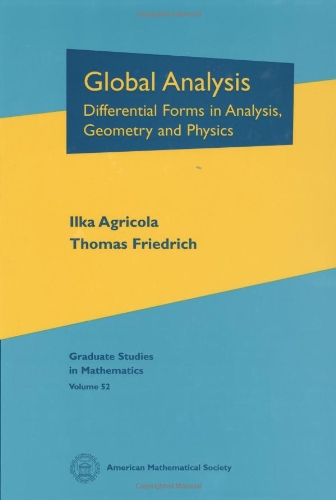
This book is devoted to differential forms and their applications in various areas of mathematics and physics. Well-written and with plenty of examples, this introductory textbook originated from courses on geometry and analysis and presents a widely used mathematical technique in a lucid and very readable style. The authors introduce readers to the world of differential forms while covering relevant topics from analysis, differential geometry, and mathematical physics. The book begins with a self-contained introduction to the calculus of differential forms in Euclidean space and on manifolds. Next, the focus is on Stokes’ theorem, the classical integral formulas and their applications to harmonic functions and topology. The authors then discuss the integrability conditions of a Pfaffian system (Frobenius’s theorem). Chapter 5 is a thorough exposition of the theory of curves and surfaces in Euclidean space in the spirit of Cartan. The following chapter covers Lie groups and homogeneous spaces. Chapter 7 addresses symplectic geometry and classical mechanics. The basic tools for the integration of the Hamiltonian equations are the moment map and completely integrable systems (Liouville-Arnold Theorem). The authors discuss Newton, Lagrange, and Hamilton formulations of mechanics. Chapter 8 contains an introduction to statistical mechanics and thermodynamics. The final chapter deals with electrodynamics. The material in the book is carefully illustrated with figures and examples, and there are over 100 exercises. Readers should be familiar with first-year algebra and advanced calculus. The book is intended for graduate students and researchers interested in delving into geometric analysis and its applications to mathematical physics.
User’s Reviews
Reviews from Amazon users which were colected at the time this book was published on the website:
⭐This book is a masterpiece, written by two accomplished researchers and educators in the field. The book emerged from graduate courses on differential geometry and analysis given by the second author, Thomas Friedrich (1949–2018), at Humboldt University in Berlin over a period that began in the early eighties. These classroom origins are evident in the global organization and the clarity of the text. In my experience (35 years as a professor of mathematics), books that develop from class-tested environments tend to be more reader-friendly. This book is so well written that it can easily serve as a primary resource for independent study, which is just about the highest praise I can offer any book on mathematics or physics. Of course, the book would represent an outstanding choice as a primary course text for a graduate course. Each chapter concludes with a set of exercises, also class-tested, which range from elementary computations to more challenging proofs.The book is published in the Graduate Studies in Mathematics series of the American Mathematical Society, and for prospective readers in the United States, I suspect that the book will appeal primarily to graduate students in mathematics and mathematical physics. The absolute prerequisites for reading the book are: (1) A solid, proof-based course in linear algebra; (2) A good course in multivariable calculus; (3) Moderate familiarity with group theory; and (4) A fair amount of that elusive quality called “mathematical maturity.” In Chapter 3 the authors discuss analysis on manifolds. They restrict the discussion to submanifolds of Euclidean space R^n, and the treatment is self-contained. Thus, a prior course on smooth manifolds is not an absolute prerequisite; but after studying the entire book, I am convinced that the reader who has had such a course will be able to make many more connections, especially in the final three chapters on applications.The Table of Contents is available on the “Look Inside” feature, so there is no need for a lengthy discussion of content. I will therefore just discuss the remarkable chapters on applications.Chapters 7, 8, and 9 discuss applications of differential geometry and forms in classical mechanics, thermodynamics, and electrodynamics, respectively. In my opinion, these three chapters alone are worth the price of the book. For mathematical physicists, it is probable that one or all of these applications served as partial motivation to learn about differential forms in the first place. A number of differential geometry texts include a chapter on applications to physics. These are typically just brief introductions, included as a final chapter and designed to indicate to the reader that more is out there; they are usually accompanied by some good references for further study. The last three chapters of Agricola and Friedrich go quite a bit beyond this sort of brief overview. Chapter 7 on classical mechanics, for example, occupies pages 229—269. This chapter discusses and compares the Newtonian approach, the Hamiltonian approach, and the Lagrangian approach to classical mechanics. This comparative discussion will be extremely helpful to the reader is who encountering for the first time the mathematics of tangent and cotangent bundles, symplectic forms, orbits of the coadjoint representation, Poisson brackets, Birkhoff’s Ergodicity Theorem, etc. Fair warning: there is a significant amount of information per page in these last three chapters. The reader should be prepared to progress slowly and carefully.I have a large number of books in my personal library that discuss differential forms. However, there are only a few references that are so authoritative and well-written that I return to them again and again as first choices. That list includes Bott and Tu’s “Differential Forms in Algebraic Topology,” Frankel’s “The Geometry of Physics, 3rd Ed.,” Abraham, Marsden and Ratiu’s “Manifolds, Tensor Analysis, and Applications,” and Choquet-Bruhat, DeWitt-Morette, and Dillard-Bleick’s “Analysis, Manifolds and Physics, Revised Ed.” Some time ago, I noticed that, quite unconsciously, Agricola and Friedrich’s book had become part of this short list of primary references. Those who are familiar with any one of these texts will understand by association my valuation of the book.I cannot resist closing with an historical observation. As long ago as the early 1960’s, Dr. Harley Flanders was attempting to convince the engineering faculty at the Purdue University School of Engineering that differential forms could provide considerable advantages over traditional tensor techniques when solving certain classes of engineering problems. I have no idea if Flanders’ lectures convinced any of the engineers, but they resulted in the now-classic book “Differential Forms with Applications to the Physical Sciences (1963),” which is still available from Dover. Despite advocates such as Flanders, I think it fair to say that in the years since 1963, the adoption of differential forms into the mainstream mathematics, physics and engineering undergraduate curricula has not been breathtakingly rapid. While front-line researchers in differential geometry and mathematical physics have made increasingly important and innovative uses of differential forms, the expected concomitant trickle-down developments in the undergraduate curriculum have not kept pace. However, I have been encouraged by the publication, over the past two decades, of a number of excellent new books devoted to differential forms in both the undergraduate and graduate mathematics and physics curricula. I am hopeful that these publications signal corresponding curricular changes, especially at the undergraduate level. I have tried to convince my own departmental colleagues that every mathematics major should be introduced to differential forms in our intermediate multivariable calculus class that has linear algebra as a prerequisite. I used the remarkable book by Agricola and Friedrich, along with others, to help make the case.
Keywords
Free Download Global Analysis: Differential Forms in Analysis, Geometry, and Physics (Graduate Studies in Mathematics) 0th Edition in PDF format
Global Analysis: Differential Forms in Analysis, Geometry, and Physics (Graduate Studies in Mathematics) 0th Edition PDF Free Download
Download Global Analysis: Differential Forms in Analysis, Geometry, and Physics (Graduate Studies in Mathematics) 0th Edition 2002 PDF Free
Global Analysis: Differential Forms in Analysis, Geometry, and Physics (Graduate Studies in Mathematics) 0th Edition 2002 PDF Free Download
Download Global Analysis: Differential Forms in Analysis, Geometry, and Physics (Graduate Studies in Mathematics) 0th Edition PDF
Free Download Ebook Global Analysis: Differential Forms in Analysis, Geometry, and Physics (Graduate Studies in Mathematics) 0th Edition