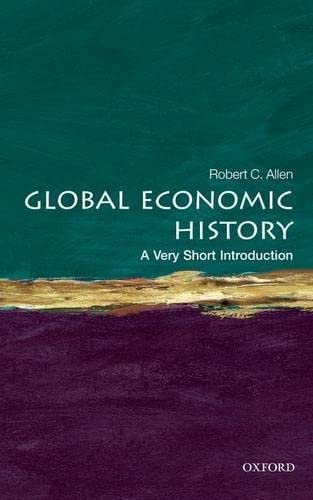
Ebook Info
- Published: 2011
- Number of pages: 170 pages
- Format: PDF
- File Size: 2.62 MB
- Authors: Robert C. Allen
Description
Why are some countries rich and others poor? In 1500, global income differences were small, but disparities have grown dramatically since Columbus reached America. In this Very Short Introduction, Robert C. Allen shows how the interplay of geography, globalization, technological change, and economic policy has determined the wealth and poverty of nations. Allen shows how the industrial revolution was Britain’s path-breaking response to the challenge of globalization. Western Europe and North America joined Britain to form a club of rich nations, pursuing four polices–creating a national market by abolishing internal tariffs and investing in transportation, erecting an external tariff to protect their fledgling industries from British competition, creating banks to stabilize the currency and mobilize domestic savings for investment, and promoting mass education to prepare people for industrial work. Together these countries pioneered new technologies that have made them everricher. A few countries–Japan, Soviet Russia, South Korea, Taiwan, and perhaps China–have caught up with the West through creative responses to the technological challenge and with Big Push industrialization that has achieved rapid growth through coordinated investment.
User’s Reviews
Editorial Reviews: About the Author Robert C. Allen is Professor of Economic History at Oxford University. He is a fellow of the British Academy.
Reviews from Amazon users which were colected at the time this book was published on the website:
⭐Robert C. Allen wrote whole global economic history vigorously. A thin book has a substantial contents. His profound knowledge overwhelms us, passing on his strong message. He divides the last 500 years, when countries developed differently in prosperity, into three periods, the mercantile era, the catch-up and the big push. He paid attention to real wages, which tells the standard of living in the region of each period. He claims cheap labour takes off incentives from businesses to invent or adopt machinery to raise productivity. Allen thinks Globalization, technological change, and economic policy have become the immediate cause of unequal development, while admitting certain roles of institutions, culture, and geography in it’s background.Globalization spurred northwestern Europe forward but held southern Europe back, while demanding additional labour, agricultural revolution, energy revolution, and high level literacy. The Industrial Revolution became a turning point in the world history for it’s inaugurating the era of sustained economic growth. Why The Industrial Revolution started in Britain is explained by profitability. Considering Britain’s high-wage and cheap-energy economy as a result of political, cultural and geometrical context at that time, business in England found using technology as profitable. All of today’s rich countries were involved in creating entirely new industries made in the late 19th century. High wages induced more capital-intensive production that led to higher wages. The Western countries enjoyed an ascending spiral of progress, while today’s poor countries missed the elevator. Technical change with globalization prompted de-industrializing the ancient manufacturing economies of the empires in the east of Europe.The industrialization of the USA depended on four supportive policies which constituted “the standard model” for economic development in the 19th century; mass education, expanding the market, a national bank, and a tariff. Allen thinks these four policies were the necessary conditions to industrialize, though not always were enough. The different development trajectories of North and South America are rooted in geography and demography. The abundance of free land on the frontier generated high real wages in North America.Sub-Saharan Africa lacked preconditions for modern economic growth, like productive agriculture, diversified manufacturing, and the institutional and cultural resources, which kept Africa poor for so long.While Europe and North America had pushed ahead of the rest of the world, Tsarist Russia, Japan, and Latin America tried to apply “the standard model,” however, less fruitful. The large economies that have broken out of poverty in the 20th century have to make a grand design of the big push which requires a planning authority to coordinate the activities and ensure it’s being carried out. Soviet, Japan, China succeeded in this by government intervention. What to do for Africa, Latin America, and the rest of Asia, to close gaps with the West. Allen concludes the best policy to effect economic development to these countries remains in dispute.
⭐Very interesting book. At least, if you like reading about how countries industrialized, and the theories on how to effectively do so. Allen does a good job of explaining a rather convincing theory that high wages drove investments in high-capital labor saving devices/methods, which forms a positive feedback cycle, as the high-capital devices allow wages to increase, and so higher-capital devices can be introduced economically.He also gives good accounts of other theories of how economic history such as staples (use a “staple” product to grow by exporting it), and industrial planning.He tackles every area of the world and pretty much every time from 1500 (mostly focusing on Europe for the early times). Japan, Russia, Korea, Taiwan, and China get special mentions for accomplishing the catch-up of GDP/capita with Western Europe, with some thoughts on how and why.Overall, just an interesting viewpoint as to how the world has gotten where we gotten. Allen does a good job of pointing out problems with theories and also accepting that no simple explanation will probably due. He ends with “The best policy to effect economic development, therefore, remains very much in dispute,” which I think is a fitting ending for an area with so many uncertainties.
⭐The author writes with a style where he consistently gets to the point with compelling facts and commentary. I found this book to cause me to reflect on what the US (or any country) needs to focus on to thrive, as well as to further increase my appreciation for the decisions made by our country’s leaders over its first 100 plus years. While we have gotten a lot wrong, and still do, we got a lot right. If we focus on what we did right, we should be able to convince ourselves to do more of the same in the future. One example is education, how our approach to universal education gave us so many advantages. This book also gives one a sense of how lucky we were in many ways with inherent advantages one could argue we squandered. My thoughts are that one reason we are where we are today is that our founders were far more intellectual and influenced by great thinkers of the day (e.g. Scottish Enlightenment), whereas today we are simplistic, closed minded, and afraid to be bold with new approaches. Seems like we will have to go down further before we wake up and begin to dialogue as was done in the past. If we don’t, my fear is whole generations will come out cynical and poorly prepared for the new world. This book seems to have answers to create an environment where future generations can develop the skills needed to thrive and compete with other countries, or even other generations who were given a head start.In sum, I found this to be one of the more enjoyable and enlightening reads.
⭐This is almost an excellent book. Unfortunately the author is stuck on a few themes that take away from the otherwise great merit of this book. At least 37 times he says “Businesses develop new technology to counteract high wages paid to their employees.” This is completely not a new idea, and one that does not need to be stated more than once, for the readers of this book to understand. Seriously he mentions this same idea nearly every third page of this book. The second hobby horse of this author is to prove that England is somehow still relevant in the world of economics. Twice, for example, on one page he notes that America copied English ideas, or built its success on English thoughts, and so on. The author does here with UK what King and I did by putting Siam as the Center Piece of the world’s map, with all else around it being small in comparison. Please dont misunderstand me. I think England is great–but please, Mr. Allen, dont make more of it than is appropriate. BTW: You skip entirely the Scottish contribution to Global Economic History. With some real editing of this book, it would be incredible. But it is clear no one above the author is editing this series of books by Oxford Press.
⭐This book is part of the OUP’s “Very Short Introduction” series of slim volumes (each would fit in a jacket pocket) covering a wide variety of topics, written by an expert in the relevant field, and aimed at the general reader. Each is about 100+ pages long (this one is about 170 pages), complete with maps, illustrations, a bibliography and an index. This one has lots of charts.I’m a fan of the series, having read about two dozen of them. One criticism I do have is that sometimes their titles can be misleading. This history covers ‘only’ the last 500 years and operates at the national and supranational level. It addresses, as it says in the opening paragraph, “the fundamental question – ‘why are some countries rich and others poor?’” (The question of why some people are poor in rich countries isn’t addressed). Furthermore, it deals with the history of traditional industries such as textiles, steel, etc without covering the emergence of newer industries such as computers and biotech.The author takes as his starting point 1500 because for him the present division between rich and poor largely emerged after Europeans reach America and India by sea. He divides the period since then into three, 1500 to 1800 as the mercantilist period, the 19th century as the catch-up period where western countries tried to catch up with Britain’s industrialization and the 20th century as the period where some non-Western counties caught up by a “Big Push” while others failed.In chapters 1 and 2 he looks at “The Great Divergence” and “The Rise of the West” where he is very much of the California school.Chapter 3 asks why the Industrial Revolution started in Britain and he ascribes it to a combination of high wages, cheap energy and access to cotton, with nods to the Glorious and Scientific revolutions.Chapter 4, “The Ascent of the Rich”, describes how certain Western countries caught up with and even surpassed Britain by adopting a fourfold strategy: creating a large internal market by eliminating internal tariffs, having external tariffs to protect fledgling native businesses from British imports, a banking system to provide a stable currency and capital for investment, and mass education to provide a skilled workforce.Chapter 5, “The Great Empires”, deals with how the non-Western great powers had a bad 19th century and how the globalized effects of the Industrial Revolution led to deindustrialization in Asia.Chapter 6 covers the Americas and the very different paths taken and outcomes achieved north and south of the Rio Grande, both pre- and post-independence.Chapter 7 begins by telling us African poverty isn’t new and that Sub-Saharan Africa was the poorest part of the world in 1500 (Australia barely merits a mention). The author rightly argues that to understand why Sub-Saharan Africa is poor today we must understand why it was poor in 1500 – he attributes this to the fact that Sub-Saharan Africa, already handicapped by diseases, lacked the advantages of the advanced agricultural societies, productive agriculture, diversified manufacturing and the necessary institutional and cultural resources (writing, the maths needed for land surveying, a written legal code, etc) to advance. The slave trade and colonialism would only exacerbate the situation.Chapter 8, “The standard model and late industralization”, covers the catch-up efforts in tsarist Russia, Meiji Japan and Latin America to catch up using the methods outlined in chapter 4.Chapter 9 covers the efforts by the Soviet Union and some East Asian countries to catch up through “Big Push Industrialization”, i.e. through building steel mills, power plants, car factories etc.A brief Epilogue (concluding that, “The best policy to effect economic development, therefore, remains very much in dispute.”), reviews how few countries have managed to catch up with West. Basically, if you exclude those few with oil wells or diamond mines, your left with countries that cluster together on an Inglehart World Values Chart and are neighbours on Huntington’s map and this is where to my mind the author’s account is an overly materialistic one in that he pays insufficient attention to the effect of culture. For example, for centuries the great Islamic empires rejected the introduction of printing. Similarly, there was a reluctance by the Chinese elites to adopt non-Chinese learning and method whereas the Japanese rulers, even when they tightly controlled access to Japan by foreigners, were more willing to learn, so Japan became wealthy while China is still playing catch-up. Such factors don’t get covered by the author.The one factual error I noticed is that on page 133 he refers to Germany invading the USSR in 1940. That happened in 1941.
⭐This book is full of interesting stories backed up by a welter of tables and graphs from the Industrial Revolution to the present and across the world. But its arguments about the prosperity trajectory of countries is quite wrong and misleading. The arguments are virtually entirely based on the old heavy industries of the Industrial Revolution of coal, steel and cotton.Energy supply and demand is not addressed: its vast industries of oil, gas and electricity production surely have a critical part to play in today’s economics. The huge telecommunications industry (mobile phones, Internet, TV) is likewise ignored. The enormous impact of computers on business and government administration productivity gets no mention, nor the trillions of derivative dollars in computer storage, not in currency. Also for software applications that create solutions that replace devices that used to be produced by manufacturers, with zero production costs. 30% of the US GDP is based on quantum mechanics. The point is that in these days there are so many more opportunities to create wealth that you do not have to build steel and cotton mills and mine coal. That would probably have the opposite effect! The newer factors are part of economic history that need further analysis, which could be done in the same style.As China has taken 800 million people out of poverty, and the WHO reports that poverty has been virtually eliminated, the world seems to have passed this book by!AND…Kindle, you still keep spoiling our vsi books by failing to proof read them!! In this one I despaired when the Japanese Emperor ascended his thrown (sic)!
⭐I’ve read about 50 of the the VSI series and this was one of my favourites. I work in finance, read a lot of economics, and studied economics modules at uni, so it was a positive surprise to learn so much from this book, with the author covering times and countries that are often overlooked. I found the writing style excellent and it was a joy to read, and I have recommended it to many friends since.
⭐I’ve come to expect good things from the Very Short Introductions series, but I must say this one is particularly good. It gives a very clear overview of the development of modern economic systems, in perfectly paced chronological order, along with touching on the main economic theorists in their historical contexts where relevant. It even manages to fit in the odd joke! All in all if you’re looking for a good gateway to understanding modern economic theory then this is definitely a fantastic starting point.
⭐Clearly, it is no mean feat to simplify a huge topic such as this into a concise and easy to read book. For background, its perfect. The book suggests a few common denominators to kick-start an economy, such as: transport infrastructure, cheap production costs (especially wage prices) proximity to markets, etc., where the same format is used throughout to analyse the rise of regions in the global economy.This book does it’s job well. However, the author provides no personality or humour to a fairly dry topic. Once one gets the rhythm of the way it was researched, it does become a little predictable. It is a very short history and if its background you need, this is where you will find it. I would recommend others to read it.
Keywords
Free Download Global Economic History: A Very Short Introduction in PDF format
Global Economic History: A Very Short Introduction PDF Free Download
Download Global Economic History: A Very Short Introduction 2011 PDF Free
Global Economic History: A Very Short Introduction 2011 PDF Free Download
Download Global Economic History: A Very Short Introduction PDF
Free Download Ebook Global Economic History: A Very Short Introduction