

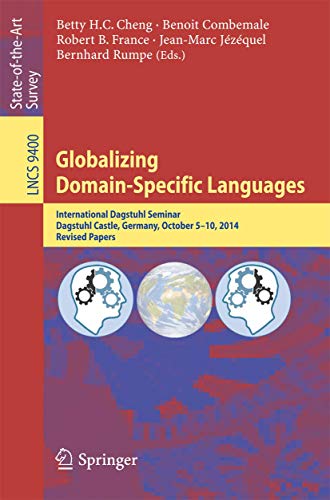
Ebook Info
- Published: 2015
- Number of pages: 104 pages
- Format: PDF
- File Size: 6.23 MB
- Authors: Benoit Combemale
Description
The development of modern complex software-intensive systems often involves the use of multiple DSMLs that capture different system aspects. Supporting coordinated use of DSMLs leads to what we call the globalization of modeling languages, that is, the use of multiple modeling languages to support coordinated development of diverse aspects of a system.In this book, a number of articles describe the vision and the way globalized DSMLs currently assist integrated DSML support teams working on systems that span many domains and concerns to determine how their work on a particular aspect influences work on other aspects.Globalized DSMLs offer support for communicating relevant information, and for coordinating development activities and associated technologies within and across teams, in addition to providing support for imposing control over development artifacts produced by multiple teams. DSMLs can be used to support socio-technical coordination by providing the means for stakeholders to bridge the gap between how they perceive a problem and its solution, and the programming technologies used to implement a solution. They also support coordination of work across multiple teams. DSMLs developed in an independent manner to meet the specific needs of domain experts have an associated framework that regulates interactions needed to support collaboration and work coordination across different system domains.The articles in the book describe how multiple heterogeneous modeling languages (or DSMLs) can be related to determine how different aspects of a system influence each other. The book includes a research roadmap that broadens the current DSML research focus beyond the development of independent DSMLs to one that provides support for globalized DSMLs.
User’s Reviews
Editorial Reviews: From the Back Cover The development of modern complex software-intensive systems often involves the use of multiple DSMLs that capture different system aspects. Supporting coordinated use of DSMLs leads to what we call the globalization of modeling languages, that is, the use of multiple modeling languages to support coordinated development of diverse aspects of a system.In this book, a number of articles describe the vision and the way globalized DSMLs currently assist integrated DSML support teams working on systems that span many domains and concerns to determine how their work on a particular aspect influences work on other aspects.Globalized DSMLs offer support for communicating relevant information, and for coordinating development activities and associated technologies within and across teams, in addition to providing support for imposing control over development artifacts produced by multiple teams. DSMLs can be used to support socio-technical coordination by providing the means for stakeholders to bridge the gap between how they perceive a problem and its solution, and the programming technologies used to implement a solution. They also support coordination of work across multiple teams. DSMLs developed in an independent manner to meet the specific needs of domain experts have an associated framework that regulates interactions needed to support collaboration and work coordination across different system domains.The articles in the book describe how multiple heterogeneous modeling languages (or DSMLs) can be related to determine how different aspects of a system influence each other. The book includes a research roadmap that broadens the current DSML research focus beyond the development of independent DSMLs to one that provides support for globalized DSMLs.
Reviews from Amazon users which were colected at the time this book was published on the website:
⭐
⭐
Keywords
Free Download Globalizing Domain-Specific Languages: International Dagstuhl Seminar, Dagstuhl Castle, Germany, October 5-10, 2014, Revised Papers (Lecture Notes in Computer Science, 9400) in PDF format
Globalizing Domain-Specific Languages: International Dagstuhl Seminar, Dagstuhl Castle, Germany, October 5-10, 2014, Revised Papers (Lecture Notes in Computer Science, 9400) PDF Free Download
Download Globalizing Domain-Specific Languages: International Dagstuhl Seminar, Dagstuhl Castle, Germany, October 5-10, 2014, Revised Papers (Lecture Notes in Computer Science, 9400) 2015 PDF Free
Globalizing Domain-Specific Languages: International Dagstuhl Seminar, Dagstuhl Castle, Germany, October 5-10, 2014, Revised Papers (Lecture Notes in Computer Science, 9400) 2015 PDF Free Download
Download Globalizing Domain-Specific Languages: International Dagstuhl Seminar, Dagstuhl Castle, Germany, October 5-10, 2014, Revised Papers (Lecture Notes in Computer Science, 9400) PDF
Free Download Ebook Globalizing Domain-Specific Languages: International Dagstuhl Seminar, Dagstuhl Castle, Germany, October 5-10, 2014, Revised Papers (Lecture Notes in Computer Science, 9400)