

Ebook Info
- Published: 2013
- Number of pages: 150 pages
- Format: PDF
- File Size: 5.21 MB
- Authors: Joanna A. Ellis-Monaghan
Description
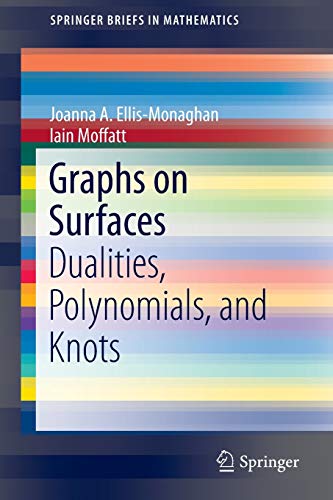
Graphs on Surfaces: Dualities, Polynomials, and Knots offers an accessible and comprehensive treatment of recent developments on generalized duals of graphs on surfaces, and their applications. The authors illustrate the interdependency between duality, medial graphs and knots; how this interdependency is reflected in algebraic invariants of graphs and knots; and how it can be exploited to solve problems in graph and knot theory. Taking a constructive approach, the authors emphasize how generalized duals and related ideas arise by localizing classical constructions, such as geometric duals and Tait graphs, and then removing artificial restrictions in these constructions to obtain full extensions of them to embedded graphs. The authors demonstrate the benefits of these generalizations to embedded graphs in chapters describing their applications to graph polynomials and knots. Graphs on Surfaces: Dualities, Polynomials, and Knots also provides a self-contained introduction to graphs on surfaces, generalized duals, topological graph polynomials, and knot polynomials that is accessible both to graph theorists and to knot theorists. Directed at those with some familiarity with basic graph theory and knot theory, this book is appropriate for graduate students and researchers in either area. Because the area is advancing so rapidly, the authors give a comprehensive overview of the topic and include a robust bibliography, aiming to provide the reader with the necessary foundations to stay abreast of the field. The reader will come away from the text convinced of advantages of considering these higher genus analogues of constructions of plane and abstract graphs, and with a good understanding of how they arise.
User’s Reviews
Editorial Reviews: Review From the reviews:“Here, the venerable knot-theoretic and graph-theoretic themes find a host of unifying common generalizations. Undergraduates will appreciate the patient and visual development of the foundations, particularly the dualities (paired representations of a single structure). Summing Up: Recommended. Upper-division undergraduates through researchers/faculty.” (D. V. Feldman, Choice, Vol. 51 (7), March, 2014)“This monograph is aimed at researchers both in graph theory and in knot theory. It should be accessible to a graduate student with a grounding in both subjects. There are (colour) diagrams throughout. … The monograph gives a unified treatment of various ideas that have been studied and used previously, generalising many of them in the process.” (Jessica Banks, zbMATH, Vol. 1283, 2014)“The authors have composed a very interesting and valuable work. … For properly prepared readers … the book under review is the occasion for all sorts of fun including the inner life of ribbon groups, Tait graphs, Penrose polynomials, Tutte polynomials, and of course Jones polynomials and HOMFLY polynomials. This is fascinating mathematics, presented in a clear and accessible way.” (Michael Berg, MAA Reviews, October, 2013)
Reviews from Amazon users which were colected at the time this book was published on the website:
⭐I’m not a mathematician and no longer a student, just someone who reads math occasionally for refreshment. I picked up this book as part of my summer break reading, and found it perfectly suited to an enjoyable couple of days. Although it claims to be directed to an audience of grad students and professionals, I’m far away from either qualification: having read a book or two about knots and pieces of books about graphs in the distant past was enough to enable me to enjoy most of it.Most of the book relates to material published jointly or severally by the authors in the past couple of years, especially concerning the group action of duals and twists on ribbon graphs. Many of the pertinent references are on the arXiv and more than a few date from between 2010-2014, so the material is still very current as I write. However, the book is a synthesis and refinement, not just a repetition, of that material. It’s richly illustrated, so you can learn a lot from trying to reproduce the diagrams. The pictures alone are already very suggestive of how embedded graphs are connected to knots and links. (I also really liked the authors’ phrase “twisted duality” — geometrically apt, but maybe also a useful metaphor for marriage counselors and other therapists?)I do recommend though that you know something about graph and knot polynomials, which are of great interest to working mathematicians. My knowledge was more than zero but epsilon-sized in this area, and I wound up skimming large chunks of the algebraic proofs showing how various polynomials (e.g. Tutte, Penrose, Bollabás-Riordan, Jones, and HOMFLY, plus Kaufmann bracket) were related to each other and/or to the authors’ “transition polynomial”. The book’s treatment of these topics is self-contained but only in a perfunctory way, despite (or perhaps because of) the topics’ importance for many readers.I read this in the paperback edition. Thanks to Springer for allowing many illustrations in the print book to make effective use of color. The list of references is good, the index is mostly adequate, and the number of typos average or less for a typical math book. The one drawback is that the price is a little steep for a thin book like this; but it’s still pretty good value compared to some Springer Briefs in other fields. (I bought mine at a discount during the publisher’s annual Yellow Sale.) Assuming you have the background mentioned above, this book is a fun and visually stimulating way to engage with current mathematical research, even for undergraduates and amateurs.
⭐First a caveat. I am not an expert. I am not even an amateur mathematician. My hobby is reading mathematics, particularly knot theory. I have been following the development of partial and twisted duality via preprints for about four years.In my opinion this is a beautiful book about a beautiful theory. The writing, the diagrams and the presentation make the subject matter accessible. The clarity with which the topics are described is excellent. A wide diversity of ideas is assembled concisely demonstrating the power of the theory. This book is a serious exposition not a popularisation. It deserves to become a classic.
⭐Not found.
⭐Not found.
Keywords
Free Download Graphs on Surfaces: Dualities, Polynomials, and Knots (SpringerBriefs in Mathematics) 2013th Edition in PDF format
Graphs on Surfaces: Dualities, Polynomials, and Knots (SpringerBriefs in Mathematics) 2013th Edition PDF Free Download
Download Graphs on Surfaces: Dualities, Polynomials, and Knots (SpringerBriefs in Mathematics) 2013th Edition 2013 PDF Free
Graphs on Surfaces: Dualities, Polynomials, and Knots (SpringerBriefs in Mathematics) 2013th Edition 2013 PDF Free Download
Download Graphs on Surfaces: Dualities, Polynomials, and Knots (SpringerBriefs in Mathematics) 2013th Edition PDF
Free Download Ebook Graphs on Surfaces: Dualities, Polynomials, and Knots (SpringerBriefs in Mathematics) 2013th Edition