

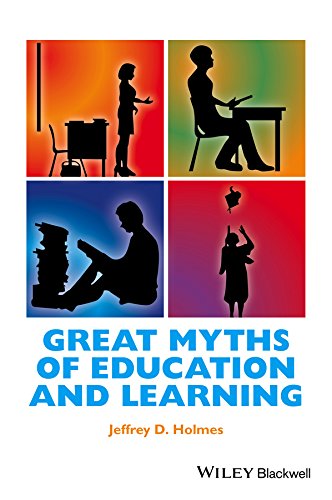
Ebook Info
- Published:
- Number of pages:
- Format: PDF
- File Size: 0.84 MB
- Authors: Jeffrey D. Holmes
Description
Great Myths of Education and Learning reviews the scientific research on a number of widely-held misconceptions pertaining to learning and education, including misconceptions regarding student characteristics, how students learn, and the validity of various methods of assessment. A collection of the most important and influential education myths in one book, with in-depth examinations of each topicFocusing on research evidence regarding how people learn and how we can know if learning has taken place, the book provides a highly comprehensive review of the evidence contradicting each beliefTopics covered include student characteristics related to learning, views of how the learning process works, and issues related to teaching techniques and testing
User’s Reviews
Reviews from Amazon users which were colected at the time this book was published on the website:
⭐Holmes addresses the specific topics that make up the chapters of this book. This is not an overview of education and learning in general. He does a very good job in his exploration of these topics. He offers a thorough look at the topic, explaining the myth and taking a detailed look at a wide array of studies which address the issue. This is not just a listing of studies; Holmes explains the studies (pointing out strengths and flaws) and offers conclusions. He looks at the nuances of the myths, and how parts of the myth may be true under certain circumstances, but not true when broadly applied. The book is well written and easy to understand.Holmes starts out by telling us, “One of the most meaningful insights I acquired while researching and writing this book is that the line of belief between adherents and skeptics is often the same line that separates those who conduct the research in a particular area from those who do not. For example, it is difficult to identify neuroscientists – experts who study brain function – who agree that people are left- or right-brained, or that education can be tailored to activate one brain hemisphere or the other.” Thus, we have insight into why “myths” may be myths. Often they are due to a shallow look at the topic, often on the basis of one study, which may have flaws. He also points out that studies vary in quality and that doctoral dissertations (which he says are a common source of myths) are not subjected to as rigorous standards as peer-reviewed published studies. A broader look offers a better perspective, and Holmes offers that in this book. He also acknowledges that research is ongoing and we continue to learn more, which can change the perspective that we have.Each chapter often concludes with a brief discussion of studies or books which offer guidance to instructors on how to improve their teaching, as it relates to the topic of the chapter. For example, on page 34, Holmes writes, “Instructors seeking guidance to improve their lecture skills have a host of resources available to them (e.g., Bligh, 2000; Di Leonardi, 207); DeGolia, 2013). For example, DeGolia provides excellent step-by-step guidance for preparing and implementing lectures. She provides strategies for identifying learning objectives, identifying interesting content, understanding the audience, capturing attention and activating students’ interest, encouraging participation, establishing rapport, and establishing an effective classroom environment. Much of DeGolia’s advice is grounded in empirical research.”Two other books on the topic of education and learning that I highly recommend are Teaching and Learning STEM: A Practical Guide, by Richard M. Felder and Rebecca Brent and Brain Rules, by John Medina.
⭐This is a book of meta analyses. The author takes 16 widely accepted beliefs and subjects each to scientific scrutiny by collecting the scientific studies which would either confirm or deny these beliefs. The book itself is a debunking of those 16 beliefs and so the author classifies them as myths. I suppose that’s as good a term as any.This is a thin volume but informationally dense. The typeface is small as are the margins. Each page consists of two or three paragraphs giving the pages that overall gray look. Think of reading a Bible but without the usual two columns per page convention used in most Bibles and then add only one or two paragraph breaks per page. This is a book for those with good eyes or reading glasses or both.In each belief, the author tends to not so much prove the belief is a myth, which would be a form of doing the impossible: proving the negative. Instead he shows there is no scientific support, or at best scant support for each belief and much support for dismissing the belief. The amount of research he did is exhaustive and it looks like he closes his cases solidly for each of these beliefs.The narrative is limited to the minimum needed to tie the research together. The author rarely inserts much editorial into this extensive collection of research. One such insertion is when he editorializes that the reason the idea of multiple intelligences was proposed is the distress some felt at the differing racial outcomes of general intelligence tests. In most cases, he gives no rationale for why the myth appeared and there’s no real reason he should have.I would have liked to see a bit more editorializing not so much as to why the myths rose up but what to do about them being myths. For example, the first myth has to do with student’s appraisal of their own abilities. Poor students think they are doing better than they are while good ones tend to discount how well they’re performing. OK, that’s clearly the case in one of the most objective set of studies in the book. So what does a teacher do with this information? The book does not delve into this area at all.To be fair, the author does not promise any classroom solutions because while this is labeled a book on education, it’s really one on general psychology where the research is the thing and not the use of that research.After finishing this book and wading through the rather thick forest of studies collected by the author, I can’t fault a single one of his meta analyses. He makes all his cases convincingly.
⭐The topic is very interesting, and there is some quite surprising research cited in the book. The language is quite dry, with many many references to research in the area. I liked that not only the myths were discussed, but also implications of the following the wrong ideas, and what it is should be done instead, at least briefly. In many cases some of the research supporting the myth is proved to be flawed in some way, intentional or not. Quite a lot is about fad ideas like unguided learning and power point presentations.Large part of the book is references to cited research, and each of the myth chapters is quite small in comparison, but there is no fluff in the book at all.
Keywords
Free Download Great Myths of Education and Learning (Great Myths of Psychology) 1st Edition in PDF format
Great Myths of Education and Learning (Great Myths of Psychology) 1st Edition PDF Free Download
Download Great Myths of Education and Learning (Great Myths of Psychology) 1st Edition PDF Free
Great Myths of Education and Learning (Great Myths of Psychology) 1st Edition PDF Free Download
Download Great Myths of Education and Learning (Great Myths of Psychology) 1st Edition PDF
Free Download Ebook Great Myths of Education and Learning (Great Myths of Psychology) 1st Edition