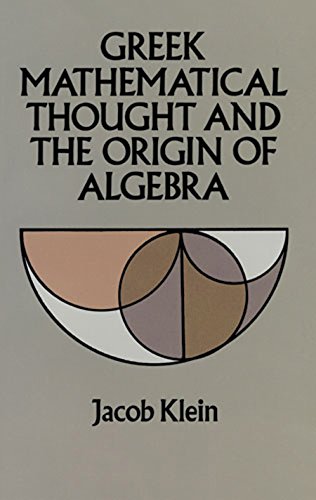
Ebook Info
- Published: 2013
- Number of pages: 384 pages
- Format: PDF
- File Size: 9.16 MB
- Authors: Jacob Klein
Description
Important study focuses on the revival and assimilation of ancient Greek mathematics in the 13th–16th centuries, via Arabic science, and the 16th-century development of symbolic algebra. This brought about the crucial change in the concept of number that made possible modern science — in which the symbolic “form” of a mathematical statement is completely inseparable from its “content” of physical meaning. Includes a translation of Vieta’s Introduction to the Analytical Art. 1968 edition. Bibliography.
User’s Reviews
Reviews from Amazon users which were colected at the time this book was published on the website:
⭐What Klein does in this book is nothing short of genius. The section on Plato’s Forms is by itself a good enough reason to read it; the story afterwards about the historical development of algebra from the Forms is nothing short of remarkable. As Klein himself notes, the book is very assiduous in its scholarship to a fault, as it can be tedious in the quotes. But still, it leaves very little room for doubt that Klein’s analysis of the historical development of algebra is right on target. If the reader wishes to understand Plato’s Forms better and the influence of his idea of ideas, this is the book to read.
⭐The scholar or academic may find this book quite engaging — I’m just an amateur mathematician with an added mild interest in the history. For me, it’s rather pedantic (over my pay grade as it were).
⭐Good thoughts but the writing style is very difficult. At the beginning, there is a guide to about 30 Greek words that are used throughout the book. You’d better memorize all of them or else be ready to turn back to the front of the book two or three times on every page. Sentences are long, rambling, and broken up by Greek sentences in the same font in the middle of sentences. One paragraph can last two pages. As a double major in mathematics and philosophy, I thought I would be able to read this without too much difficulty. I was wrong. Maybe the second time through when I am more aware of what he is trying to say. It sounds really interesting; I just have a hard time getting past all the stumbling blocks.
⭐I have returned to this book after a number of years and still find something of value in every page and sometimes every paragraph.My interest comes through music. The use of ratios and proportion is something the Greeks understood intimately. Prior to the nineteenth century musicians were generally more aware of this. But in the Renaissance, a decline started to take place. This decline is linked with an alienation of ancient math within the corpus of modern thought.It is essential that a truer knowledge of Greek math, musical theory, and philosophy be restored. Klein knows intimately how the late Renaissance and early age of Reason did a great disservice to the place and important of ancient Greek mathematical thought and its philosophic foundation.Buy this book. Heath’s History of Greek Mathematics is just as important but does not tackle the philosophical issues the way Klein’s book does. It demands attention but you will be amply rewarded.
⭐Roughly, this book is to Greek mathematics as Lewis’s
⭐is to medieval natural philosophy. (However, Lewis’s book is a tighter work and Lewis writes more clearly than Klein does.) To understand what how mathematicians think about the objects they talk about, Klein should have given close readings on a few theorems and problems from Euclid, Archimedes, Diophantus, Apollonius, and instead refers overwhelmingly to statements of theorems and definitions and commentaries and scholia.Klein explains how Greek mathematicians thought about the objects with which they worked. What Klein says reminds me of the notion of a theory (in mathematical logic) being “categorical” when it has a model that is unique up to isomorphism. Talking about objects that are determinate but have only some general property, like “a red thing” being a fixed object that only has those properties which are entailed from being red, reminds me for different vague reasons of equivalence classes and universal objects. (One usually speaks about “the tensor product”, and thus works with something that is not fixed but merely unique up to unique isomorphism.)I think I would have understood this book more deeply if I were familiar with Aristotle’s Metaphysics and Organon, and ideas from Scholastic logic like the first and second intentions of terms, and the metaphysical problem of universals, and it would also help to know ancient Greek. I would like to have a stock of examples for the various technical Greek terms that Klein uses. Klein does not work out the helpful pedestrian examples that let a reader feel familiar with a subject, and without having meaning beyond their dictionary meaning attached to, say, eidos, aisthesis, noesis, dianoia, I often became confused or frustrated. But because this book has so much value and is unique, my complaints are small, and I would be delighted if another work like this is published some day. Most of what non-mathematicians write about mathematics seems shallow to a mathematician (for example, there is much more to say about the ontology of universal objects in category theory or the indeterminateness of the sample space in probability theory than there is about “what is a number”, but getting to these more substantial questions requires more command of mathematics than most philosophy graduate students have, and likewise someone with meager mathematical training will ask shallow questions about general relativity and quantum physics, missing the substantial questions that tend not to be asked by initiates), and Klein is an exception to this. Even though I have not fully connected with Klein’s book I feel that his thoughts are deep and are based on long reading of the original writings.
⭐A very philosophical review of the development of our understanding of number and the origin of algebra Sometimes I had to re-visit parts of the text to grasp a better understanding of the author’s ideas, as the academic philosphical language is not familiar to me. The author teases out the historical ideas behind numbers and algebra, showing the revolutions of thinking through the ages, and exposing the unexpected gulf between Greek and modern mathematical thinking. Kost important is the exposure of the limitations to development which the Greeks caused themeselves by their particular conception of the unit. A thought-provoking text, well worth the effort in understanding it.
⭐El problema matemático en Aristóteles y Platón generó una tradición que muchas veces asume a las matemáticas como ciencias, otras veces como lenguaje. Klein es uno de los grandes maestros del siglo XX, el cuidado y paciencia para clarificar un pasaje de cualquier texto es algo escaso en la actualidad.
⭐Le livre de Jacob Klein, malgré son âge, reste un grand classique de l’histoire des mathématiques, pour l’érudition, la précision et la profondeur des analyses sur la question qui anime le livre: comment a été définie et utilisée la notion de nombre dans l’Antiquité d’une part, et à la Renaissance d’autre part.Le livre n’est pas d’une approche aisée, avec un fond de phénoménologie husserlienne, des pré-requis nécessaires en philosophie antique (surtout Platon et Aristote), et des longues citations (en grec mais de immédiatement traduites en anglais).A la fois très bon et très exigeant.
⭐Always good to view subjects through different points of view. This is interesting and the material well presented
Keywords
Free Download Greek Mathematical Thought and the Origin of Algebra (Dover Books on Mathematics) in PDF format
Greek Mathematical Thought and the Origin of Algebra (Dover Books on Mathematics) PDF Free Download
Download Greek Mathematical Thought and the Origin of Algebra (Dover Books on Mathematics) 2013 PDF Free
Greek Mathematical Thought and the Origin of Algebra (Dover Books on Mathematics) 2013 PDF Free Download
Download Greek Mathematical Thought and the Origin of Algebra (Dover Books on Mathematics) PDF
Free Download Ebook Greek Mathematical Thought and the Origin of Algebra (Dover Books on Mathematics)