

Ebook Info
- Published: 2012
- Number of pages: 352 pages
- Format: PDF
- File Size: 4.34 MB
- Authors: John Marincola
Description
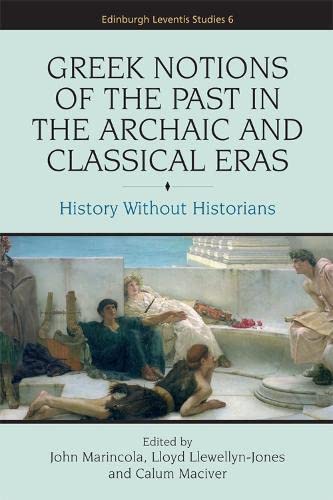
A wide examination of the ways in which the Greeks constructed, de-constructed, engaged with and relied on their pastsThis volume in The Edinburgh Leventis Studies series collects the papers presented at the sixth A. G. Leventis conference organised under the auspices of the Department of Classics at the University of Edinburgh. As with earlier volumes, it engages with new research and new approaches to the Greek past, and brings the fruits of that research to a wider audience. Although Greek historians were fundamental in the enterprise of preserving the memory of great deeds in antiquity, they were not alone in their interest in the past. The Greeks themselves, quite apart from their historians and in a variety of non-historiographical media, were constantly creating pasts for themselves that answered to the needs – political, social, moral and even religious – of their society. In this volume eighteen scholars discuss the variety of ways in which the Greeks constructed de-constructed, engaged with, alluded to, and relied on their pasts whether it was in the poetry of Homer, in the victory odes of Pindar, in tragedy and comedy on the Athenian stage, in their pictorial art, in their political assemblies, or in their religious practices. What emerges is a comprehensive overview of the importance of and presence of the past at every level of Greek society.In the final chapter the three discussants present at the conference (Simon Goldhill, Christopher Pelling and Suzanne Saïd) survey the contributions to the volume, summarise its overall contributions as well as indicate new directions that further scholarship might follow.
User’s Reviews
Editorial Reviews: Review “If there is any single inference to be drawn safely from this brilliant collection, it is that ‘the past’ is itself a deeply questionable notion.” — Paul Cartledge, University of Cambridge, The Anglo-Hellenic Review (No 47)A rich volume. — Gocha R. Tsetskhladze, Linacre College, Oxford, Ancient West and East…offer[s] much to anyone interested in scholarly debates as well as in archaic and classical Greece more broadly… The editors deserve thanks, then, for a volume that should do much to inform and nuance future debate. — Tim Rood, St. Hugh’s College, Oxford, Classical Journal OnlineJohn Marincola opens this volume with a lucid critique of Jacoby’s influential entwicklungsgeschichtliches model, according to which the development of Greek historiography (and of the Greeks’ historical consciousness in general) resided in the individual progress of Herodotus from geographer and ethnographer to historian. What follows is a tour-de-force from Homer to third-century inscriptions. The sixteen contributors and three commentators (Simon Goldhill, Suzanne Saïd and Christopher Pelling) break down the old dichotomy of critical historiography, on the one hand, and other, “inferior” forms of engagement with the past, on the other. This book provides excellent snapshots of the current state of the study of social memory in ancient Greece, but also shows the way for further research in this exciting field… Everybody interested in the manifold uses and meanings of the past in archaic and classical Greece should read it. — Bernd Steinbock, University of Western Ontario, Bryn Mawr Classical Review Review If this brilliant collection allows any one unarguable inference, it is that there’s no such thing as ‘the past’, any more than there’s one single and uncontestable definition of, or way of doing, ‘history’. Going back to the very roots of Western historiography in early Greece, John Marincola and his expert team do a grand job of radical conceptual reappraisal in this far-reaching, deeply scholarly and yet accessible addition to the outstanding “Edinburgh Leventis Studies” series. — Paul Cartledge, A.G. Leventis Professor of Greek Culture From the Back Cover AUTHOR APPROVED ‘If this brilliant collection allows any one unarguable inference, it is that there’s no such thing as “the past”, any more than there’s one single and uncontestable definition of, or way of doing, “history”. Going back to the very roots of Western historiography in early Greece, John Marincola and his expert team do a grand job of radical conceptual reappraisal in this far-reaching, deeply scholarly and yet accessible addition to the outstanding Edinburgh Leventis Studies series.’ Paul Cartledge, A.G. Leventis Professor of Greek Culture A wide examination of the ways in which the Greeks constructed, de-constructed, engaged with and relied on their pasts This book looks at Greek notions and beliefs about the past as they are revealed in areas other than historical texts. A range of experts from diverse fields examine, amongst other things, epic, didactic, lyric and epinician poetry, tragedy, comedy and philosophy in an attempt to tease out how the Greeks in the archaic and classical eras thought about, imagined and constructed their pasts. But it is not only literary texts that are studied here. Material culture, cult acts, inscriptions and monumental buildings are analysed to see what each of these can tell us about the relationship between past and present and about the important role that the past played for Greeks of all social classes. John Marincola is Leon Golden Professor of Classics at Florida State University in Tallahassee. Lloyd Llewellyn-Jones is Senior Lecturer in Ancient History at the University of Edinburgh. Calum Maciver is a Lecturer in Classics at the University of Leeds. About the Author John Marincola is Leon Golden Professor of Classics at Florida State University in Tallahassee. He is the author of Authority and Tradition in Ancient Historiography, Greek Historians, and, with Michael A. Flower, Herodotus Histories: Book IX. He revised the Penguin edition of Herodotus’ Histories, and provided the translation for The Landmark Xenophon’s Hellenica. His edited volumes include the Cambridge Companion to Herodotus and A Companion to Greek and Roman Historiography.Lloyd Llewellyn-Jones is Professor of Ancient History at Cardiff University and a specialist in the histories and cultures of ancient Iran and Greece. He also works on dress and gender in antiquity and on the ancient world in popular culture, especially Hollywood cinema. He is the author of Designs on the Past: How Hollywood Created the Ancient World, Aphrodite’s Tortoise: The Veiled Woman of Ancient Greece, King and Court in Ancient Persia 559 to 331 BCE and Ctesias’ History of Persia. He is editor of Women’s Dress in the Ancient Greek World, Greek Notions of the Past in the Archaic and Classical Eras, Creating a Hellenistic World and The Hellenistic Court as well as numerous articles on Greek and Persian culture. He is the series editor of Edinburgh Studies in Ancient Persia and co-series editor of Screening Antiquity.Calum Maciver is a Lecturer in Classics at the University of Edinburgh Read more
Reviews from Amazon users which were colected at the time this book was published on the website:
⭐Fascinating topic. Wish I could afford to spend that much! Lower he price to one in line with the electronic medium and I’ll buy the book.
Keywords
Free Download Greek Notions of the Past in the Archaic and Classical Eras: History Without Historians (Edinburgh Leventis Studies) 1st Edition in PDF format
Greek Notions of the Past in the Archaic and Classical Eras: History Without Historians (Edinburgh Leventis Studies) 1st Edition PDF Free Download
Download Greek Notions of the Past in the Archaic and Classical Eras: History Without Historians (Edinburgh Leventis Studies) 1st Edition 2012 PDF Free
Greek Notions of the Past in the Archaic and Classical Eras: History Without Historians (Edinburgh Leventis Studies) 1st Edition 2012 PDF Free Download
Download Greek Notions of the Past in the Archaic and Classical Eras: History Without Historians (Edinburgh Leventis Studies) 1st Edition PDF
Free Download Ebook Greek Notions of the Past in the Archaic and Classical Eras: History Without Historians (Edinburgh Leventis Studies) 1st Edition