

Ebook Info
- Published: 2012
- Number of pages: 272 pages
- Format: PDF
- File Size: 3.13 MB
- Authors: Pär Kristoffer Cassel
Description
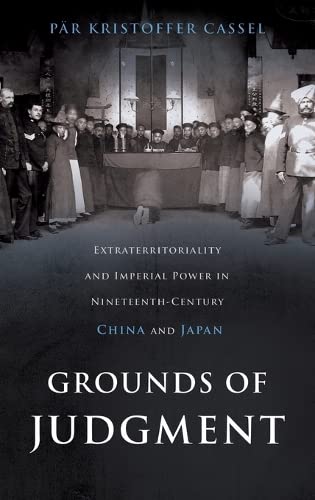
Perhaps more than anywhere else in the world, the nineteenth century encounter between East Asia and the Western world has been narrated as a legal encounter. Commercial treaties–negotiated by diplomats and focused on trade–framed the relationships among Tokugawa-Meiji Japan, Qing China, Choson Korea, and Western countries including Britain, France, and the United States. These treaties created a new legal order, very different than the colonial relationships that the West forged with other parts of the globe, which developed in dialogue with local precedents, local understandings of power, and local institutions. They established the rules by which foreign sojourners worked in East Asia, granting them near complete immunity from local laws and jurisdiction. The laws of extraterritoriality looked similar on paper but had very different trajectories in different East Asian countries.Pär Cassel’s first book explores extraterritoriality and the ways in which Western power operated in Japan and China from the 1820s to the 1920s. In Japan, the treaties established in the 1850s were abolished after drastic regime change a decade later and replaced by European-style reciprocal agreements by the turn of the century. In China, extraterritoriality stood for a hundred years, with treaties governing nearly one hundred treaty ports, extensive Christian missionary activity, foreign controlled railroads and mines, and other foreign interests, and of such complexity that even international lawyers couldn’t easily interpret them. Extraterritoriality provided the springboard for foreign domination and has left Asia with a legacy of suspicion towards international law and organizations. The issue of unequal treaties has had a lasting effect on relations between East Asia and the West.Drawing on primary sources in Chinese, Japanese, Manchu, and several European languages, Cassel has written the first book to deal with exterritoriality in Sino-Japanese relations before 1895 and the triangular relationship between China, Japan, and the West. Grounds of Judgment is a groundbreaking history of Asian engagement with the outside world and within the region, with broader applications to understanding international history, law, and politics.
User’s Reviews
Editorial Reviews: Review “Cassel’s nuanced account provides an exemplary model for future researchers….While this monograph is primarily intended to appeal to readers in the field of Asian history, its findings have broad appeal that will ensure that it enjoys a wide readership. For instance, Cassel’s findings that local agency resulted in extraterritoriality having remarkable sticking power in China has interesting implications for international politics, where the West continues to demand homogeneity, frequently under the term of ‘universal values; or ‘human rights.'”–Shogo Suzuki, Journal of Japanese Studies”This study offers a welcome perspective on the Chinese and Japanese legal orders in a global context. Cassel’s simultaneous grounding of this history in an examination of indigenous legal practices and comparative perspectives–including Russia, Central Asia, the Ottoman Empire, and Egypt, among others–it is invaluable. Rich in its analysis, this work is an important study in the fields of legal history and Sino-Japanese relations. It also serves as an excellent complement to recent works on late nineteenth-century state formation, as well as cultural and linguistic studies of diplomacy and colonialism.”–The Historian”Minutely argued and cogently presented, Pär Cassel’s Grounds of Judgment gives us a completely new base line from which to examine the practice of extraterritoriality from both the Chinese and the Japanese legal perspectives. An absorbing and valuable book.”–Jonathan Spence, author of The Search for Modern China “This sophisticated analysis of the changing legal orders in nineteenth-century East Asia nicely explodes the old dichotomy between Western international law and Chinese and Japanese responses to it. Cassel shows that even the seemingly immovable obstacle of extraterritoriality was subject to flexible interpretations that derived from domestic legal practices, which affected not only Westerners but also Japanese and Chinese in the treaty ports of the two countries. An impressive contribution both to international legal history and to the history of modern East Asia.”–Carol Gluck, Columbia University”Relying on primary and secondary sources in a host of languages, Pär Cassel’s new book offers the most thoroughgoing comparative examination of treaty port law and jurisdiction for late imperial China and late-Tokugawa and Meiji Japan. Especially interesting in his analysis is the treatment of the highly controversial topic extraterritoriality–with fascinating insights and stunning conclusions. This is a must read for anyone interested in late-Qing China, Tokugawa-Meiji Japan, or comparative legal history.”–Joshua A. Fogel, Canada Research Chair, York University”This is an impressive and important book. Cassel has gone back to the basics underpinning the nineteenth-century ‘unequal treaties’ between the different Western powers and China and Japan, and equally importantly those signed between the latter. Rich in comparative insight, Grounds of Judgement draws on an exemplary range of sources and clearly and engagingly re-writes long-unquestioned narratives. With this book Cassel compels us to rethink our fundamental assumptions about this complex tangle of relationships, and about the East Asian experience of the age of empires and its lasting legacies.”–Robert Bickers, author of The Scramble for China: Foreign Devils in the Qing Empire, 1832-1914″Innovative…Cassel provides rich, detailed case studies of consular jurisdiction.” –Journal of American-East Asian Relations About the Author Pär Kristoffer Cassel is Assistant Professor of History at the University of Michigan.
Reviews from Amazon users which were colected at the time this book was published on the website:
⭐Grounds of Judgment is a very interesting history of extraterritoriality in China and Japan. Cassel has done lots of research from primary materials in China, Japan and the UK. He has particularly explored the mutual extraterritoriality agreed between China and Japan before the Treaty of Shimonoseki (1895) as well as the early workings of the British Supreme Court for China and Japan as well as the Mixed Court in Shanghai. His case studies provide useful insights into how extraterroriality worked in practice.
Keywords
Free Download Grounds of Judgment: Extraterritoriality and Imperial Power in Nineteenth-Century China and Japan (Oxford Studies in International History) 1st Edition in PDF format
Grounds of Judgment: Extraterritoriality and Imperial Power in Nineteenth-Century China and Japan (Oxford Studies in International History) 1st Edition PDF Free Download
Download Grounds of Judgment: Extraterritoriality and Imperial Power in Nineteenth-Century China and Japan (Oxford Studies in International History) 1st Edition 2012 PDF Free
Grounds of Judgment: Extraterritoriality and Imperial Power in Nineteenth-Century China and Japan (Oxford Studies in International History) 1st Edition 2012 PDF Free Download
Download Grounds of Judgment: Extraterritoriality and Imperial Power in Nineteenth-Century China and Japan (Oxford Studies in International History) 1st Edition PDF
Free Download Ebook Grounds of Judgment: Extraterritoriality and Imperial Power in Nineteenth-Century China and Japan (Oxford Studies in International History) 1st Edition