

Ebook Info
- Published: 2004
- Number of pages: 304 pages
- Format: PDF
- File Size: 33.64 MB
- Authors: Paul H. E. Meijer
Description
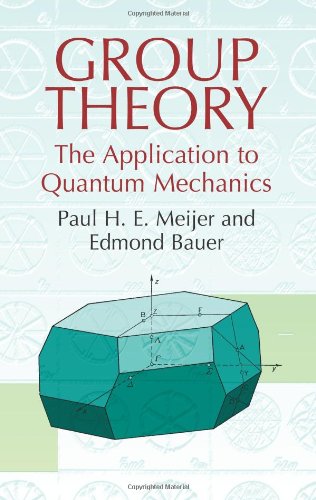
Many books explore group theory’s connection with physics, but few of them offer an introductory approach. This text provides upper-level undergraduate and graduate students with a foundation in problem solving by means of eigenfunction transformation properties. This study focuses on eigenvalue problems in which differential equations or boundaries are unaffected by certain rotations or translations. Its explanation of transformations induced in function space by rotations (or translations) in configuration space has numerous practical applications — not only to quantum mechanics but also to any other eigenvalue problems, including those of vibrating systems (molecules or lattices) or waveguides.Points of special interest include the development of Schur’s lemma, which features a proof illustrated with a symbolic diagram. The text places particular emphasis on the geometric representation of ideas: for instance, the similarity transformation is characterized as a rotation in multidimensional function space and the reduction is described in terms of mutual orthogonal spaces. General references provide suggestions for further study, citing works of particular clarity and readability.
User’s Reviews
Reviews from Amazon users which were colected at the time this book was published on the website:
⭐I found this book (first copyrighted in 1962) outdated, far too mathematically informal and in some places, the exposition too opaque to be of use in learning about applications of group theory in physics. Because of this I had to give up around page 72 so my review should be taken with that in mind. It’s also possible that the book has insightful discussion in latter parts of the book, especially for those interested in the particular applications discussed.I’ve given the book 2 stars instead of 1 star simply because I did not read it all but I hope the 2 stars serves as a heads up for those who, like me, like their math to be stated in a rigorous, clear and concise fashion. There are now many excellent, modern books on the market with clear mathematical definitions, useful exposition and examples. Check out my first choice: Tung’s lucid, self-study-friendly introductory text
⭐. Many non-mathematicians like Tinkham’s classic
⭐but I prefer Tung: it’s more modern, a bit more abstract/general and deals with space-time symmetries needed for relativity, which was my interest. On the other hand, if your interest is specifically in non-relativistic quantum mechanical applications then Tinkham would likely be a better choice for a first book.If you know something about group theory already or after reading Tung or Tinkham, you might also profit from Sternberg’s
⭐or Ramond’s
⭐, both excellent but demanding. Each of these alternatives will teach you about group theory in a mathematically clear manner as well as applications to physics without needless frustration or confusion.I also recommend supplementing such reading with a math book on elementary group theory or the relevant chapters in any decent abstract algebra book, e.g. the classic
⭐(one of my favorite books) or something more recent or elementary. As a math-degreeless autodidact, I’ve found a little concentrated study of a math book goes a long way when trying to understand math applications in physics.____________________A Detailed Example:For those who’d appreciate more concrete information. here’s the example which drove me to put the book back on my bookshelf.Section 3.6.(p. 72) is titled “Isomorphism and Homomorphism” and section 3.6.1 is titled “Definition”. But instead of a reasonable mathematical definition, one is subjected to a loose description starting with”If we have two groups G and G’ such that (1) To each element A of G corresponds one and only one element A’ of G’ and vice versa. (2) If AB = C, then A’B’ = C’ for every element in the group.”Well, sort of OK so far although not up to the standard of real mathematical definitions … but after this there’s no “Then” (then)!!!Instead of the expected “Then”, they immediately state:”The group tables of these two groups are the same and actually they differ only in the designation of the elements. In this case the two groups are called isomorphic (or have a holohedral isomorphism)”.What, I’m wondering, is “holohedral isomorphism”, which I can’t even find on the web?After some more exposition on isomorphism, they continue in section 6.2 (General Theorems):”Let us suppose that the correspondence between G and G’ is not one-to-one, that means that to an element A’ of G’ there will correspond several different elements … of G. Any element A of G, for example Ai, multiplied by one of the elements of G corresponding to B’ in G’ should lead to an element Ck which corresponds to A’B’ = C’. (See Figure 3.2). In this case, the groups are called homomorphic, that is the isomerism is merohedral.”!Searching the web again, I find I’ve been thrust into the world of crystallography; the term describes “a form of a crystal that has half (or quarter, eighth etc) of the faces of the normal form”. Good to know :)Is the mathematics of group theory getting through to you? It didn’t to me, and so I gave up.
⭐This is a goog introduction book anou arou theory.At the first chapter it gives the introductions, for example, vector space , unitar matrix and so on.At the second chapter it discus the general concepts and method of QM.At 3th, it talks about group theory.And at 4th, it gives the applications of the group theory to th QM.But the lettters are printed so samll, so like me, for the people, who could not read without glass, is so uncomfortable to read.But it is so good for the students starting to study gruop theory and QM
⭐Very good book for both who teach Quantum mechanics and for the graduate students seeking for the basis of Group Theory in order to handle all the formalism of QM. It is obvious to recommend this excellent book for its clarity, its good scientific level and especially for its pedagogical methods by which the arguments of Group Theory are exposed. Its reading is both easy and fluent.レベル的には決して易しくないが、ちゃんと量子力学の基礎から始まり、空間群の説明もされている、物理学科で学ぶ学生にとっては良き教科書になる。Doverは低価格で名著が多く、英語に自信のある人は是非英チャレンジしてみるといいだろう。群論は大変役に立つ数学である。本書は量子力学で使うトピックに限定されているが、物性への応用としても使える。
Keywords
Free Download Group Theory: The Application to Quantum Mechanics (Dover Books on Physics) in PDF format
Group Theory: The Application to Quantum Mechanics (Dover Books on Physics) PDF Free Download
Download Group Theory: The Application to Quantum Mechanics (Dover Books on Physics) 2004 PDF Free
Group Theory: The Application to Quantum Mechanics (Dover Books on Physics) 2004 PDF Free Download
Download Group Theory: The Application to Quantum Mechanics (Dover Books on Physics) PDF
Free Download Ebook Group Theory: The Application to Quantum Mechanics (Dover Books on Physics)