

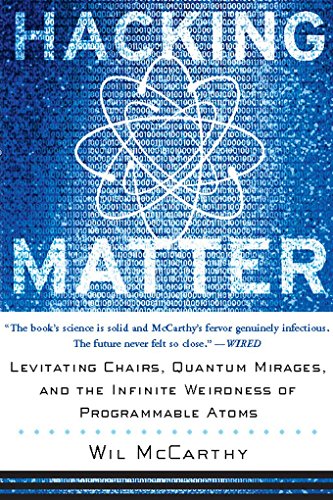
Ebook Info
- Published: 2008
- Number of pages: 241 pages
- Format: PDF
- File Size: 2.26 MB
- Authors: Wil Mccarthy
Description
Programmable matter is probably not the next technological revolution, nor even perhaps the one after that. But it’s coming, and when it does, it will change our lives as much as any invention ever has. Imagine being able to program matter itself-to change it, with the click of a cursor, from hard to soft, from paper to stone, from fluorescent to super-reflective to invisible. Supported by companies ranging from Levi Strauss to IBM and the Defense Department, solid-state physicists in laboratories at MIT, Harvard, Sun Microsystems, and elsewhere are currently creating arrays of microscopic devices called “quantum dots” that are capable of acting like programmable atoms. They can be configured electronically to replicate the properties of any known atom and then can be changed, as fast as an electrical signal can travel, to have the properties of a different atom. Soon it will be possible not only to engineer into solid matter such unnatural properties as variable magnetism, programmable flavors, or centuple bonds far stronger than diamond, but also to change these properties at will. Wil McCarthy visits the laboratories and talks with the researchers who are developing this extraordinary technology; describes how they are learning to control its electronic, optical, thermal, magnetic, and mechanical properties; and tells us where all this will lead. The possibilities are truly magical.
User’s Reviews
Reviews from Amazon users which were colected at the time this book was published on the website:
⭐One can poke several holes into a lot of the stuff that is discussed in the book – especially that this technology (using quantum dots to create artificial matter that emulates real matter) is so far away as to be in the realm of sci-fi. However -inspite of all those caveats – the author does a great job of explaining the potential of this technology. His enthusiasm is contagious – and one really wishes that this technology advances at a faster pace. I enjoyed it thoroughly.
⭐I have no degrees in physics, just a bit of curiosity and for me this book was wonderful. A very well written (for laymen) brief on a technology that is just over the horizon. If only half the apllications he describes are realized, wellstone will change our lives.I was left with only one (whimsical) question about wellstone; could you build a ringword with it?
⭐I really like this book! Don’t understand some technical terms but understand enough to make this book a fascinating read!
⭐This is the second copy I have bought. The first one was “lent” to a dear friend who won’t give it back.
⭐I think the content of the book was so far out into the future that suddenly Star Trek movies make sence. The material is discussing theory so much with real practical applications many decades away, that one cannot help but think of Star Trek. It is with programmable matter that the future trekies can enable themselves to own cool toys like tricorders, replicators, cloaking devices, shape shifters etc. I think an alternative title of the book could have been, “Star Trek Explained” :-)Being a science fiction fan, I enjoyed it thoroughly, except for the technical details of wellstone which was a drag in the end…
⭐Excellent book!!
⭐”Hacking Matter” deserves 4-5 stars for addressing a very interesting topic – artificial atoms – and 3-4 stars for its presentation. The book can be divided into two parts. The first section, about 110 of the book’s 200 pages, gives us a tour of actual research in solid-state physics and its implications for material science. The second launches us from real developments to speculative devices and applications. McCarthy tries to focus the book on programmable matter and only touches on other aspects of nanotechnology. I think that’s a great idea, but it should have afforded him the opportunity for deeper explanations of research and ideas that were only briefly described.McCarthy is facile with language, as might be expected from a writer of fiction. But while the reading flows easily, the first section suffers from an uneven handling of the material. For example, McCarthy delays the discussion of atomic orbitals until the middle of the book, and even then it’s a watered-down introduction with the reader directed to a freshman chemistry textbook for more information. Given the complexity of the topic, I felt he should have assumed a certain level of reader compentency, start with a more detailed review of the atom with better diagrams of orbitals and material characteristics, then build from there and drop the “monkey on limbs” analogy. In contrast to some areas of hand-holding explanation, some quotes from physicists, given without further explanation, assume a certain level of sophistication from readers: “In general, high temperatures tend to equal more interactions, because there are a lot more blackbody photons emitted from hot surfaces, which can then be absorbed and destroy atomic superpositions. But photon-photon interactions have such a low cross section you don’t have to worry about it for optical quantum states. A photon that’s in a quantum superposition is therefore going to be a lot more stable at room temperature.” (p. 71)Perhaps it’s praise to McCarthy that I wanted more of the first 100 pages — like a thorough introduction to atoms and how material properties arise, side-by-side diagrams of natural and artificial atoms in terms of scale, electron density plots, more details on the research, etc. It’s fascinating stuff and there are references at the end of the book.The speculative portion of the book, although it occasionally veers from the focus on programmable matter, is well-written and thought-provoking. McCarthy notes that the interviewed researchers are reluctant to speculate, and he steps into that void and presents some possibilities. One chapter describes a hypothetical construct for handling an array of quantum of dots: a “Wellstone Fiber” invented and submitted for a patent by McCarthy and his partner.Back in the late 80s, K. Eric Drexler, referenced at least twice in “Hacking Matter,” used his book “Engines of Creation” to speculate on possible directions for nanotechnology, well ahead of actual technical developments. While some of Drexler’s ideas may not be realistic, he did galvanize interest in the subject. I can’t help but think McCarthy is trying to play that role for artificial atoms and the funding of condensed matter physics research. For those of us who don’t think that much about material science, this book provides a good wake-up call in the form of an entertaining read.
⭐Despite my intrinsic interest in such futuristic topics as programmable matter, the subject of Wil McCarthy’s interesting journalistic account of research underway at laboratories around the world, I never know how much I should believe concerning these possibilities. More likely than not it will turn out to be just as real as speculations about flying cars in the 1930s or jet packs for everyone in the 1950s or…I could go on and on. In “Hacking Matter” McCarthy lays out a story as fantastic as any concocted by a master of science fiction. It has the attraction of ancient alchemy–of Midas turning anything to gold with his touch or Rumplestiltskin’s spinning of straw into gold–and may be just about as real.But there is a serious side to this, and McCarthy does a service by discussing the research underway to manipulate matter at the level of the molecule. Scientists already understand the process, and the very real science of nanotechnology is built on this knowledge. The U.S. Department of Defense, other government agencies, and some corporations are investing in this future technology. Their reasons for doing so are obvious, if we can transform one type of matter into another with the click of a mouse button the potential is incredible. Materials precious and difficult to obtain may be acquired quickly, easily, and safely. The potential to completely change the physical existence of all humanity should be apparent. This is a fascinating story, one that is probably realizable perhaps centuries in the future, that is if it realizable at all. But it is a fascinating line of scientific inquiry nonetheless.
⭐5 Gold Stars – Super Fast Delivery *****
Keywords
Free Download Hacking Matter: Levitating Chairs, Quantum Mirages, And The Infinite Weirdness Of Programmable Atoms in PDF format
Hacking Matter: Levitating Chairs, Quantum Mirages, And The Infinite Weirdness Of Programmable Atoms PDF Free Download
Download Hacking Matter: Levitating Chairs, Quantum Mirages, And The Infinite Weirdness Of Programmable Atoms 2008 PDF Free
Hacking Matter: Levitating Chairs, Quantum Mirages, And The Infinite Weirdness Of Programmable Atoms 2008 PDF Free Download
Download Hacking Matter: Levitating Chairs, Quantum Mirages, And The Infinite Weirdness Of Programmable Atoms PDF
Free Download Ebook Hacking Matter: Levitating Chairs, Quantum Mirages, And The Infinite Weirdness Of Programmable Atoms