

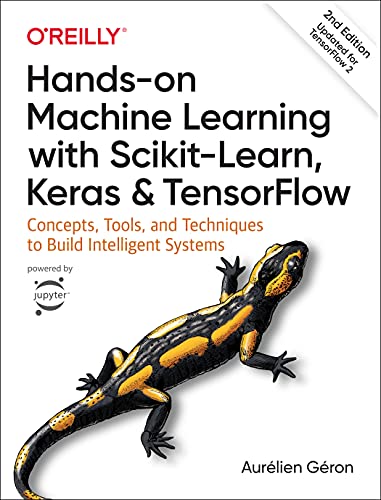
Ebook Info
- Published: 2019
- Number of pages: 856 pages
- Format: PDF
- File Size: 39.66 MB
- Authors: Aurélien Géron
Description
Through a series of recent breakthroughs, deep learning has boosted the entire field of machine learning. Now, even programmers who know close to nothing about this technology can use simple, efficient tools to implement programs capable of learning from data. This practical book shows you how.By using concrete examples, minimal theory, and two production-ready Python frameworks—Scikit-Learn and Tensor Flow—author Aurélien Géron helps you gain an intuitive understanding of the concepts and tools for building intelligent systems. You’ll learn a range of techniques, starting with simple linear regression and progressing to deep neural networks. With exercises in each chapter to help you apply what you’ve learned, all you need is programming experience to get started.Explore the machine learning landscape, particularly neural netsUse Scikit-Learn to track an example machine-learning project end-to-endExplore several training models, including support vector machines, decision trees, random forests, and ensemble methodsUse the Tensor Flow library to build and train neural netsDive into neural net architectures, including convolutional nets, recurrent nets, and deep reinforcement learningLearn techniques for training and scaling deep neural nets.
User’s Reviews
Editorial Reviews: About the Author Aurélien Géron is a machine learning consultant and trainer. A former Googler, he led YouTube’s video classification team from 2013 to 2016. He was also a founder and CTO of Wifirst (a leading Wireless ISP in France) from 2002 to 2012, and a founder and CTO of two consulting firms — Polyconseil (telecom, media and strategy) and Kiwisoft (machine learning and data privacy).
Reviews from Amazon users which were colected at the time this book was published on the website:
⭐Le sirve mucho a mi sobrino un buen regaloVery clear book with valuable applicable examples.Even if you’re well veresed in modelling you’ll learn some good coding techniques put in layman’s terms.
⭐You need to know Python first, however, once you get beyond that, the book is very useful to start.
⭐The book provides a comprehensive insight and an in-depth analysis of the core of Machine Learning. On the seller, I would say they are full responsible and trustworthy.
⭐This book covers many topics of ML and explains them with good examples. However, I believe it should be a little bit tough for a beginner. Similarly, it could not be the best book for an advanced reader because it gives pointers for advanced topics but does not go in-depth like mathematical explanation. In summary, it is an excellent book if you are looking for real-life examples with python code and you have a good basic idea in ML.
⭐I’m currently getting my MS in health data science and this was the book we had to get for my machine learning class. I was annoyed when the teacher said the class would be textbook heavy and he was only going lecture on high level concepts, I thought there was no way textbook would be able to a carry a class and boy was I wrong. This is hands down the best textbook I’ve ever bought! I never expected a data science text book to be easy to read but this book flows so well!, its easily digestible and it gives great examples with data that is easily available. You can write completely functional ML code from this book alone but one of the best features is that the book has GitHub site broken down chapter by chapter that helps fill the code out. If you are someone like me who hadn’t had any experience with Matplotlib the github was super helpful because it covers in depth how to make really nice plots for the various models. I would recommend this book to anyone who is doing machine learning. The only thing I would change about this book is when it gets into decision trees, RF, various boosting types, XGB, as it moves through the models it only gives an example of the classification form of the model or the regression for of the model and I think it would be helpful if it gave examples for both for each model. But with that being said this was a pretty minimal thing I would change and I would still buy the book again even if they didn’t change it! It’s definitely worth the money!
⭐I finished the whole book. Generally, this is an excellent book. I recommended it to everyone. The book has two parts. The first part is non-deep learning part, which is the best part. The second part is the deep learning part. In this part, some were written well, but some were written in rush (many details were missing). I wish the author gave more details on the deep learning models.All the codes can be run in colab without any error.
⭐My company was awarded an NSF grant which required me to VERY quickly brush up on machine learning. and man, did this book do a good job. I’m comfortable with many ML concepts, and have applied them to real world applications to great effect. This is a comprehensive and detailed guide.As a software engineer with 8 or so years of experience, I have to say the code snippet quality is as clean as it gets as well. The author nailed every aspect.Sometimes I don’t really get a section until I’m reading it for the third time.. but that’s just how understanding goes for me. Wish I had an equivalent book for different areas of study.
⭐If you have the budget to only buy one ML book, I would suggest going for this one. It covers most of the field in one book. Get a datacamo subscription too and you can break into the DS career.
⭐Have been advised by many people this is possibly the best book on ML but held off on owning a hard copy as I found it a bit expensive so I grabbed this one roughly 50% off. The level of detail is amazing and everything ML related is nicely explained. It’s nice to see the book was printed in colour which makes the code easier to follow and reproduce. I also liked the layout very much and found it helped to make the book flow – will happily read this cover to cover. The quality of the paper is on thin side but to be fair the content is worth more – I own other similar size ML books printed in black and white that cost more with half the content because it was printed on thick paper. Highly recommended for anyone with an interest in ML.
⭐Loved this book, I recommend whenever I’m asked by people who want to get practical with ML. The chapters follow a logical order and are well worth working though carefully, following all the code with the result being that you’ll get a very solid foundation for ML, covering both the data science driven statistical methods (first half of the book) and xNN/RL (2nd half). It fills the gap between books that are too hello world/simplistic and the other end which is greek alphabet soup. Loved the fact you can just spin up a colab notebook and point it at the github for the book and just get on with playing with all the examples…no messing around with lots of local machine setup. Oh and if you need a refresher on python or linear algebra, then he has that covered too, just look at the github only chapters. If I could give 6 stars, I would…just buy it!Am now waiting for the 3rd edition, avail in US but not in UK yet…
⭐This is an excellent book for machine learning, data science and deep learning. The print quality is great, the author’s style of explaining concepts and going into enough depth of the subject is also amazing. I use this as my reference for any machine learning project. It is not just for beginners, it also teaches a lot of advanced concept including creating your custom models, optimisers and loss functions in Tensorflow. It goes from really basic machine learning modelling like linear or logistic regression to advance Deep Learning all the way to generative modelling. It assumes basic prior knowledge in python.
⭐For a book described as “hands on”, this book was anything but. The author has an tendency to give far too much background and research examples rather than focusing on actually teaching the applied side of things. Often times multiple basic concepts and examples are given before he writes “oh but forget all that here’s a better way of doing it”.If you’re someone who is only interested in the applied side of things rather than the mathematical, I would suggest avoiding this book as it will make you scream “just get to the point already” all too often.This is not the book to learn applied machine learning if you’re working in the analytics sector. The examples and code are far too basic or unrealistic to be useful in real life.
Keywords
Free Download Hands-On Machine Learning with Scikit-Learn, Keras, and TensorFlow: Concepts, Tools, and Techniques to Build Intelligent Systems 2nd Edition in PDF format
Hands-On Machine Learning with Scikit-Learn, Keras, and TensorFlow: Concepts, Tools, and Techniques to Build Intelligent Systems 2nd Edition PDF Free Download
Download Hands-On Machine Learning with Scikit-Learn, Keras, and TensorFlow: Concepts, Tools, and Techniques to Build Intelligent Systems 2nd Edition 2019 PDF Free
Hands-On Machine Learning with Scikit-Learn, Keras, and TensorFlow: Concepts, Tools, and Techniques to Build Intelligent Systems 2nd Edition 2019 PDF Free Download
Download Hands-On Machine Learning with Scikit-Learn, Keras, and TensorFlow: Concepts, Tools, and Techniques to Build Intelligent Systems 2nd Edition PDF
Free Download Ebook Hands-On Machine Learning with Scikit-Learn, Keras, and TensorFlow: Concepts, Tools, and Techniques to Build Intelligent Systems 2nd Edition