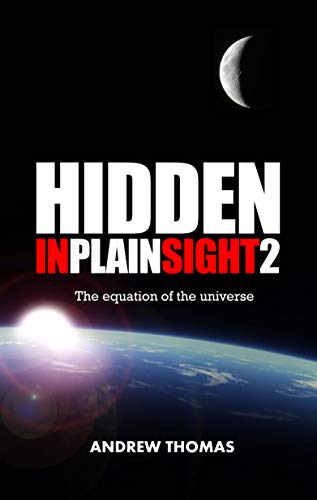
Ebook Info
- Published: 2013
- Number of pages: 165 pages
- Format: PDF
- File Size: 2.29 MB
- Authors: Andrew Thomas
Description
You never knew theoretical physics could be so simple! Why do things move? Why is the expansion of the universe accelerating? Is the universe a black hole? This exciting book considers some of the deepest and most important questions in physics. Enjoy a thrilling intergalactic tour as Andrew Thomas redefines the force of gravity and introduces a brave new view of the universe!
User’s Reviews
Reviews from Amazon users which were colected at the time this book was published on the website:
⭐Hidden in Plain Sight 2: equation of the universe by “Andrew Thomas””Hidden in Plain Sight 2″ is an informative theoretical physics book that looks at a possible solution to the unsolved mysteries behind gravity, dark energy, and black holes. I found this book to be equally and in some respects even more interesting than his previous book, ”
⭐”. In this rendition, Dr. Thomas looks at various unsolved problems in theoretical physics. Once again, I’m not a qualified physicist and can’t make any assertions to the validity of the theories presented in this book but at the very least I welcome the author’s engaging and accessible approach that makes such books enjoyable for the laypersons to read. This ambitious 170-page book includes the following nine chapters: 1. Introduction, 2. Gravity, 3. Cosmology, 4. Dark Matter and Dark Energy, 5. Black Holes, 6. The Soap Bubble Universe, 7. Gravity Revisited, 8. How to Create Your Own Universe, and 9. Conclusion.Positives:1. A well-written, succinct, accessible book for the masses.2. A fascinating topic in the hands of an inquisitive mind.3. Does a wonderful job of introducing concepts and/or scientific principles to the readers at an enjoyable and accessible level. Familiar concepts like entropy are explained in a conversational manner thus making it much easier for readers to understand. “Entropy can be thought of as the amount of disorder or randomness in a system.”4. A list of several of the most important unsolved problems in current theoretical physics including: unification of quantum mechanics and relativity, dark matter, dark energy, black holes, and an inflationary universe.5. An excellent introduction that captures the essence in the book.6. Good use of charts, illustrations and tables to assist readers.7. Our current knowledge of gravity. “The reason behind the weakness of gravity is considered one of the great mysteries of modern physics.”8. A brief history of gravity. “In the Principia, Newton presented his law of universal gravitation for the first time. He stated that every mass in the universe attracted every other mass by means of the force of gravity.”9. Einstein’s theory of relativity takes center stage. “In 1915, Einstein finally published the general theory of relativity which revealed how the curvature of spacetime depended on the distribution of mass and energy.”10. Excellent chapter on cosmology in which the author goes over the Big Bang theory, the shape of the universe, and the inflation hypothesis. Many interesting facts, “The Andromeda galaxy made the news in 2012 when it was announced that the mutual gravitational attraction between it and the Milky Way was so strong that Andromeda will collide with the Milky Way in about 4 billion years time.”11. A look at the impact of dark matter and dark energy. “We will examine the mystery of the missing 95%. We will see that there are two components to the missing substance, and these are known as dark matter and dark energy.” Great stuff.12. Some extraordinary discoveries are disclosed. Find out the scientists behind the accelerated expansion of the universe.13. An enlightening chapter on black holes. “A star produces its energy via nuclear fusion, a process which fuses hydrogen nuclei together under immense temperature and pressure to become helium nuclei.” “Einstein predicted the existence of black holes. The existence of black holes is now an accepted fact in astrophysics — more evidence of the validity of general relativity.”14. The importance of fundamental principles.15. Is the universe flat? Find out.16. The author presents an interesting hypothesis. “The hypothesis presented in this book suggests that a stable equilibrium distance is not only possible, it is a certainty.” “Considering the universe, it appears we could combine the logical principle and the conventional force of gravity together to produce a theory of modified gravity. This modified theory of gravity would act to move the radius of the universe to its equilibrium distance.” Hmmm…17. Provides a link to simulating your own universe.18. Interesting and eye-opening conclusion that I won’t spoil here.19. Further reading section.20. A tremendous Kindle value! Very few books give you so much for 0.99 cents!Negatives:1. Speculative theories that haven’t been validated by the scientific community.2. Very few endnotes.In summary, this was a fun and succinct book on theoretical physics. Dr. Thomas builds up the foundation of his theory by educating laypersons on the fundamental principles of physics and then goes on to his eye-opening theory. Is the theory valid? I don’t know but what is presented up to that point is in fact accepted by the scientific community and makes this book worthwhile to read. There are very few digital bargains better than this one, I recommend it!Further recommendations: “Hidden in Plain Sight” by the same author, ”
⭐” by Jim Baggott, ”
⭐” by David Blatner, ”
⭐” and ”
⭐” by Brian Greene, ”
⭐” by Lawrence M. Krauss, ”
⭐” by Adam Frank, “Higgs Discovery” and “Warped Passages” by Lisa Randall, ”
⭐” by Stephen Hawking, ”
⭐” by Brian Cox, “The Blind Spot” by William Byers, and “The Fallacy of Fine-Tuning” and ”
⭐” by Victor Stenger.
⭐In the past two weeks I read Hidden in Plain Sight and Hidden in Plain Sight 2. I have an MS degree in solid state physics from Purdue (1969). I worked my entire career in the quartz crystal field (mostly for sensor applications). I am not really conversant in the field of Cosmology, but I have had an interest in it, especially with the attention being given to the new discoveries in recent times.However, just as Thomas, I have always been troubled by String Theory and any theory that involves multiverses (a nearly infinite number of universes being “created” every second—give me a break!). His two books present a very thoughtful, logically progressive, and easy to understand development of his theory of almost everything. Not being conversant in cosmology, I cannot find fault in his work. I await the consensus of his peers. But I must say, WELL DONE!I made notes of comments and questions as I read book 2:1. On page 74 of Hidden in Plain Sight 2 you left out the c2 term in Friedmann’s Acceleration equation. Otherwise, the density term cannot be added to the pressure term because the units don’t correspond. The equation should have (ρ + 3P/c2).2. Why isn’t there a “hole” at the “center” of the universe caused by the Big Bang, if the Big Bang caused all of the mass-energy to “fly” away? Because of inflation, or your modified gravity theory? Why is the entire universe more-or-less uniform? Is it “spherical”?3. One simplified description of the Big Bang I have heard is to think of galaxies being represented by raisins in the rising dough of a loaf of raisin bread—as the dough rises all of the raisins move away from each other. If that were the case, all the visible objects in the universe should be red-shifted. But, if the Andromeda Galaxy is going to collide with the Milky Way Galaxy in a few billion years, and other galaxies have collided (e.g. the Bullet galaxy), then this simple view is obviously not correct, but how then is it explained that some galaxies are approaching each other?4. On page 85 you have a value for the mass of a black hole to be “as much as 450 times the mass of the Sun.” Then, on page 87 you have the mass of a supermassive black hole at the center of the Milky Way Galaxy “of about 4.3 million solar masses.” Why make the distinction? It’s confusing.5. On page 89 you state “If one corner of an object is hot, then that heat will spread through the object so that the entire object becomes one temperature.” This is only true if the object is thermally isolated (including being isolated from black-body influences).Thank you for two brilliant books that simplify and add a fundamentally new look at the most complicated topics in physics.
⭐A cosmological theory is proposed to account not only for the accelerating expansion of the universe but also for its flatness, without calling upon either primordial inflation or dark energy. Quite an undertaking, which would leave a few Nobel laureates with somewhat hollow awards, if it worked.Drawing upon mainstream cosmology, the thesis examines some reasons why light emitted from a source may fail to reach an observer: insufficient time; intervening space expanding faster than light can travel; gravity at source so strong as to impose superluminal escape velocity. The first two define the limits of our observable universe at various times; the third concerns black holes.The author then notes a curious coincidence between the current extent of our locally observable universe (calculated as speed of light divided by Hubble parameter) and its notional Schwarzschild radius based upon the included mass.It is truly surprising that the two radii should be similar (to within an order of magnitude) but perhaps too much can be made of this. The author’s proposition is that we therefore effectively exist within a black hole and must expect to observe negative gravitational effects (the implications for anyone residing just over the horizon are not examined). This is a bold proposal, as also is the notion that the universe will settle down at about its current size or average density on account of its overall zero energy content.Negative gravity, as against any primordial cosmic inflationary phase, is also taken to explain the flatness of the universe’s geometry. Little is made of the tiny temperature fluctuations in the cosmic microwave background, for which Alan Guth’s inflation theory also provides an explanation. And the recently-claimed observation of evidence for gravitational waves in the CMB will (if confirmed) provide further support for a short-lived inflationary expansion. Guth must be very relieved.I took less from this book than from the standard primer “An introduction to Modern Cosmology” by Andrew Liddle which provides a seriously convincing account of what is known and currently explicable in a perhaps ultimately incomprehensible universe. The concept of the zero energy universe has also already been expounded in the thoroughly cogent and readable narrative “A universe from nothing” by Lawrence Krauss.
⭐Alright, so who is this bloke, Dr Andrew H. Thomas?Who does he think he is coming up with a theory like this, tweaking Einstein’s theory’s and totally destroying the whole notion of dark energy?Why is he building his theories up from the very foundations of logic?Truth is, I’d never heard of him prior to taking a gamble and getting his first book – it was a 99p gamble.He raised my curiosity enough to purchase the rest of his Hidden in Plain Sight series in one go.And this book, mostly about tweaking gravity (not tweaking it like MOND, which has proved not to work) and introducing a kind of averaging system into gravity using the already established event-horizon notion… Well, let’s just say, it works for me.Please Mr T, work this one out fully, submit it as a paper and do away with the dumb tack-ons such as dark energy and dark matter.More books please.
⭐The ‘Equation of the Universe’ is the relation between mass-energy (mc squared) and gravitational-energy, where they are postulated to be equal and opposite, resulting in a value of exactly zero. It was known to Einstein, so isn’t exactly new. Using Relativity, quantum theory, a few Universal constants and the fact that Nature always minimises the energy of any given system, the Author derives the ‘Equation’ simply and straightforwardly (basic level algebra) and uses it as a hypothesis to demonstrate that the Universe has many of the characteristics of an expanding black-hole i.e an object with sufficient mass to prevent anything escaping from it, no matter how fast it is travelling. I find this concept of the Universe immensely satisfying, corresponding as it does with my beliefs over many years- it seemed glaringly obvious! I always liked the analogy of the galaxies as ‘spots’ on the surface of an expanding balloon, the distances between the spots continually increasing, but I couldn’t work out how the thickness of the rubber would fit in. Now I see it as the material within the event-horizon- dare I say the ‘dark-matter’- circulating as a band at the far reaches of space. There is no time element in the Andrew Thomas Hypothesis, so the Universe may be coasting gently towards stability without the need for a big-bang, rapid inflation, gravitons, dark matter particles, strings, multi-universes etc. and it’s age completely unknown! R.I.P Fred Hoyle…Well, what do you want for a Quid…?!I note, wryly, that other Reviewers appear to have a similar respect for professional physicists as they show to politicians…
⭐Andrew’s two books, ‘Hidden in Plain sight’ 1 & 2, give us together, an in-depth alternative view of how Quantum Mechanics and Relativity could already be, not two separate theories that don’t sit well together, but one beautiful ‘unified’ theory of the universe. A good read that any man or woman not versed in maths can follow with ease. Well done, Andrew.
⭐This was a very enjoyable book. It was easy to understand and very thought provoking. I do not see a problem with making adjustments to Einstein’s Theory of Relativity as long as the data fits and Andrew showed that the data does fit. After all Einstein made adjustments to newton’s 200 year old Theory of Gravity.I have read both books by Andrew and I loved them both. I hope Andrew writes more books presenting us with more thought provoking hypothesis’
Keywords
Free Download Hidden In Plain Sight 2: The equation of the universe in PDF format
Hidden In Plain Sight 2: The equation of the universe PDF Free Download
Download Hidden In Plain Sight 2: The equation of the universe 2013 PDF Free
Hidden In Plain Sight 2: The equation of the universe 2013 PDF Free Download
Download Hidden In Plain Sight 2: The equation of the universe PDF
Free Download Ebook Hidden In Plain Sight 2: The equation of the universe