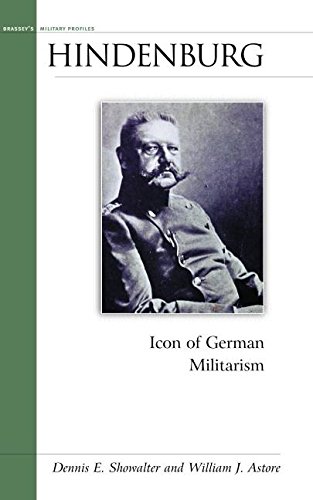
Ebook Info
- Published: 2005
- Number of pages: 160 pages
- Format: PDF
- File Size: 7.10 MB
- Authors: Dennis Showalter
Description
With his victory over the Russian army at the battle of Tannenberg in August 1914, Paul von Hindenburg became a war hero. By 1916 he had parlayed an exaggerated reputation for decisive victory into near dictatorial powers. After Germany’s defeat at Verdun and War Minister Erich von Falkenhayn’s dismissal in late 1916, Hindenburg, along with his chief of staff Erich Ludendorff, took over strategic direction of the war. The eponymous Hindenburg Program attempted with some success to mobilize Germany’s economy for war. He also oversaw many of Germany’s most important wartime decisions, including the resumption of unrestricted submarine warfare, Bethmann Hollweg’s dismissal as chancellor, Russia’s defeat and negotiation of the Treaty of Brest-Litovsk, and the “Ludendorff Offensives” of 1918, which sought decisive victory on the Western Front but ended in Germany’s catastrophic defeat. After the war, Hindenburg played a crucial role in creating the Dolchstosslegende (the myth that the German Army had been “stabbed in the back” by a Jewish-Bolshevik conspiracy on the homefront), in leading Germany as president of the Weimar Republic, and, most tragically, in acquiescing to Adolf Hitler’s rise to power.
User’s Reviews
Editorial Reviews: About the Author Dennis Showalter, Ph.D., has taught history at Colorado College since 1969 and is a former president of the Society for Military History. He also served as a distinguished visiting professor at both the United States Military Academy and the United States Air Force Academy. The first edition of Showalter’s Tannenberg won the prestigious Paul Birdsall Prize for best new book of 1992 from the American Historical Association. His other books include Railroads and Rifles and The Wars of Frederick the Great. He lives in Colorado Springs, Colorado.William J. Astore, D.Phil., read modern history at Oxford and taught military history at the United States Air Force Academy. He is currently serving as associate provost and dean of students at the Defense Language Institute’s Foreign Language Center. He lives in Monterey, California.
Reviews from Amazon users which were colected at the time this book was published on the website:
⭐I like it
⭐A useful overview, but there’s little here that hasn’t been around for years.
⭐As the authors point out, it was not the Chancellor or William II that ran Germany late in World War I, but Hinderburg and Ludendorf. These men were responsible for the gamble that payed off in huge losses to the German Army and moral problems both at the front and at home. These guys called the shots, and when Germany could no longer go on, they blamed it on the minorities back home (Jews, Communists, profiteers). Hinderburg was the author of the stab in the back theory. Rather than admit that it was their policies that lost the war, they blamed it on someone else.Hinderburg was later responsible for bringing Hitler to power and he should be blamed for losses in both wars. The authors show Hinderburg in a negative light with all he did.This is a nice short read on a bad military leader. At a little over a hundred pages, it shows Hinderburg’s rise and the faults that resulted in millions of deaths.
Keywords
Free Download Hindenburg: Icon of German Militarism (Military Profiles) in PDF format
Hindenburg: Icon of German Militarism (Military Profiles) PDF Free Download
Download Hindenburg: Icon of German Militarism (Military Profiles) 2005 PDF Free
Hindenburg: Icon of German Militarism (Military Profiles) 2005 PDF Free Download
Download Hindenburg: Icon of German Militarism (Military Profiles) PDF
Free Download Ebook Hindenburg: Icon of German Militarism (Military Profiles)